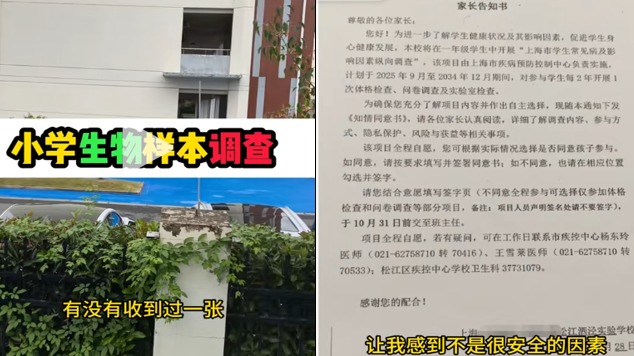
Rumors circulating on Chinese social media have drawn widespread concern among parents in Shanghai.
Several videos posted online allege that local schools have distributed “consent forms” from the Shanghai Center for Disease Control and Prevention (CDC) requesting parental signatures to allow the collection of children’s biological samples and blood tests.
Some parents said they refused to sign, citing privacy and safety concerns.
On Nov. 1, a Douyin blogger known as “Ai Xuexi de Xibei” shared what appeared to be an official questionnaire or “intent form” issued by the Shanghai CDC.
The blogger said the document included language that “did not feel entirely safe” and appeared unrelated to ordinary health checks.
Success
You are now signed up for our newsletter
Success
Check your email to complete sign up
Parents were reportedly offered a small reward of 50 yuan per year if they consented.
The post described procedures involving red blood cell sampling and biological specimen analysis, with multiple signature lines marked “voluntary.”
“I chose not to agree,” the parent said, noting that such medical data—including blood type and tissue information—belongs to a child’s most private personal information.
Screenshots from one experimental school in Shanghai dated Oct. 28 showed a “Parent Information Letter” stating that the school would participate in a longitudinal survey on common diseases and related factors among students, led by the Shanghai CDC.
The project was scheduled to run from September 2025 to December 2034, with physical exams, questionnaires, and lab tests conducted every two years.
Parents were asked to return a signed “Informed Consent Form” by Oct. 31, confirming voluntary participation.
Allegations of unauthorized blood draws
Following the post, some Shanghai parents claimed their children’s schools had drawn blood samples without prior notice.
One parent wrote that they “never received any form to sign—my child’s blood was taken, and I only learned about it afterward.”
Others voiced fears that personal data could be misused, commenting, “Once you sign, who knows when your child might disappear?”
Online comments reflected growing mistrust:
“This is gene research targeting teenagers.”
“Some areas are testing all males—what are they planning?”
“So many disappearances linked to blood sampling, how can this be legal?”
Other social media posts suggested that similar programs were underway elsewhere in China.
One anonymous submission to the X account “Wall Nation Frog Haha” alleged that after the Sept. 3 military parade, kindergartens across the country began mandatory blood tests for children.
In Shaanxi Province’s Baoji City, parents reportedly protested but were told the measure was non-optional.
A reply from the Baoji Education and Sports Bureau stated that all children over age three must undergo annual hemoglobin or routine blood testing, citing health inspection requirements.
Online users reacted with alarm:
“They’re building a national organ donor database.”
“Everyone’s a potential donor now.”
“For some people to live to 150, the whole nation is paying the price.”
Wider male DNA collection raises legal concerns
Similar collection efforts have been reported among adult men.
In September, police in Xilinhot, Inner Mongolia, announced a campaign to gather DNA samples from all male residents for a regional database, describing it as a tool for identity verification and public safety.
In Pingwu County, Sichuan, villagers said all male family members were required to submit blood samples, prompting questions about legality and consent.
Tsinghua University law professor Lao Dongyan publicly questioned the practice: “There is no legal basis for police to collect DNA from all male residents. The Criminal Procedure Law applies only to suspects or defendants—are they treating everyone as one?”
She also asked why “so few people are objecting to such obvious violations.”
Another commentator, known as “Old Man Channel” on X, warned: “Don’t doubt it—this is about organ matching for the red elite. There’s no legal DNA database in China, no oversight, and no clear budget. If you ever get such a notice, leave immediately.”