By He Qinglian, Vision Times
When New Yorkers elected Zohran Mamdani, a self-proclaimed socialist and the city’s first Muslim mayor, they made history — and launched one of the boldest political experiments in recent memory. His campaign platform promised sweeping changes: Strict rent control, free public transportation, universal childcare, city-run supermarkets, and increased taxes on the wealthy.
But Mamdani’s win sparked an almost immediate global reaction. U.S. President Donald Trump called the result “a battle between truth and common sense.” House Speaker Mike Johnson described Mamdani’s win as “the greatest socialist victory in U.S. history,” warning of its national repercussions. While America’s progressive left celebrated the rise of a new icon, moderates in the Democratic Party scrambled to shift the narrative, promoting New Jersey’s female governor as the party’s “future model.”
Across Europe, left-wing politicians hailed Mamdani’s victory as a sign that socialism could once again find fertile ground in Western democracies.
RELATED: ‘I’m Giving Him a Chance’: Mixed Feelings as NYC Voters Look to Mamdani for Change
A city already on the brink
Success
You are now signed up for our newsletter
Success
Check your email to complete sign up
For decades, New York City has been dominated by Democratic leadership. Once the beating heart of global capitalism, it now struggles with rising crime, fiscal imbalance, and urban decay. Even before Mamdani’s election, city management “barely earned a score of four out of ten.” With the mayor’s ambitious socialist agenda, that score may soon fall to zero.
The situation can be likened to a theatrical production: New Yorkers, ever fond of experiments, have built themselves a political stage — another big show funded by the taxpayers.
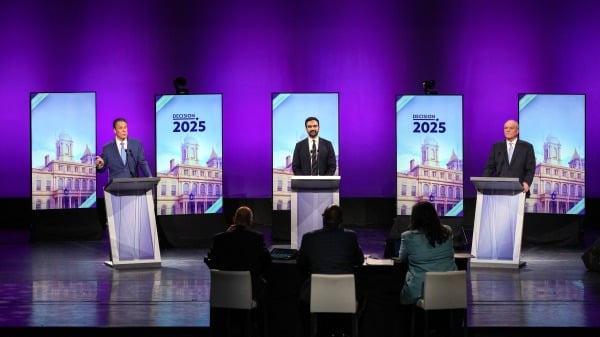
The 2025 mayoral race was not so much a contest between Democrats and Republicans as a civil war within the Democratic Party itself.
Mamdani defeated establishment heavyweight Andrew Cuomo to win the nomination, while Republican challenger Curtis Sliwa captured less than eight percent of the vote.
RELATED: Democratic Socialist Zohran Mamdani Elected as Mayor of New York
His unapologetically socialist message resonated with younger voters. Turnout among those aged 25 to 35 reached historic highs, propelling him to victory. Surveys show that more than half of Americans under 35 now view socialism favorably, a generational shift that rejects both the conservative ideal that “hard work pays off” and the Democratic establishment’s incremental welfare policies.
Instead, many young voters want what Mamdani promised: a fully government-supported “democratic socialism.” Some pundits dubbed his election a “socialist shockwave,” suggesting that Karl Marx’s vision — socialism realized in an advanced capitalist society — had finally found a foothold in New York.
Promises that don’t add up
Yet every grand promise raises a single unavoidable question: Where will the money come from?
Mamdani’s proposals cover nearly every aspect of urban life — food through state-run supermarkets, housing via rent control, and transportation through free public transit — all funded by taxpayers.
Except for clothing, every part of daily life is supposed to be free.
But the city’s balance sheet tells another story. According to New York’s 2024 Capital Debt and Obligations Report, total debt has surged from $69.5 billion to $104.1 billion in just ten years. Federal subsidies already cover 41 percent of public expenditures, leaving little fiscal room for new programs.
Mamdani’s rise rests atop decades of mismanagement by the city’s Democratic establishment. Even in calmer times, crime remained high and homelessness rampant.
Growing homelessness
The Coalition for the Homeless reported that in August 2025, over 103,000 people slept in city shelters — the highest number since the Great Depression. Thousands more slept on streets or rotated between friends’ homes. Of these, 56 percent were black, 32 percent Hispanic, 7 percent white, less than 1 percent Asian or Native American, and 4 percent unrecorded.
Meanwhile, under the Biden administration’s open-border policy, New York has legally absorbed more than one million migrants, many of whom now occupy city-run shelters. Mamdani’s million votes likely included more than a few of them. With soaring debt and collapsing infrastructure, New York has little fiscal room left to sustain new welfare programs. Mamdani’s administration will have to rely on annual revenue, federal subsidies, and more borrowing.
Hours after his victory, Mamdani posted a video urging supporters to “start donating again,” claiming his transition team lacked funds for staffing and research. Many of his voters, expecting free housing, childcare, and transportation, were stunned to find that their first act of socialism would be to pay for it themselves.
A standoff with Washington
Federal support may no longer be guaranteed. With Trump in the White House, New York’s new mayor faces an administration unlikely to bankroll his socialist experiment. Trump, is known for using money as leverage — tariffs abroad, withheld funds at home. If you defy him, he cuts your budget or blocks your contracts. Even universities like Columbia and Maine have learned that lesson the hard way.
Should federal aid dry up, Mamdani’s entire platform could collapse. Police, fire departments, sanitation, and transit would be first to suffer. “Defund-the-police” activists may celebrate, but ordinary residents will bear the consequences: rising crime, mounting waste, and civic disorder.
This paints a grim picture of New York’s current reality: Subways that reek of urine, stations strewn with garbage, and commuters pressing against walls to avoid being shoved onto the tracks. Public bathrooms are scarce; sidewalks overflow with trash.
Once everything becomes free, the city will resemble a living hell. The subway will turn into an express train to chaos.
Should Mamdani’s socialist experiment implode, he will simply deflect responsibility. He’ll accuse Trump of obstruction, claim sabotage, and walk away. Even if public anger mounts, she doubts voters could remove him. A look at California Governor Gavin Newsom shows us what is likely to happen. Two recall drives failed, and now he’s eyeing the 2028 presidency.
Ultimately, the burden will once again fall on the federal government to clean up the mess.
During the Black Lives Matter protests of 2020, looting and arson caused billions in property losses across Democratic-run cities, yet no officials were held accountable.
Democracy may be wonderful, but when those who play the game stop taking responsibility, it becomes theater without accountability. New York is now that stage — a noisy performance of leftist experiments, one after another, until the curtain falls.
However, as long as the U.S. maintains economic strength and federal stability, one city’s ideological detour won’t shake the republic’s foundations.
Editorial note: Views expressed in this article are the opinions of the author and do not necessarily reflect the views of Vision Times.
This article was originally published by “The Up Media (Taiwan)” and is exclusively authorized for reprint by Vision Times. Unauthorized reproduction or plagiarism is prohibited.