On Nov. 13, Nikkei Asia reported that U.S. President Trump appears to have shifted his approach toward Cambodia. He now intends to cooperate with Cambodian Prime Minister Hun Manet and his cabinet, reversing the tough stance of imposing 49 percent tariffs on the country in April.
A US State Department spokesperson told Nikkei: “The United States seeks to work with Prime Minister Hun Manet and his cabinet to advance our shared vision for a free, prosperous, secure, and resilient Indo-Pacific region. We are committed to cooperating with the Hun Manet government to improve Cambodia’s investment climate and international standing, including cracking down on widespread online scams targeting U.S. citizens, ending politically motivated trials, and allowing independent media to operate without interference.”
Mira Rapp-Hooper, former senior director for East Asia and Oceania affairs under President Biden, told Nikkei that in 2024, then-Defense Secretary Lloyd Austin and USAID Administrator Samantha Power conducted high-level visits to Cambodia to explore the possibility of restoring cooperation between the two countries.
Rapp-Hooper noted that this development comes as Cambodian leaders are willing to take greater risks and potentially expand partnerships into areas beyond what Hun Manet’s father, former long-time leader Hun Sen, engaged in. She added that with a reduction in Belt and Road funding, Cambodia has become a location where many China-backed projects have failed.
Hun Manet is the son of former Cambodian Prime Minister Hun Sen, who defected from the Khmer Rouge in the late 1970s and came to power after Pol Pot’s brutal regime collapsed. Hun Manet graduated from the United States Military Academy at West Point and New York University, and succeeded his father as prime minister in 2023.
Success
You are now signed up for our newsletter
Success
Check your email to complete sign up
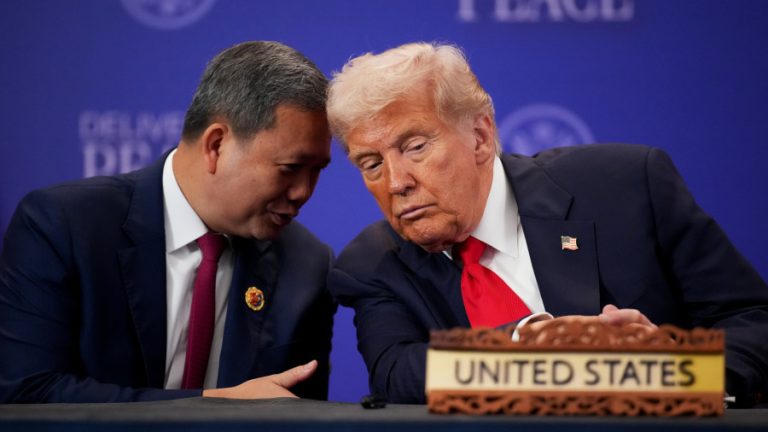
In April, Trump had imposed one of the world’s highest tariffs on Cambodia, citing it as “the most important transshipment hub used by mainland China to avoid US tariffs,” according to a White House official. However, the Trump administration has recently changed course. On Oct. 26, during the ASEAN Summit in Malaysia, Trump met with Hun Manet, signed a trade agreement, and agreed to lower US tariffs on Cambodia to 19 percent. Additionally, Hun Manet had nominated Trump for the Nobel Peace Prize in July.
US-Cambodia joint military drills resume after eight years
On Nov. 6, U.S. Secretary of State Marco Rubio announced the lifting of the arms embargo on Cambodia, citing the country’s persistent efforts to maintain peace and security, including renewed engagement with the U.S. on defense cooperation and combating transnational crime. The two sides also agreed to resume the “Angkor Sentinel” joint military exercises, which had been suspended for eight years.
While Washington has sent positive signals to Cambodia, the U.S. continues to take a tough stance on Southeast Asian scams and has expressed concern over China renovating the Ream Naval Base in Cambodia in exchange for establishing a military foothold.
A visiting scholar at the ISEAS-Yusof Ishak Institute in Singapore noted that the Trump administration had already been actively engaging Cambodia since February, suggesting that Washington aims to counterbalance China in Cambodia. Trump’s objective, at a minimum, appears to be gaining leverage over Beijing through Cambodia.
Belt and Road projects cause hardship in Cambodia
In 2021, Human Rights Watch released a report accusing China’s Belt and Road projects in Cambodia of destroying the lives and livelihoods of indigenous and minority communities.
The 137-page report, titled “Submerged: The Human Rights Impact of a Chinese Belt and Road Project in Cambodia”, documents how the China-funded Sesan 2 Dam displaced more than 5,000 local residents and disrupted the livelihoods of tens of thousands of people upstream and downstream. Cambodian authorities, the Chinese government, and China Huaneng Group, the company responsible for construction, failed to provide adequate support or compensation.
Residents forced to relocate received only rudimentary housing and no training or assistance to sustain their livelihoods. Other affected communities upstream and downstream received no compensation or aid.
The dam was constructed from 2011 to 2018. Community members protested and wrote numerous letters to government officials, including Prime Minister Hun Sen, and to Chinese companies, but concerns were repeatedly dismissed. Some opponents faced threats or imprisonment.
The dam has significantly impacted fisheries, preventing multiple fish species from completing critical reproductive migrations, leading to sharp declines in fish yields. Fisheries and ecological experts warned that the dam is reducing the productivity of the entire Mekong River system, which provides food and income for tens of millions of people in Thailand, Cambodia, Vietnam, and Laos.
By Wang Jun