By Li Jingyao, Vision Times
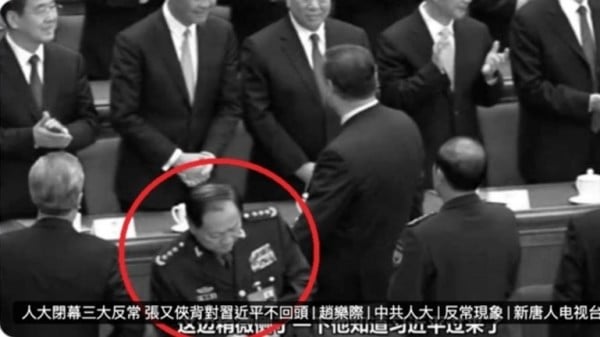
Following the Chinese Communist Party’s (CCP) Fourth Plenum that wrapped up on Oct. 24, speculation surrounding the relationship between China’s top military figure Zhang Youxia and CCP leader Xi Jinping has only intensified in recent weeks. After the pair conspicuously kept distance during their recent joint appearance in Guangdong, Zhang’s sudden visit to Russia, coupled with muted state-media coverage, has triggered widespread debate across social media as political experts weigh in.
Analysts say the abnormal signals suggest a deep rupture between Xi and Zhang, one Beijing’s propaganda system is scrambling to conceal.
RELATED: Leaked Reports Claim Xi Jinping Stripped of Power at CCP Plenary Session
Zhang visits Russia
On Nov. 20, China’s Ministry of Defense published a brief, hundred-word notice: Zhang Youxia, vice chairman of the Central Military Commission (CMC), met with Russian Defense Minister Andrei Belousov in Moscow to discuss bilateral military ties, regional security, and “areas of mutual concern.” Belousov reportedly held a formal welcoming ceremony and accompanied Zhang in reviewing the honor guard.
Success
You are now signed up for our newsletter
Success
Check your email to complete sign up
But the announcement did not appear on state mouthpieces Xinhua News Agency or People’s Daily, in what analysts are calling an extraordinary and purposeful omission. Chinese political commentator Lei Ge identified three major abnormalities in Zhang’s trip, including:
- State media completely ignored the visit. The visit was not reported on Xinhua, People’s Daily, or even a CCTV headline. Only the Ministry of Defense posted a short bulletin.
Lei notes the pattern matches how the downfall of nine PLA generals was handled ahead of the Fourth Plenum, announced solely by the Defense Ministry while Party mouthpieces refused to publish original reports. At most, commercial arms like Xinhuanet or People.cn quietly reposted without comment.
RELATED: Beijing Pushes Loan-Driven Consumption: How Xi Jinping Is Undermining China’s Economy
This time, even those reposts did not appear. By comparison, Li Qiang’s visit to Russia was splashed across state media the very next day. Zhang Youxia’s earlier Russia trips — in 2017, 2019, and 2023 — were all carried prominently by Xinhua within 24 hours. His 2023 meeting with Putin and Shoigu received immediate nationwide coverage. The blackout, Lei argues, is “the first red flag.”
- Zhang received a higher level of reception than Premier Li Qiang. According to the Defense Ministry’s own description, Zhang’s visit featured: a formal welcoming ceremony, an honor guard performance, and a direct bilateral discussion on military cooperation between Beijing and Moscow.
Just 48 hours earlier, Premier Li Qiang had been in Russia — and received no red carpet, no honor guard, and no high-protocol ceremony. For a vice chairman of the CMC to receive higher honors than China’s No. 2 civilian official is highly unusual and signals Moscow’s recognition of Zhang’s unique authority.
- Zhang appeared “by invitation.” This suggests that Li Qiang cannot handle military matters on his own. This third anomaly: the Ministry of Defense specified that Zhang visited Russia at Moscow’s invitation.
“What issue could Li Qiang not discuss that required Zhang Youxia to go?” asked Lei Ge, adding, “There is only one explanation: Li Qiang does not control the military.” Instead, the Defense Ministry statement focused exclusively on military-to-military cooperation — an area only Zhang, not Xi’s civilian lieutenants, can credibly negotiate.
An undeniable split
Lei Ge argues that state-media behavior shifted dramatically after 2024. “Before 2023, coverage of Zhang Youxia was normal,” he says, but “Starting in 2024 — after the Third Plenum — reporting on Zhang became abnormal. That is because he and Xi Jinping have split, while propaganda remains in Xi and Cai Qi’s hands.”
RELATED: Xi Jinping’s Absence Raises Alarms as Zhang Youxia Spearheads PLA Meeting
International actors have noticed the shift as well. Zhang’s unique standing in the PLA has prompted senior foreign leaders to seek him out, including:
- On Aug. 29, 2024, U.S. National Security Adviser Jake Sullivan, after meeting Xi, specifically requested a separate meeting with Zhang — a highly unusual diplomatic signal.
- During Zhang’s official visit to Vietnam in October 2024, new Vietnamese President Lương Cường mentioned Xi by name, but Zhang notably did not reciprocate.
- Vietnamese state media reported Zhang’s words accurately — no mention of Xi — while Chinese state media fabricated a line claiming Zhang conveyed Xi’s greetings.
Lei concludes this was a deliberate attempt to hide growing fissures between Zhang and Xi.
Who sent Zhang to Moscow?
Sources within China’s political circles told overseas outlets that Zhang traveled to Russia on instructions from the Hu–Wen faction. They claim China’s internal power map has shifted, with Wang Yang now overseeing Party affairs, Liu Yuan handling military matters, Hu Chunhua assuming administrative responsibilities, Zhang Shengmin controlling the military disciplinary apparatus, and Liu Zhenli holding operational command of the PLA.
RELATED: Hu Chunhua’s Article Sparks Speculation of His Rising Rank Amid Xi’s Waning Grip
Under this framework, Zhang Youxia’s sudden Russia trip served two purposes: To reassure Putin that China will maintain support despite Xi Jinping’s loss of real authority, and to prevent Russia from pivoting fully toward the United States
Sources say Beijing fears that if Russia concludes Xi is falling and China is turning inward, Putin may “flip” and align more closely with Washington — leaving Beijing isolated. Commentators note that China could be afraid of losing Russia’s support. China once considered leveraging control of certain supplies to Russia to push for an end to the war in Ukraine — a goodwill gesture toward Europe and the U.S.
‘Xi’s power is largely symbolic’
But Washington unexpectedly released a 28-point Russia–Ukraine ceasefire proposal, which alarmed Beijing. If Russia accepts a U.S.-led peace framework, China could be thrust into a new Cold War alone. Zhang’s mission, therefore, is viewed as a desperate attempt by the CCP’s internal factions to keep Moscow in its corner.
“Xi Jinping’s power is now largely symbolic,” said former Wen Wei Po reporter Jiang Weiping. “The real control lies with Hu Jintao, Wen Jiabao, and Wang Yang.”
Political columnist Zhou Xiaohui also emphasized that the Defense Ministry’s report on Zhang’s Russia trip did not mention Xi Jinping or “the two heads of state,” instead offering a generic summary of the meeting — a sign that Xi’s authority is “no longer being affirmed in military diplomacy.”
“Zhang Youxia’s mission to strengthen military cooperation with Russia is ultimately about prolonging the CCP’s survival,” said Zhou. “But a regime moving against the tide of history cannot extend its life forever.”