By Li Jingyao, Vision Times
After wrapping up the Fourth Plenary Session on Oct. 24, several Politburo Standing Committee members (China’s top ruling body), including Li Qiang, Cai Qi, Wang Huning, and Ding Xuexiang, published signed commentaries in state mouthpiece the “People’s Daily,” outlining Beijing’s new policy directions for the upcoming “15th Five-Year Plan.”
- On Oct. 30, Premier Li Qiang released “Guiding Principles for Economic and Social Development During the Fifteenth Five-Year Period.”
- On Oct. 31, Chinese People’s Political Consultative Conference (CPPCC) Chairman Wang Huning followed with “Deepening Economic Reform to Promote High-Quality Development.”
- On Nov. 3, Cai Qi, Secretary of the CCP Secretariat, published “Upholding Comprehensive Party Discipline.”
- And on Nov. 4, Vice Premier Ding Xuexiang issued “Main Objectives for Fifteenth Five-Year Development.”
Political commentator Chen Pokong, who’s based in the U.S., noted the significance of these articles: “For thirteen years, only Xi Jinping was allowed to publish signed essays. This sudden shift marks a return to collective leadership — and that’s not good news for Xi.”
RELATED: Hu Jintao Strikes Back: Xi’s ‘Dragon Vein’ Base Collapses as Hu Haifeng Flees to Xi’an
He added that, together with the Third and Fourth Plenums, this pattern shows Xi’s once-unchallenged dominance is eroding. Rumors that the Chinese leader no longer holds absolute power, Chen said, “are not baseless.”
A political chess game
Success
You are now signed up for our newsletter
Success
Check your email to complete sign up
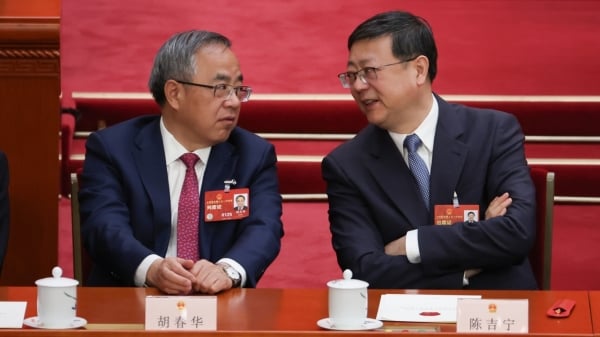
What drew even more attention was not what the Standing Committee members wrote, but who published first. On Oct. 29, one day before Li Qiang’s article appeared, Hu Chunhua — neither a Standing Committee member nor a full Politburo member — released his own signed piece titled “Deeply Study and Implement the Spirit of the Plenum to Promote High-Quality Development During the Fifteenth Five-Year Plan.”
The article was published on the official CPPCC website and later widely republished by state media — an extraordinary privilege for someone of Hu’s current rank. Though several vice-chairpersons of the CPPCC, including Shi Taifeng, also wrote on the same day, only Hu Chunhua’s piece gained national circulation.
RELATED: Are Hu Chunhua and Wang Yang Poised for a Comeback as the CCP’s Fourth Plenum Nears?
Once regarded as a rising star and protégé of former Premier Hu Jintao, Hu Chunhua fell sharply from grace in 2022. During the 20th Party Congress, he was demoted from vice-premier and Politburo member to an ordinary Central Committee member and reassigned to the largely ceremonial post of first vice-chairman of the CPPCC.
Chen Pokong observed that Hu’s article placement — prominently featured in the official CPPCC Daily and echoed across Chinese outlets — “gave the impression that he now stands on the same level as Li Qiang, Cai Qi, or Wang Huning.”
“The publicity drive suggests Hu Chunhua still wields significant political influence and organizational support,” said Chen.
A loyalty test?
Each signed article referenced Xi Jinping, but with varying enthusiasm.
- Li Qiang mentioned Xi five times — noticeably restrained.
- Cai Qi mentioned him seven times.
- Wang Huning, known for his ideological zeal, cited Xi 14 times.
- Yet Hu Chunhua mentioned Xi a staggering fifty-three times, repeatedly invoking slogans such as “the Two Establishments” and “the Two Safeguards.”
Chen Pokong interpreted this not as simple flattery but as a nuanced political maneuver. “In CCP politics, gestures can mean the opposite of what they appear. Xi’s inner circle — Li Qiang, Cai Qi — feel secure and don’t need to overpraise him,” said Chen, adding, “But Hu, as a non-Xi faction figure, must tread carefully. Over-emphasizing loyalty is a form of survival.”
He added, “When Xi hints that succession is open, he often gives subtle signals to multiple figures — Ding Xuexiang, Hu Chunhua, Chen Jining — and watches who performs best. Hu’s eagerness to demonstrate loyalty shows he still believes he has a chance, or that he’s been given one.”
RELATED: Xi’s Waning Power: Generals Absent at Scaled-Down Fujian Carrier Ceremony
Acting like an heir apparent
Hu Chunhua’s tone surprised many observers for another reason — it read less like a subordinate praising a leader and more like an incoming statesman defining a legacy. His opening paragraph began, “During the Plenary Session, I personally listened to General Secretary Xi Jinping’s important speech. I was deeply educated, greatly inspired, and profoundly moved. We must earnestly study and implement the spirit of the Plenum.”
Analysts noted that Hu’s phrasing — emphasizing “I” before shifting to “we” — suggested authority and inclusion unusual for someone of his current rank. “Who does his ‘we’ refer to?” one observer asked. “He writes as though speaking on behalf of the Party leadership.”
Hu went further, writing that since the 20th Party Congress and particularly after the Third Plenum, “the Central Committee with Xi Jinping at its core has united the whole Party and the people of all ethnic groups to overcome difficulties and strive forward.” He praised Xi for “personally commanding” and “taking the field,” for “firmly holding the direction” under U.S. pressure, and for providing “our greatest confidence and strength to overcome hardship.”
Though the language appears laudatory, analysts detected a subtle undertone. “It reads almost like an evaluation — even a closing eulogy,” Chen noted. “Hu’s article discusses Xi’s achievements as though summing up an era, not serving within it.”
He added that Hu’s comprehensive discussion of the “15th Five-Year Plan” also resembled the tone of a successor laying out policy priorities. “We can’t say definitively that Hu, Ding Xuexiang, or Chen Jining will be next in line,” Chen said, “but the possibility is clearly being floated.”
Hu’s renewed visibility and political momentum
Since last year’s Third Plenum, Hu Chunhua has re-emerged with an unusual public profile. On July 18, 2024, state television aired rare footage showing Hu seated beside Xi Jinping during a group discussion — a symbolic placement seldom seen since his demotion.
RELATED: Xi’s Grip on Power Falters Amid Military Shake-Up and Rising Successor Hu Chunhua
In December 2024, Hu represented Xi at the 2024 Chungdu International Forum in Madrid, delivering Xi’s congratulatory message. From April 8 to 17, 2025, he led a delegation to Nigeria, Côte d’Ivoire, and Senegal, and later visited regions he once governed, including Inner Mongolia and Tibet.
During Tibet’s 60th anniversary celebration in August, Hu toured the Yarlung Tsangpo hydropower project and the Sichuan-Tibet railway, both flagship infrastructure projects championed by Xi Jinping. The visit drew attention precisely because these projects are viewed as Xi’s personal legacy.
Veteran journalist Yan Chungou noted on Facebook that the Yarlung Tsangpo Dam project “was personally approved by Xi.” For Xi not to attend, and for Hu to appear in his place, “was no ordinary inspection — it was a deliberate opportunity for Hu Chunhua to re-enter the national spotlight.”
Yan observed that Party media subsequently ran a coordinated publicity campaign using the phrase “chunhua qiushi” (“spring blossoms and autumn fruit”) — a play on Hu’s given name — to cast him in a favorable light.
“CCP propaganda never wastes symbolism,” he wrote. “Repetition of ‘chunhua qiushi’ signaled an intentional warm-up — preparing public opinion for Hu’s potential promotion.”
Chen Pokong agreed that Hu remains a “political figure to watch,” predicting that a “lightning-fast change” could occur at the upcoming Fifth Plenum or even the 21st Party Congress.
Rumors of a leadership transition
Inside China, speculation about Hu’s future has reached fever pitch. One domestic commentator writing under the pseudonym Qiangnei Putongren claimed, “It’s already an open secret among Party insiders — Xi Jinping is stepping down, and Hu Chunhua is stepping up.”
He asserted that during the two-year transition to the 21st Party Congress, real authority would lie in the Party’s ideological and decision-making apparatus under the influence of Hu Jintao, Wen Jiabao, and Zhang Youxia, with Wang Yang, Liu Yuan, and Hu Chunhua executing day-to-day control.
“Xi has lost both Party and military power,” he wrote. “Like Hua Guofeng in the early 1980s, even if he wants to stage a comeback, there’s no longer any path.”
Editorial note: Views expressed in this article are the opinions of the author and do not necessarily reflect the views of Vision Times.