By Hezi, Vision Times
In May 2006, what appeared to be a routine PLA naval drill in the Yellow Sea became the backdrop to one of the most explosive (and tightly concealed) political conspiracies in modern Chinese history. The attempted assassination of Hu Jintao, buried for years by official silence, offered a rare glimpse into the bloody world of CCP elite infighting, where political survival is often measured in seconds.
When Hu Jintao replaced Jiang Zemin as CCP General Secretary in November 2002, it was widely assumed that China had entered a period of peaceful leadership transition. But Jiang never intended to relinquish real power. Instead, kept his position as chairman of the Central Military Commission (CMC) — the true source of authority in CCP politics.
RELATED: A Trio of Events Puts Xi Jinping Under Scrutiny at Home and Abroad
Neutralizing Hu
What Chinese state media described as Jiang “helping Hu for a while” was, in reality, an attempt to rule from behind the curtain. Jiang packed the Politburo Standing Committee and the military with loyalists: Zeng Qinghong, Huang Ju, Jia Qinglin, Guo Boxiong, Xu Caihou, and others. Hu Jintao, despite his formal title, was hemmed in on all sides — a general secretary without real control of the gun.
Success
You are now signed up for our newsletter
Success
Check your email to complete sign up
Jiang did not formally give up the CMC chairmanship until 2004, and even then, his influence over the military remained “dangerously ambiguous,” experts say.
On the other hand, Zhang Dingfa, born in 1943 in Shanghai’s Pudong district, was one of Jiang Zemin’s most crucial military loyalists. Rising at an unusually rapid pace through the North Sea Fleet — from assistant chief of staff to fleet commander — Zhang became head of the PLA Navy in 2003 and a CMC member in 2004.
RELATED: Historic Power Struggle Between Jiang Zemin and Hu Jintao: Shanghai Faction Battle Unfolds
Though Hu Jintao awarded him the rank of general, Zhang’s allegiance lay firmly with Jiang. Hong Kong media later reported that Jiang promised Zhang a future CMC vice chairmanship, or even the defense minister post, should the Jiang faction succeeded in sidelining Hu. The North Sea Fleet, which Zhang had commanded for years, controlled waters near Beijing and served as the perfect staging ground for a political strike.
A conspiracy at sea
In May 2006, the PLA launched a massive naval exercise in the Yellow Sea, also known as Zhang Dingfa’s home turf. Officially, the drill showcased China’s growing maritime capabilities. Unofficially, it became the stage for a carefully orchestrated assassination attempt.
RELATED: PLA’s ‘Gunfire’ Warning Reveals Deepening Turmoil Inside China’s Military Purge
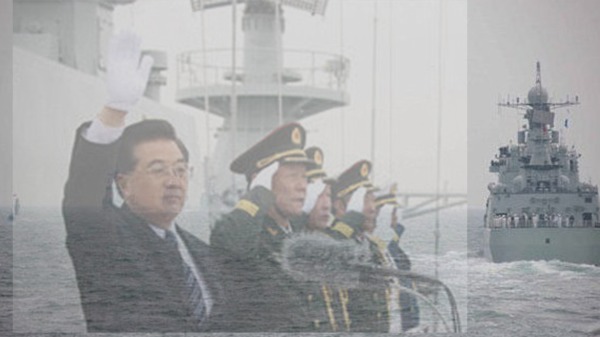
Both Hu Jintao and Jiang Zemin were present in an extremely rare overlap. Jiang stayed in Qingdao, allegedly directing the event remotely. Hu boarded a Type 051C missile destroyer to observe from sea.
It was the perfect setup for a “training accident,” analysts note. Around 10:30 a.m., radar operators noticed two warships quietly break formation and accelerate toward Hu’s vessel. Moments later, both opened fire. “Boom! Boom! Boom!”
Hu Jintao’s near-death experience
Heavy cannon fire exploded around the destroyer. Water columns blasted upward; the ship rocked violently. Alarms blared as sailors shouted across the deck. Five crew members were killed instantly, with their blood splattered across the ship’s steel plating.
RELATED: PLA Told to ‘Live a Tight Life’ as Germany Warns Beijing May Strike Taiwan Amid US Election Unrest
Hu’s bodyguards pushed him into the armored command room as the ship sustained multiple hits and nearly capsized. For nearly ten minutes, the destroyer endured live fire. Realizing the danger, the captain issued a distress call and maneuvered at maximum speed. More vessels began closing in. Hu was evacuated by helicopter under emergency air cover and flown to Qingdao.
He did not stay the night. Instead, Hu left immediately for Yunnan, later vanishing from public view for a full week. Rumors of his death spread as global markets reacted.
Bejing’s cover-up
Hong Kong outlets reported that captured ship commanders confessed they fired under orders—“from Jiang Zemin,” with Zhang Dingfa directing operations. The claims triggered international alarm. Western media described it as the “most severe” internal crises since China’s Great Cultural Revolution.
Financial markets dipped, investment banks issued warnings, and Chinese diplomats were ordered to insist everything had been a “training accident.” Inside China, a sweeping blackout began. Officers were detained; naval units reshuffled; journalists silenced. But Hu’s disappearance and sudden purges fueled worldwide suspicion.
From 2006 onward, Hu used the crisis to consolidate power and curtail Jiang’s influence. He later purged Shanghai Party boss Chen Liangyu and sidelined senior Jiang-era figures such as Huang Ju and Jia Qinglin.
Zhang Dingfa’s mysterious death
After the failed plot, Zhang lost his political protection. Jiang Zemin distanced himself as Hu prepared to purge him. Rumors circulated that Zhang lived in constant fear, knowing too many secrets to be left alive.
In August 2006, Zhang collapsed while inspecting a nuclear submarine base. He was confined in a guarded ward at Beijing’s 301 Hospital, in what many say was more a “political quarantine” than necessary medical care. Then at 3:30 a.m. on Dec. 14, 2006, Zhang died. The official cause of death: cancer, though few believe this.
Months earlier, he had appeared healthy. His sudden, dramatic health decline fueled speculation. Reports circulated that senior PLA officers were abruptly ordered to undergo mandatory testing for HIV and venereal diseases as part of a campaign to deny funeral honors to those who died of “moral degradation.” Zhang’s rumored sexual misconduct and visits to entertainment venues in Qingdao, Dalian, and Zhanjiang added to the intrigue.
His obituary was a 33-character note with no photograph. His memorial service had no public viewing, no eulogy, no media presence, in what experts say is an extraordinary deviation from CCP norms.
The Yellow Sea incident became a turning point in CCP elite politics. In 2014, mainland media quietly lifted the ban on discussing Zhang Dingfa. Reports resurfaced, revealing how close Hu Jintao came to being killed at sea.
Within the CCP’s opaque system, political rivalry is not fought with policy debates, but with live ammunition. If Zhang Dingfa’s death was any reminder, it’s that those who play the CCP’s deadly power game often end up consumed by it.
Editorial note: Views expressed in this article are the opinions of the author and do not necessarily reflect the views of Vision Times.