By Lu Yixin
In response to the growing threat from the Chinese Communist Party (CCP), President Lai Ching-te announced an increase to Taiwan’s defense budget, with plans to invest NT$1.25 trillion over the next eight years through a special national defense program. The Kuomintang (KMT) and Taiwan People’s Party later issued statements responding to the announcement.
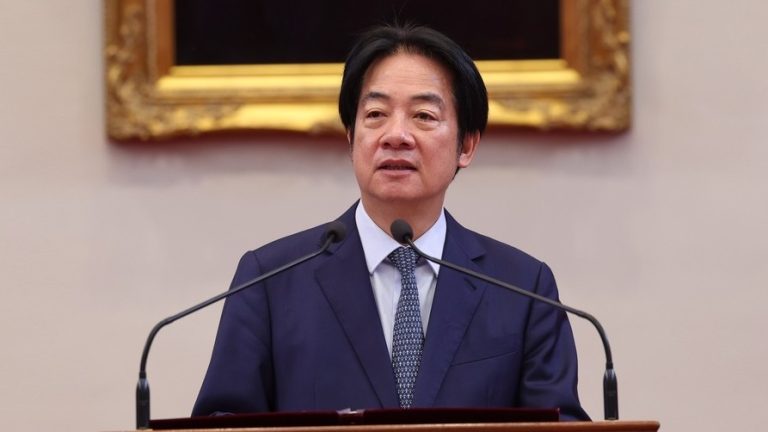
According to CNA and newtalk, President Lai held a high-level national security meeting at the Presidential Office on the morning of Nov. 26, titled, “Protecting Democratic Taiwan – National Security Action Plan.” After the meeting, Lai stated that the CCP is attempting to force unification by military coercion, eventually annexing Taiwan. The government, he said, has drafted two response strategies:
- Firmly safeguard national sovereignty and build a comprehensive democratic defense system.
- Strengthen military capabilities and develop a full-spectrum national defense industry.
Lai announced that the Ministry of National Defense has completed work on a Special Funding Act for Strengthening Defensive Resilience and Asymmetric Warfare Procurement, along with a budget plan. From 2026 to 2033, the government will invest a total of NT$1.25 trillion to build an advanced defense system designed to ensure both economic and security resilience. He emphasized that this special budget is a necessary investment in peace and in Taiwan’s safety, and he hopes the opposition parties will support it.
Political reactions
Former President Ma Ying-jeou said that Lai’s actions make it seem as though Taiwan has entered a “quasi-war state.” Ma also criticized Lai for dividing citizens into “China’s Taiwan” and “Democratic Taiwan,” and warned that future cross-strait exchanges by parties or civic groups may face deterrence.
Success
You are now signed up for our newsletter
Success
Check your email to complete sign up
At a press conference held by the KMT caucus, Secretary-General Lo Chih-chiang argued that Lai used the claim that China may take Taiwan by force in 2027 as justification to propose the NT$1.25 trillion budget. The KMT, he said, believes in necessary military readiness, but peace also requires investment, and that balance is key to Taiwan’s survival and development.
Lo noted that under KMT administrations, the annual defense budget was NT$300 billion, while under the current government it has risen to over NT$940 billion—now to be increased further by NT$1.25 trillion. Yet, he said, what Taiwan has received in return is repeated PLA incursions over the median line and normalized encirclement drills. He questioned whether such a massive budget could truly deter Chinese aircraft and secure Taiwan’s strategic defense depth.
Support from Taiwan Statebuilding Party
The Taiwan Statebuilding Party expressed firm support for President Lai’s decision. Party chairman Wang Hsing-hwan said, “Peace requires preparedness for war”—a truth that does not change. Those advocating compromise with the CCP, he said, are the real source of risk, as they would push Taiwan toward danger.
Wang stressed that China’s intent to attack Taiwan has not changed, and Taiwan must recognize the possibility of conflict. Increasing the defense budget is necessary to prevent a military imbalance. He cited Poland’s 2023 increase in defense spending to 4.15 percent of GDP in response to Russian aggression, noting Taiwan faces equal or greater geopolitical risk. The Russia-Ukraine war, he said, proves that sanctions after invasion are limited—only credible defense can deter aggression.
Wang also pointed to the U.S. Congress’ recently passed “Porcupine Act,” designed to fast-track arms sales to Taiwan and strengthen asymmetric defense capabilities. He highlighted ongoing U.S.–Japan–Philippines cooperation in maritime denial and anti-ship warfare, noting that Japan has already deployed anti-ship missiles to Yonaguni Island—just 110 km from Taiwan—with range covering the Taiwan Strait.
He argued that allies are actively strengthening deterrence, and as a core point of the First Island Chain, Taiwan must demonstrate a willingness to stand with the U.S., Japan, and the Philippines in resisting Chinese expansion.
Wang praised Lai for declaring, as head of state, that Taiwan will never yield to aggression, calling it a critical signal to the world. Without clear resistance, he warned, Beijing could use both intimidation and pro-China voices internally to create a false impression that Taiwan accepts unification willingly.
He warned that Beijing’s ideal scenario is to “blockade Taiwan to force unification.” The key issue, he said, is not whether China can conquer Taiwan, but whether Taiwan gives up resisting. As long as Taiwan shows it will fight, and China expects a long war with sanctions, Beijing is unlikely to strike. “Preparing for war does not increase the risk of war—compromise does.”
New Power Party: First time a president has publicly stated the timeline
NPP Chairwoman Claire Wang said this is the first time a president has publicly revealed a concrete timeline for potential Chinese aggression. She argued it is not Lai’s personal speculation, but the result of years of international intelligence analysis. She criticized KMT lawmakers for overreacting, saying failing to recognize danger is the true danger.
She added that China reaching full readiness in 2027 does not guarantee war, but the intent is clear: “We may hope for peace, but we cannot ignore the aggressor’s preparation.”
The TPP released a six-point statement acknowledging parts of Lai’s plan, including creating a “Taiwan Shield,” enhancing air defenses, and integrating AI into rapid battlefield decision-making. However, the party noted discrepancies between Lai’s 2027 threat assessment and U.S. analyses, saying national security should not be used to create fear and that the public should not be left last to know.
Raymond Greene, director of the American Institute in Taiwan (AIT), wrote on AIT’s Facebook page that Taiwan, like Europe, Japan, and South Korea, is making vital defense investments essential to deterring unprecedented global security threats.
He said the U.S. supports Taiwan’s acquisition of key asymmetric capabilities—consistent with the Taiwan Relations Act and decades of bipartisan policy.
A U.S. State Department spokesperson also welcomed Lai’s announcement, saying Washington supports Taiwan in acquiring necessary defense capabilities based on the threats it faces. The spokesperson also welcomed Taiwan’s commitment to raise defense spending to at least 3 percent of GDP by 2026 and to 5 percent by 2030, calling it evidence of Taiwan’s determination to strengthen its self-defense.