Analysis by Yuan Shan
Japan’s new prime minister, Sanae Takaichi, wasted no time making her foreign-policy stance clear.
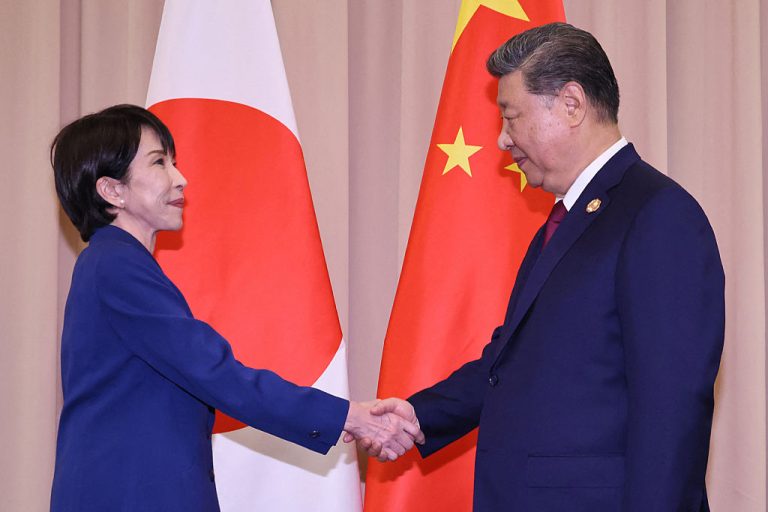
At the APEC Summit in South Korea on Nov. 1, 2025, she met Chinese leader Xi Jinping for the first time—an encounter that lasted less than 30 minutes but instantly became one of the most discussed moments in recent Japan–China diplomacy.
The tone was set in the opening two minutes. Takaichi, calm but unyielding, went straight to issues that Japan had long avoided addressing directly: the Senkaku Islands, the East China Sea, Taiwan, rare-earth export restrictions, detained Japanese citizens, Hong Kong’s erosion of freedoms, and human rights concerns in Xinjiang.
Observers said Xi’s expression visibly tightened. For a leader accustomed to tightly orchestrated diplomatic environments, the directness was jarring. Japanese media would later call it “a thunderclap in the history of Japan–China relations.”
Success
You are now signed up for our newsletter
Success
Check your email to complete sign up
The exchange underscored a deeper shift: Japan is no longer willing to soften its language to preserve superficial stability. And for Beijing, Takaichi has quickly become one of the foreign leaders it least wishes to confront.
An unexpected personal story behind Japan’s new leader
Takaichi’s political style reflects a personal history that has never fit the typical mold.
Born in Nara in 1961 to a middle-class family with no political background, she spent her youth on motorcycles, riding loudly to school as part of a local biker subculture. At Kobe University, she played drums in a heavy-metal band inspired by Iron Maiden and Black Sabbath.
Her marriage story is equally unconventional.
After losing her Diet seat in 2003, she was introduced to fellow lawmaker Taku Yamamoto. What began as a conversation about transferring office staff ended a few months later with Yamamoto’s abrupt declaration of affection—and the promise that, as a certified chef, he would cook for her for life.
The two married in 2004, a union the Japanese press later dubbed a “zero-day courtship.”
The political training that shaped her rise
After graduating, Takaichi entered the Matsushita Institute of Government and Management—an elite incubator often compared to a political military academy for future leaders. Alumni include former prime ministers and senior lawmakers.
She won her first Diet seat in 1993. Soon after, she aligned with the Liberal Democratic Party’s conservative Seiwa faction, deepening her connection with Shinzo Abe. Under Abe’s long second administration, she served as Minister for Internal Affairs and Communications—the first woman to hold the post.
Takaichi has long been regarded as one of Abe’s ideological heirs, sharing his views on constitutional revision, economic security, and Japan’s role in the Indo-Pacific. After Abe’s assassination in 2022, she became one of the most visible guardians of his political legacy.
The kingmaker who tipped the balance
Takaichi’s path to the premiership was not straightforward. She ran for LDP president three times, losing twice before her narrow victory in 2025.
Her main rival was Shinjiro Koizumi, scion of a powerful political family and one of Japan’s most recognizable public figures.
What changed this time was the intervention of former Prime Minister Taro Aso, a formidable faction leader and longtime conservative kingmaker. Backed by more than 40 lawmakers in his faction, Aso threw his support behind Takaichi in the runoff vote, a move that commentators described as “the hammer strike that decided the race.”
His endorsement proved decisive.
A foreign-policy voice that refuses to tiptoe around Beijing
Takaichi’s diplomatic worldview is unapologetically assertive.
She favors strengthening the U.S.–Japan alliance, deepening cooperation with Taiwan, and confronting Beijing on issues ranging from security to human rights. During APEC, she twice posted photos of her meeting with Taiwan’s representative Lin Hsin-yi—a gesture that triggered immediate anger from Beijing, which accused her of sending a dangerous signal to “Taiwan independence forces.”
Takaichi has also defended visits to the Yasukuni Shrine as matters of personal freedom, criticized China’s trade practices, and emphasized Japan’s economic and strategic autonomy.
Admiring Margaret Thatcher since her youth, she wore Thatcher’s trademark blue suit when she became LDP president—an intentional nod to the leadership style she aims to project.
At the same time, she acknowledges the challenges ahead: reviving Japan’s economy, reinforcing ties with Washington, and reshaping a Japan–China relationship long defined by caution.
Whether Takaichi becomes a durable political force or a transitional leader remains to be seen. What is clear—even from her first minutes with Xi—is that Japan’s voice has changed.