By Li Jingyao, Vision Times
In recent days, both state media and China’s ultra popular Douyin platform (a video-sharing app similar to TikTok) have displayed unusually “abnormal” signals that analysts say could mirror shifting political winds within the Chinese Communist Party (CCP). On Dec. 11, state mouthpiece “People’s Daily” published a shocking commentary titled: “Making the Rise and Fall of Leading Cadres a Normal State (Thought Horizons)”, emphasizing the principle of “letting cadres rise and fall.”
But many observers immediately interpreted the message as an implicit warning aimed at Chinese President Xi Jinping himself. Simultaneously, Douyin has seen several days of unprecedented posts featuring politically-sensitive content, including videos openly mocking or criticizing Xi.
RELATED: Sensitive Keywords Break Through China’s Iron-Clad Social Media Controls
A coded message?
The Dec. 11 commentary argued that the CCP suffers from “bad coins driving out good coins,” and urged Party organs to promote officials who “dare to take responsibility, are willing to work, and can deliver results,” while removing those who “idle away time, cling to their turf, or slack off.”
Success
You are now signed up for our newsletter
Success
Check your email to complete sign up
The article emphasized that the real challenge is ensuring officials can be removed when necessary: “A position is not an ‘iron chair.’ If one’s virtue does not match their role, or their capabilities do not match their responsibilities — if they fail to take responsibility or fail to act — they will be adjusted.”
It further stated that leadership positions are limited, and that those whose abilities “do not match the position” should be reassigned — both to make room for better candidates and to give the removed cadres “an opportunity to relearn, train, and improve.”
Though comments were disabled on the “People’s Daily’s” official Weibo account, netizens were quick to point out the inconsistencies. On X, users wrote:
- “Is ‘leaders can rise and fall’ referring to cadres under Xi, or Xi himself? That is the key point.”
- “The ruling party must be able to rise and fall; otherwise nothing else matters.”
- “They must be courting death. Who are they talking about? Xi Jinping?”
- “When is Xi Jinping stepping down?”
Calls for Xi to step down
13 years into Xi Jinping’s rule, China’s economic downturn, fiscal exhaustion at both central and local levels, and soaring unemployment have created widespread public resentment. Many citizens, netizens say, “hate Xi to the bone” and hope for his resignation.
Recently, X user “Tiny Reverie” published a piece titled “Proposal: Xi Jinping Should Resign,” which went viral. The essay accused Xi of placing his personal interests above national welfare, stating he “harbors a petty mind” and “abuses state machinery to settle private grievances.”
The article also referenced the Causeway Bay Books disappearances and the case of Swedish publisher Gui Minhai, who was kidnapped from Thailand after producing books about Xi Jinping’s private life, forced to confess on state television, and coerced into renouncing Swedish citizenship and resuming Chinese citizenship to serve a prison sentence.
The author wrote, “As president, Xi had absolutely no reason to make such a petty matter into a national incident. As a citizen, if he believed Gui Minhai defamed him, he could have filed a lawsuit. Whether as president or as an individual, Xi Jinping is unqualified. He has turned the state apparatus into a tool for personal revenge, with extremely harmful consequences.”
The essay further blasted Xi for amending the constitution to abolish term limits: “The presidency is just a job, no different from that of a sanitation worker. Yet Xi insists on acting like an emperor, seeking lifelong rule.”
A slew of videos mocking Xi
In another surprising development, Chinese netizens have begun “storming the tower” on Douyin by posting unusually bold political content critiquing Xi Jinping and referencing some of the most heavily censored moments in CCP history. Videos, comments, and even hashtags deemed to be “politically-sensitive” are typically scrubbed within minutes under China’s iron-fisted censorship controls.
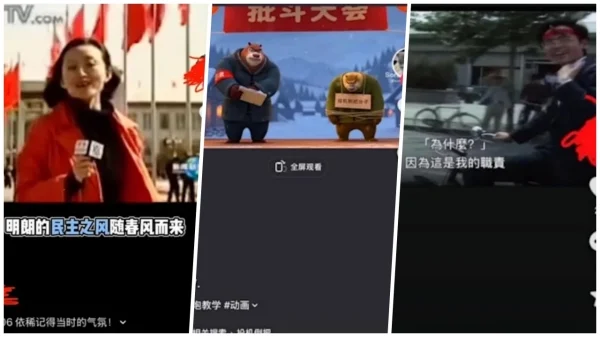
But a series of sensitive political and historical videos, featuring Zhao Ziyang, Hu Jintao, Wang Yang, investigative journalist Chai Jing, and even Xi Jinping, have appeared on Douyin in recent days. Many users expressed shock, commenting that they felt as though they had “entered YouTube,” thanks to the lack of censorship.
Even videos related to China’s own June Fourth crackdown that saw its military brutally gun down student activists protesting equal rights and democracy at Beijing’s Tiananmen Square: A young man with a red headband cycling toward Tiananmen to join the demonstrations. When a foreign journalist asked where he was going, he replied firmly, “Going to march, at Tiananmen Square.” When asked why, he answered without hesitation: “Why? I think it’s my duty!”
Politically-sensitive content bypassing censors
Even content related to the Tiananmen Square crackdown appeared on the platform. One clip showed a young man with a red headband cycling toward the square to join the demonstrations. When a foreign journalist asked where he was heading, he replied, “Going to march, at Tiananmen Square.” When asked why, he answered without hesitation: “Why? I think it’s my duty!”
The massacre took place on June 4, 1984 when Chinese military brutally opened fire on student protesters demanding equal rights and democracy in Beijing’s Tiananmen Square. Many commented that this was “the first time ever seeing such footage on Douyin.”
Users also posted historic clips of former CCP General Secretary Zhao Ziyang visiting Tiananmen Square in 1989 to plead with the students. Comment sections included references to “8964,” breaking the usual censorship boundaries.
Another viral edit used the cartoon character Bald Qiang (光头强) to creatively present past speeches by former Vice Premier Wang Yang. One highlighted quote spread rapidly across the platform: “The pursuit of happiness is the people’s right, and bringing happiness to the people is the government’s responsibility. We must break the erroneous theory that people’s happiness is a gift from the government.”