By Li Jingyao, Vision Times
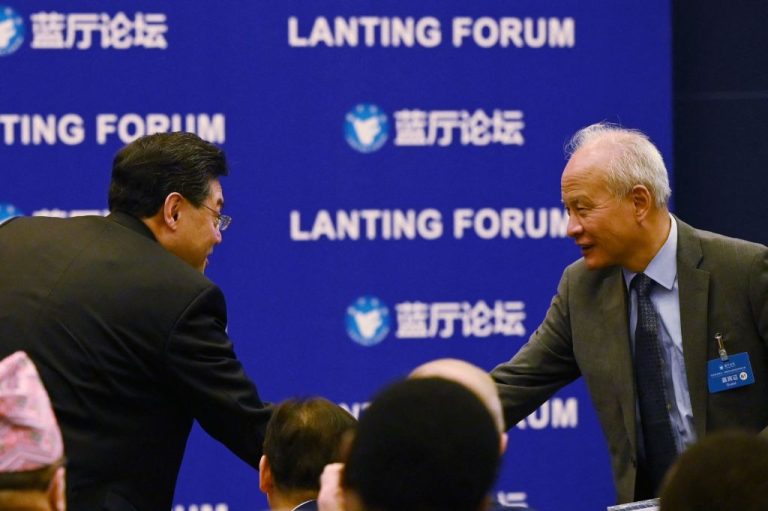
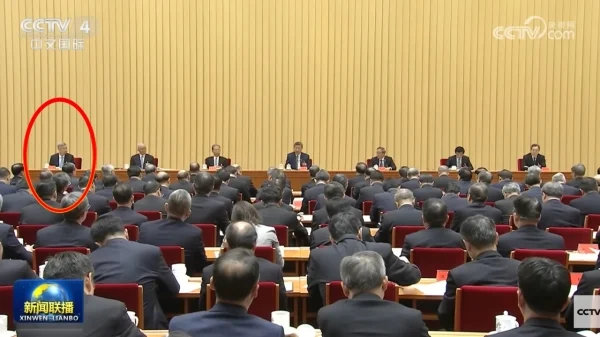
After nearly two weeks out of public view, including an absence from a Politburo meeting (China’s top ruling body), Li Xi has once again resurfaced at the Central Economic Work Conference held in Beijing from Dec. 10-11. Effectively dispelling rumors that he had “run into trouble,” Li currently serves as the Chinese Communist Party’s (CCP) Central Commission for Discipline Inspection (CCDI) chief.
Yet analysts caution that Li’s reappearance does not necessarily mean he has disentangled himself from the unfolding Ma Xingrui corruption case. Some observers argue that Li may be attempting to “jump ship” and draw a clear line of separation — a maneuver that would not be difficult under the circumstances. Others believe Party elders may be preparing to wield the CCDI as a “sharp blade” to launch a sweeping purge of the Party–state system — one widely described as “anything but benign.”
RELATED: Ma Xingrui’s Third Absence Points to Trouble as Hu Chunhua Faces Scrutiny
Key members in attendance
According to state news agency Xinhua, the Central Economic Work Conference was held in Beijing from Dec. 10 to 11. CCP leader Xi Jinping attended and delivered an important speech, while Premier Li Qiang gave the concluding remarks. Politburo Standing Committee members Li Qiang, Zhao Leji, Wang Huning, Cai Qi, Ding Xuexiang, and Li Xi were all present.
Success
You are now signed up for our newsletter
Success
Check your email to complete sign up
The official readout declared that 2025 had been an “extraordinary year,” claiming that under “the Party Central Committee with Xi Jinping at its core,” the nation had overcome difficulties and that major economic and social development goals would be achieved through more proactive macroeconomic policies.
RELATED: Anti-Xi Faction Floats Political ‘Kill Order’ as Xi Jinping’s Grip on Power Wanes
At the same time, the statement acknowledged persistent structural problems, worsening external pressures, weak domestic demand, and mounting risks in key sectors.
Outside observers, however, noted that the communiqué offered nothing new — merely a repetition of stock phrases and hollow slogans. Many concluded that Beijing has effectively run out of tools to arrest economic deterioration. The real focus of the meeting, analysts said, was not what was said — but who did not attend.
Former Xinjiang Party secretary Ma Xingrui, who had already missed recent Politburo meetings amid swirling rumors, was once again absent. His repeated absence is now widely interpreted as a de facto official confirmation of his downfall. By comparison, Li Xi’s appearance — after his own unexplained absence — drew renewed attention amid political analysts.
Politburo members under watch
Political commentator Wu Jianmin analyzed on his self-media channel that since Ma Xingrui was removed as Xinjiang Party secretary in July, he has effectively remained under CCDI investigation. “The reason there has been no conclusion for so long appears to be tied to rumors of entanglements between Ma Xingrui and Li Xi,” Wu said. “Li Xi’s involvement relates to his role as CCDI chief and the degree of protection he may have provided to Ma.”
Wu noted that Politburo Standing Committee members have long been regarded as “iron-capped kings.”
“Unless they are involved in treason or rebellion, they are absolutely not allowed to be investigated. This is a Party rule established after Deng Xiaoping and Chen Yun consolidated power.”
Wu cited former security chief Zhou Yongkang as a rare exception. Although Zhou was officially convicted of corruption and sentenced to life imprisonment, Wu argued that his true crimes were participation in two coup attempts against Xi Jinping and a major intelligence leak.
Li Xi’s longstanding ties to Xi Jinping
Li Xi graduated from Gansu Normal College and served as secretary to Li Ziqi — a longtime subordinate of Xi Jinping’s father, Xi Zhongxun — when Li Ziqi was Gansu Party secretary between 1982 and 1986. Whenever Li Ziqi traveled to Beijing or Shenzhen to visit Xi Zhongxun, Li Xi accompanied him.
“That was when Li Xi and Xi Jinping first got to know each other. They encouraged each other and helped pull each other along,” noted Wu. Because of this close relationship, when Xi Jinping was still vice president and heir apparent, he once tasked Li Xi — then Yan’an Party secretary — with personally delivering a reply letter to Xi’s former village, Liangjiahe.
After Xi assumed top leadership at the 18th Party Congress in late 2012, he quickly transferred Li Xi to Shanghai as deputy Party secretary in 2013. “From there, Li Xi rose steadily, eventually entering the Politburo Standing Committee at the 20th Party Congress,” added Wu.
Is Li in the clear?
Wu Jianmin argued that if Li Xi — one of Xi Jinping’s early associates — had not betrayed Xi, there would be no reason for Xi to strip him of his “iron-capped” status. “However,” Wu cautioned, “even with Li Xi’s reappearance, it is difficult to say he has completely disentangled himself from Ma Xingrui.”
Wu added that investigating a sitting CCDI chief would amount to a humiliating slap in Xi Jinping’s face. “Li Xi has only temporarily passed this hurdle. We need to wait until Ma Xingrui’s downfall is officially announced before drawing conclusions.”
Political commentator Li Linyi told overseas media that although Li Xi has reappeared, the December Politburo meeting notably did not emphasize anti-corruption efforts, nor did it announce the date for next year’s CCDI plenary session. “That alone suggests something is wrong within the CCDI,” Li said, “even if the full picture remains unclear.”
Commentator Tang Jingyuan believes Li Xi’s earlier absence from Politburo meetings was not due to his being investigated, but rather because he is personally leading the investigation into Ma Xingrui. “Ma Xingrui’s case could become the party-state system’s version of the He Weidong case — an entry point for a sweeping purge of Xi’s own faction within the civilian bureaucracy. For anti-Xi forces, this case is critical. For Xi’s camp, it is equally critical.”
Could Li be at the helm of the Ma Xingrui probe?
Tang emphasized that though Li Xi may have benefited indirectly from Ma’s network, the likelihood of Li being taken down now is extremely low. First, Li Xi is a sitting Standing Committee member, and the Party has an unwritten rule of ‘no punishment for Standing Committee members.’ Second, he is in the midst of handling a case of enormous political significance.
Tang also noted that Li Xi has never been particularly conspicuous within Xi’s inner circle “He is not as flamboyant as Cai Qi, not as wildly corrupt as Ma Xingrui, and unlike Wang Qishan, he does not command an independent faction capable of threatening the top leadership.”
At most, Tang said, Li Xi may have used family members or intermediaries to take a share of Ma Xingrui’s gains. “For someone like him, cutting ties is relatively easy.”
Another key factor, Tang argued, is political optics. Arresting Li Xi and replacing him with a Hu-Wen faction figure who then launches an aggressive purge would make Xi Jinping appear to be nothing more than a figurehead. “So instead of playing that card openly, using a turncoat Li Xi to strike back offers enormous advantages — what’s known as ‘waving the red flag to strike the red flag.’”
Party elders on high alert
Tang Jingyuan said the Central Economic Work Conference once again underscored that the real focus of the regime is personnel purges and reshuffles, not economic recovery. The military, a closed system, has already undergone a dramatic shake-up, with nine generals removed in one sweep ahead of the Fourth Plenum — a move that stunned observers.
“The Party–state system is different,” Tang said. “It is relatively open. Historically, before a major purge, the pattern is always the same: public opinion moves first, troops move later.” Tang also warned that this coming purge appears particularly ruthless: “Some people may not even be granted the privilege of retiring quietly in Qincheng. If things go badly, heads could roll.”
On Dec. 10, the CCDI–National Supervisory Commission’s official WeChat account republished an article titled “Severely Punishing the Liu Qingshan and Zhang Zishan Case — Corrupt Officials Must Be Harshly Dealt With Once Discovered.” The case, dating back to the early years of the PRC, was the CCP’s first major anti-corruption campaign.
Tang noted that Xi Jinping had similarly revived the Liu Qingshan and Zhang Zishan case at the start of his rule to build momentum for anti-corruption, which preceded the downfall of top-level figures such as Zhou Yongkang, Su Rong, Xu Caihou, and Ling Jihua between 2013 and 2014. “The Liu Qingshan and Zhang Zishan case is symbolic. Every time it is brought out, there is a high probability that major ‘tigers’ are about to fall.”
He added, “This is what it means to wave the red flag against the red flag. Xi once used anti-corruption to purge other factions. Now, anti-Xi elders are using the same weapon to purge Xi’s own camp. And the CCDI blade remains extremely sharp.”
Editorial note: Views expressed in this article are the opinions of the author and do not necessarily reflect the views of Vision Times.