By Yang Tianzi
Southeast Asia reached a pivotal geopolitical moment on Dec. 13, as Cambodia and Thailand agreed to a full ceasefire along their disputed border following days of escalating military tensions.
Cambodian Prime Minister Hun Manet formally accepted a ceasefire proposal put forward by Malaysian Prime Minister Anwar Ibrahim, confirming that all military operations along the border would halt starting at 10:00 p.m. local time.
Beyond easing immediate hostilities, the agreement introduced an unprecedented dual monitoring framework combining ground-based observation with satellite surveillance.
The mechanism will be jointly implemented by an ASEAN observer mission led by Malaysia and satellite monitoring support provided by the United States, marking a new model of international cooperation in regional conflict management.
Malaysia’s emergency diplomatic mediation
Success
You are now signed up for our newsletter
Success
Check your email to complete sign up
The breakthrough followed intensive diplomatic efforts by Malaysian Prime Minister Anwar Ibrahim, whose country serves as ASEAN’s rotating chair in 2025.
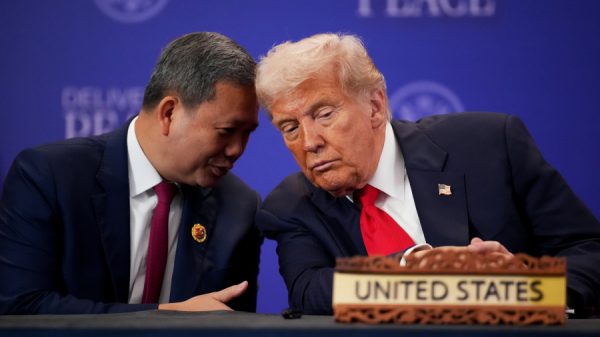
After a phone call with U.S. President Donald Trump, Anwar reportedly concluded that continued instability along the Thailand–Cambodia border posed serious risks to broader regional security.
He subsequently held direct calls with Thai Prime Minister Anutin Charnvirakul and Cambodian Prime Minister Hun Manet, urging both sides to exercise restraint and immediately de-escalate.
According to Thai media outlet Khaosod, the ceasefire requires both militaries not only to stop combat operations but also to freeze troop movements and changes in military deployments, aiming to prevent renewed clashes.
The comprehensive nature of the agreement reflects Malaysia’s intent to remove any conditions that could trigger further escalation.

A ‘ground-plus-space’ monitoring innovation
To ensure compliance, Malaysia and the United States jointly designed a monitoring system that integrates traditional field observation with modern satellite surveillance.
On the ground, an ASEAN observer mission led by the commander of the Malaysian Armed Forces will deploy to the border region.
The mission will collect on-site evidence, document troop positions and equipment status, and respond to any suspected ceasefire violations.
From space, U.S. satellite monitoring technology will provide continuous, wide-area surveillance of military movements and activities along the border.
This capability allows for objective, real-time tracking that is not constrained by terrain or weather conditions.
Officials involved in the process said the two layers of monitoring are intended to complement and cross-verify each other, significantly increasing transparency and reducing the likelihood that violations could be concealed.
Cambodia’s cautious but affirmative response
Cambodia responded to the initiative with a mix of public support and continued vigilance.
Prime Minister Hun Manet welcomed the ceasefire and confirmed on social media that ASEAN observers, with U.S. participation, would oversee its implementation.
At the same time, Cambodia’s Ministry of Interior announced the temporary suspension of all cross-border land crossings with Thailand, citing concerns over civilian safety following what it described as indiscriminate attacks by Thai forces.
The closures will remain in effect until further notice.
The move was backed by former Prime Minister and current Senate President Hun Sen, who said the decision was necessary to protect civilians from potential spillover violence.
The unified stance of Cambodia’s current and former leadership underscored policy continuity during the crisis.
ASEAN foreign ministers to assess compliance
All monitoring data and evidence collected by ASEAN observers and U.S. satellite systems will be presented at the ASEAN Foreign Ministers’ Meeting scheduled for December 16.
The meeting is expected to serve as a key platform for evaluating ceasefire compliance and addressing accountability concerns.
By placing the review process within a multilateral framework, ASEAN aims to avoid bilateral deadlock and reinforce collective pressure for restraint.
Officials say the approach could also help rebuild trust between Thailand and Cambodia and lay groundwork for longer-term dispute resolution.
Regional security implications
Analysts say the ceasefire and its monitoring framework carry broader implications for Southeast Asian security.
The episode highlights ASEAN’s growing capacity to manage intra-regional conflicts, demonstrating that the bloc can function not only as an economic forum but also as a stabilizing security actor.
U.S. involvement, particularly through satellite surveillance, reflects Washington’s continued strategic interest in regional stability.
Observers note that the ASEAN-led, U.S.-supported model may serve as a template for addressing future disputes in the region.
Despite the ceasefire, challenges remain.
Long-standing border demarcation disputes, historical grievances, and nationalist sentiment continue to complicate prospects for lasting peace.
The current truce represents a first step, analysts say, but sustained dialogue and political will will be required to transform it into a durable settlement.
As ASEAN foreign ministers prepare to review the ceasefire later this month, international attention will remain focused on whether this innovative “ground-plus-space” monitoring mechanism can deliver lasting stability—and whether it signals a new chapter in regional conflict management.