
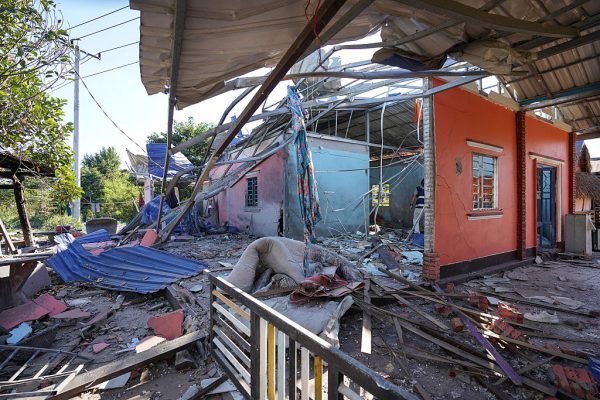
The Thai–Cambodian border was again shaken by artillery fire this week, but Thai authorities insist the latest barrage was not a routine border clash. On Dec. 18, the Thai military released footage on its official Facebook account showing armored units conducting what it described as precision artillery strikes on a large casino complex inside Cambodian territory. The structure was quickly engulfed in flames, thick smoke billowing skyward as multiple breaches appeared in the roof.
According to Thai officials, the target was not a civilian commercial site but a major transnational scam hub operating under the cover of a casino and resort complex. The Thai military confirmed that six scam compounds inside Cambodia have been destroyed to date, marking an unprecedented escalation in Bangkok’s response to cross-border fraud and human trafficking.

Thailand tanks open fire on alleged scam hubs
In an official statement, the Thai military said the operation was based on intelligence indicating that Cambodian soldiers had used these border facilities as cover to launch drone attacks into Thai territory. Thai authorities described the alleged use of ostensibly civilian commercial sites for military activity as a serious threat to national security and a clear red line.
Thai officials further noted that at least one of the destroyed casino-resort complexes had previously been placed under U.S. Treasury sanctions for alleged links to large-scale scam operations. They described the convergence of international financial sanctions and direct military action as evidence that the regional crackdown on Southeast Asia’s scam industry has entered a more coordinated and forceful phase.
Cambodian authorities have rejected Thailand’s claims, insisting that the shelled buildings were legally operated hotels and casinos with no military or criminal function. Phnom Penh has denied any connection between the sites and scam activity.
Success
You are now signed up for our newsletter
Success
Check your email to complete sign up
The sharply conflicting accounts reflect a deeper regional dispute over how to confront transnational crime. International media outlets and human rights organizations have repeatedly documented how many casinos and hotels in Cambodia operate dual systems—presenting legitimate businesses to regulators while housing large-scale scam operations in restricted or hidden sections of the same compounds.
A decisive break from past restraint
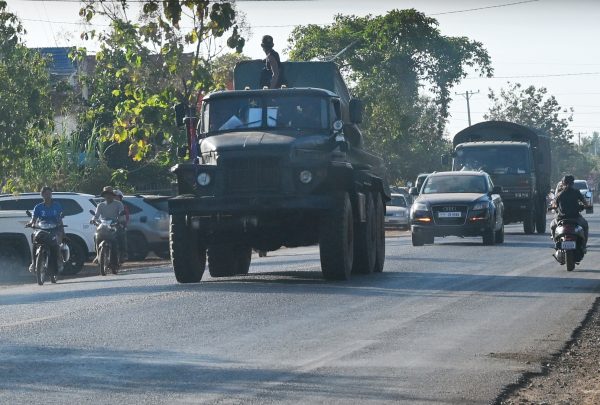
Thailand’s decision to deploy heavy military assets against cross-border criminal infrastructure represents a major departure from its previous approach. For years, Bangkok relied on diplomatic engagement, bilateral police cooperation, and information-sharing mechanisms—measures Thai officials now openly describe as ineffective.
Analysts point to several converging pressures behind the shift. First, a rising number of Thai citizens have been financially devastated by scam operations. Second, Thailand has increasingly been exposed as a transit hub in regional human trafficking networks, with foreign nationals allegedly lured or abducted and transferred onward to scam compounds in Cambodia. Third, Thai authorities argue that once these facilities began using military-grade equipment and launching attacks across the border, the issue ceased to be mere organized crime and became a direct security threat.
In this context, Thai officials appear to have concluded that traditional law enforcement tools were no longer sufficient.
The scale of the scam economy
According to estimates by the United Nations and Interpol, transnational scam networks operating in Southeast Asia generate tens of billions of U.S. dollars in losses each year, victimizing individuals across Asia, Europe, and North America.
Reports from the UN Office of the High Commissioner for Human Rights describe a system built on coercion and brutality. Foreign nationals are allegedly recruited with promises of high-paying jobs, only to have their passports confiscated upon arrival. Victims are reportedly detained in fortified compounds and forced to conduct online scams under threats of violence, torture, sexual abuse, and unlawful detention.
While Thailand’s military strikes are not formally linked to recent joint U.S.–U.K. enforcement actions, those cases provide critical context. In October, American and British authorities announced the seizure of more than USD 14 billion in Bitcoin and criminal allegations against Chen Zhi, founder of the Cambodia-based Prince Group.
According to the U.S. Department of Justice, the group operated at least ten scam compounds in Cambodia. Prosecutors said two sites alone housed more than 1,250 mobile phones controlling roughly 76,000 fake social media accounts, illustrating the industrial scale of these operations.
Allegations of CCP-linked ‘gray operations’
More sensitive questions have emerged regarding the possible involvement of the Chinese Communist Party. Media reports and testimony from former intelligence personnel have raised the possibility that some scam networks maintain indirect ties to Chinese security services.
The Times of London has quoted former U.S. intelligence officer David Sauer as saying that Chinese security agencies have historically relied on criminal organizations for “gray operations,” including money laundering, intimidation, and harassment of dissidents abroad.
A former CCP agent identified only as “Eric” has alleged that the Prince Group functioned not merely as a commercial empire but also as a proxy platform for overseas covert operations. He claimed to have witnessed meetings between senior Chinese security officials and Chen Zhi in Cambodia to plan surveillance and entrapment of exiled dissidents.
These claims are based on media reporting and individual testimony and have not been independently confirmed by any government authority. Analysts caution that while such allegations warrant scrutiny, they remain unproven.
Cambodia’s entrenched dilemma
Cambodia’s role in the regional scam economy remains deeply contested. The country is heavily dependent on Chinese investment, and the scam industry is widely believed to generate significant foreign currency inflows and employment—creating powerful vested interests.
Critics argue that this political–business entanglement has severely constrained Phnom Penh’s willingness or ability to dismantle scam networks, even under mounting international pressure. Thailand’s military intervention is therefore widely interpreted as a message not only to Cambodia but to the broader ecosystem of enablers sustaining cross-border crime.
The strikes also represent a notable breach of ASEAN’s long-standing principle of non-interference. Regional analysts say Thailand’s actions signal that when transnational crime reaches a certain scale—and begins to threaten national security—traditional diplomatic norms may no longer hold.

A new and uncertain phase
Despite the immediate impact of Thailand’s strikes, observers caution that the broader campaign is far from over. Scam networks are highly adaptive and capable of relocating operations once individual sites are destroyed.
Many analysts argue that lasting change will require deeper structural shifts: dismantling protection networks, cutting financial pipelines, strengthening governance, and sustaining international coordination through law enforcement, sanctions, and regulatory pressure.
Thailand’s military action, combined with U.S. and U.K. financial enforcement, reflects the emergence of a multi-layered strategy against Southeast Asia’s scam industry. Whether it can produce durable results remains uncertain.
For those still trapped inside scam compounds—and for families whose lives have been shattered by fraud—the sound of artillery carries more than military meaning. It signals that the crimes long tolerated in the shadows are no longer being ignored, and that accountability, however belated, is beginning to be pursued.