By Li Deyan
Although CCP leader Xi Jinping has designated the Eastern Theater Command as the primary force responsible for contingencies in the Taiwan Strait and the East China Sea, a wave of purges among its senior officers has increasingly hollowed out the command structure. Analysts note that signs of this leadership vacuum were already evident during the April 2025 military exercises targeting Taiwan.
Recent public appearances by two newly identified acting leaders of the Eastern Theater Command suggest that their immediate mission is twofold: to eliminate the remaining influence of disgraced generals Miao Hua and He Weidong, and to stabilize morale amid growing uncertainty within the ranks—while preparing for potential emergencies.
Acting Theater Leaders Surface at Nanjing Memorial Ceremony
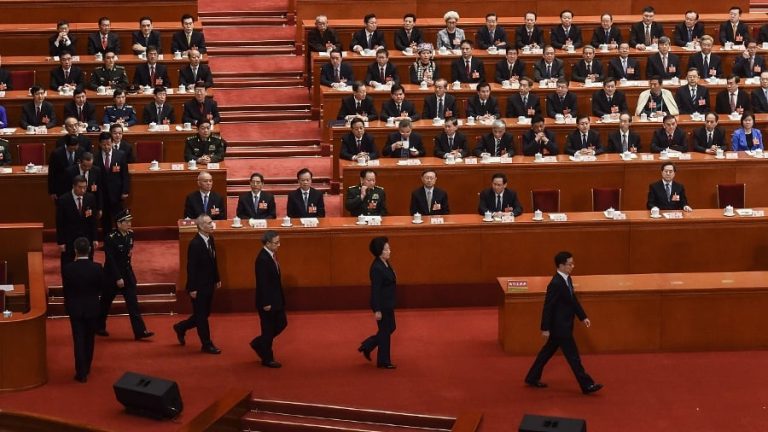
On December 13, 2025, Chinese authorities held the annual National Memorial Ceremony for the Nanjing Massacre Victims in Nanjing. According to state media, the event was presided over by Wang Xiaohong, Secretary of the CCP Central Secretariat and State Councilor. Shi Taifeng, Politburo member and head of the CCP Organization Department, delivered remarks. Other attendees included NPC Vice Chairman Zhang Qingwei, CPPCC Vice Chair Su Hui, and Central Military Commission (CMC) member Liu Zhenli, Chief of the Joint Staff Department.
Notably, state media reports stated only that “responsible officials from the Eastern Theater Command, Jiangsu Province, and Nanjing City” were present—without naming them.
Success
You are now signed up for our newsletter
Success
Check your email to complete sign up
In previous years, senior Eastern Theater Command leaders were explicitly identified at the ceremony. In 2024, then-Commander General Lin Xiangyang and Political Commissar General Liu Qingsong both attended and were named.
Footage from this year’s ceremony, however, showed Lieutenant General Yang Zhibin, Deputy Commander of the Eastern Theater Command, standing beside Jiangsu Party Secretary Xin Changxing, while Lieutenant General Zhang Jichun, Deputy Political Commissar and Director of the Political Work Department, stood next to Jiangsu Governor Liu Xiaotao. Their placement in the front row alongside top provincial leaders strongly suggests that Yang and Zhang are now overseeing the theater’s day-to-day operations.
Independent commentator Zhonggui Zhongju reported that as early as September 2025, Yang Zhibin and Zhang Jichun had been transferred to the Eastern Theater Command, assuming roles as acting commander and acting political commissar, respectively.
Eastern Theater Command: From Xi’s Stronghold to Purge Epicenter
Following the 2016 military reforms, the Eastern Theater Command inherited the operational territory of the former Nanjing Military Region. Between 2016 and 2025, its commanders were Liu Yuejun, He Weidong, and Lin Xiangyang.
Analyst Li Yanming notes that both He and Lin originated from the now-disbanded 31st Group Army, historically based in Xiamen, Fujian—a unit long associated with Taiwan contingency planning. Former CMC member Miao Hua also rose through the same formation, serving as political commissar of the 31st Group Army and later as deputy political commissar of the Nanjing Military Region. Wang Xiubin, former deputy chief of the CMC Joint Operations Command Center, likewise held senior posts in the 31st Group Army and later in the Eastern Theater Command.
This concentration of officers from a single lineage underscores how deeply the Eastern Theater Command had become tied to Xi Jinping’s personal network.
As Xi’s position within the CCP has shown signs of weakening, the Eastern Theater Command has emerged as a primary target of internal military purges. On October 17, 2025, the Ministry of National Defense abruptly announced that nine generals had been expelled from both the Party and the military for “serious disciplinary and legal violations.” Five of them had direct Eastern Theater Command backgrounds, including He Weidong, Miao Hua, Lin Xiangyang, Wang Xiubin, and Wang Chunning, commander of the People’s Armed Police.
During the Fourth Plenum period, 14 generals who were Central Committee members disappeared from public view, including former Eastern Theater Command political commissar Liu Qingsong.
According to Zhonggui Zhongju, the Eastern Theater Command had long been the power base of Miao Hua and He Weidong, dominated by their loyalists—making it one of the hardest-hit regions in the ongoing military purge. The acting leadership of Yang Zhibin and Zhang Jichun is therefore tasked with dismantling this legacy while restoring operational stability.
April Taiwan Drills Reveal Absence of Key Commanders
Xi’s designation of the Eastern Theater Command as the spearhead for Taiwan contingencies brings renewed attention to events in early April 2025.
On April 1, 2025, the PLA launched large-scale exercises around Taiwan. Yet the operation appeared unusually disorganized. The drills were not formally named “Strait Thunder–2025A” until the following day and were then abruptly concluded. Observers speculated at the time that the exercise had been hastily assembled and lacked unified command.
Taiwan defense analyst Shen Ming-shih noted that the April 1–2 drills appeared chaotic, with the delayed naming suggesting last-minute adjustments rather than pre-planned operations.
At the height of the drills, CMC Vice Chairman Zhang Youxia and Joint Staff Chief Liu Zhenli were publicly seen participating in a tree-planting event, while Vice Chairman He Weidong was notably absent—already signaling internal disruption.
Strategic analyst Su Ziyun of Taiwan’s Institute for National Defense and Security Research later assessed that turmoil within the CMC prevented timely political authorization, delaying the exercise’s designation by 24 hours. He characterized this as both a political and military failure.
Su warned that while tactical training at lower levels might continue unaffected, repeated upheavals among senior commanders would severely undermine morale and confidence among operational officers.
In October 2025, Shen Ming-shih further observed that PLA exercises targeting Taiwan from 2022 to 2025 had steadily decreased in scale and increasingly avoided live-fire components. The April drills, he argued, were more performative than operational—now confirmed to have lacked direction from either He Weidong or Lin Xiangyang.
Shen predicted that responsibility for Taiwan operations would likely shift to Liu Zhenli, while the Eastern Theater Command would rely on acting leadership. A key question going forward, he said, is whether these newly elevated officers align more closely with Xi Jinping or with Zhang Youxia.
Backgrounds of the Acting Leaders
According to Zhonggui Zhongju, acting commander Yang Zhibin rose from the PLA Air Force’s 26th Division, stationed in Fujian Province. His former superior was Xu Qiliang, the late CMC vice chairman who died suddenly in June 2025.
Acting political commissar Zhang Jichun, a lieutenant general from the Rocket Force, previously intersected professionally with Zhang Shengmin, a current CMC vice chairman who earlier oversaw political work in the former Second Artillery Corps.
Analysts caution that if the ongoing purge extends to officers below the rank of major general, the impact on morale could be far more severe—potentially leading to refusal of orders or even internal fractures.
Conclusion
The emergence of acting leadership in the Eastern Theater Command underscores the depth of disruption caused by the CCP’s sweeping military purges. What was once Xi Jinping’s most trusted strategic command has become a focal point of instability—its April drills revealing not strength, but institutional strain.
Whether the new leadership can restore coherence—or merely preside over further erosion—remains an open and consequential question for cross-strait security.