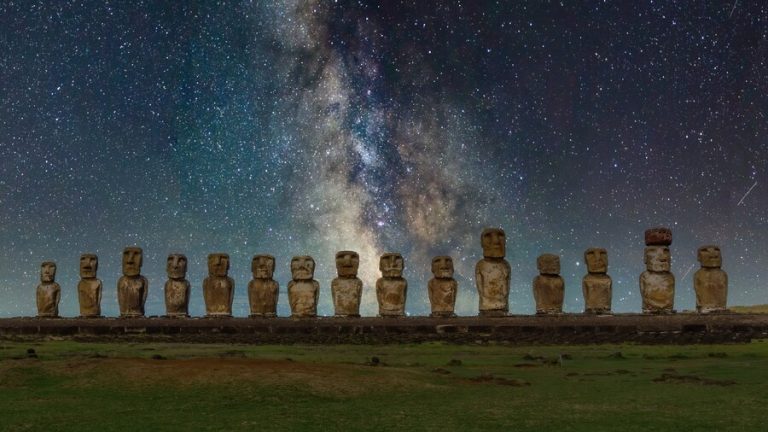
In the vast central Pacific, a small volcanic island stands in isolation. Easter Island, both distant and lonely, is famous worldwide for its massive stone statues, the Moai, and has become a puzzle that has sparked endless debate among archaeologists and researchers.
Graham Hancock, a journalist and author who has long studied ancient civilizations, points out that mainstream archaeology generally believes Easter Island’s settlement history is relatively recent, occurring roughly a thousand years ago, with the earliest possibly dating back to around 700 CE. This view considers Easter Island as one of the outcomes of the late Polynesian expansion. Hancock does not deny that the indigenous people of today’s Easter Island are indeed part of the Polynesian cultural sphere, whose maritime achievements are human history’s marvels—crossing the vast Pacific without modern technology to find this “tiny dot” almost invisible on the map. Yet he raises a crucial question: could Easter Island have an older, overlooked history that predates the arrival of the Polynesians?

Evidence left by bananas on Easter Island
In recent years, intriguing clues have emerged regarding this question. Hancock mentions that Sonia Haoa, an archaeologist from Easter Island, and her team discovered tiny remnants of banana phytoliths during excavations at the Rano Kau volcanic crater. These plant traces, invisible to the naked eye, were dated to approximately three thousand years ago.
The key point of this discovery is that bananas could not have naturally drifted across the ocean to grow on the island. The only possibility is that they were carried and planted by humans. In other words, this evidence suggests that human activity on Easter Island may have occurred at least twice as early as previously thought.

Which era does the memory of the flood come from?
Besides physical evidence, Hancock also emphasizes the island’s oral traditions. Generations of islanders have passed down memories of their homeland sinking. Their ancestors came from a land called “Hiva,” an ancient home in the Pacific that ultimately disappeared in a great flood, with only a few survivors drifting to Easter Island.
Success
You are now signed up for our newsletter
Success
Check your email to complete sign up
The problem is that, according to geological and sea-level studies, by the time of Polynesian expansion, sea levels had long stabilized, and there was no global flood capable of submerging large islands. If this memory is accurate, its timeline may need to reach back to around the end of the Ice Age.

Are the Moai really just a product of the last thousand years?
Easter Island’s most iconic Moai statues are the focus of Hancock’s questioning of conventional dating. Archaeologists generally believe these statues were carved in the past seven to eight hundred years, but there are significant issues with the actual dating.
At the Rano Raraku quarry, most of the Moai visible today show only heads and shoulders. However, as early as the 20th century, explorer Thor Heyerdahl’s excavations confirmed that the bodies of these statues were buried underground, some to depths exceeding ten meters. Hancock notes that these statues were not deliberately buried; the thick sediment accumulated naturally over a long period. On a small, isolated island far from any large landmass, accumulating such a thick sediment layer would likely require far more than a few hundred years.
Robert Shock, a geologist at Boston University, holds a similar view. Having studied weathering evidence on the Sphinx of Giza, he suggested its age could exceed twelve thousand years. He believes the sedimentary conditions of Easter Island’s Moai similarly point to a much older age.

The ‘power’ of the statues and the seven sages
In Easter Island tradition, the Moai are not merely sculptures. Local elder Leo Pakati once explained to researchers that the statues were believed to contain “mana,” a force that could influence crop growth and maintain harmony between humans and the cosmos. They are symbols of ancestors and guardians of the island.
The island also preserves stories of the “Long Ear” and “Short Ear” peoples, representing two early groups. One row of seven Moai is said to commemorate seven sages who survived the flood. The significance of “seven” repeatedly appears in ancient civilizations worldwide, from Mesopotamia to Egyptian mythology, with similar narratives.

Cross-civilization similarities remain unrecognized
Hancock also notes that he has observed similarities between Easter Island’s statues and the Göbekli Tepe stone structures in Turkey. The T-shaped megaliths at Göbekli Tepe are similarly carved with arms and hands folded over the abdomen, closely resembling the Moai, and are dated to about 11,600 years ago. Yet Easter Island’s statues still lack systematic, advanced dating studies. Hancock believes this gap is one of the most crucial—and easily overlooked—problems in ancient history research.
A history yet to be fully told
Hancock suggests that Easter Island is not an isolated civilization but may be a remnant of a much older human history. As dating technology, interdisciplinary research, and the study of oral traditions advance, this isolated Pacific island may compel humanity to rethink whether we truly understand our own past.