By Li Muzi, Vision Times
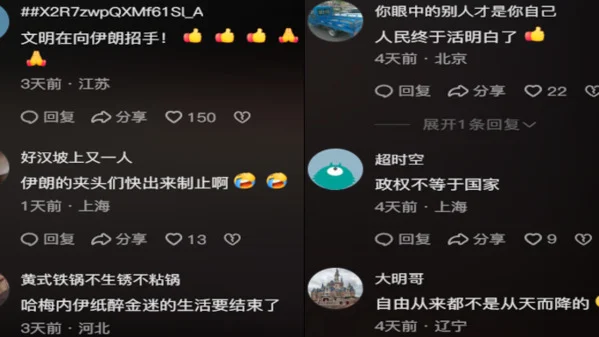
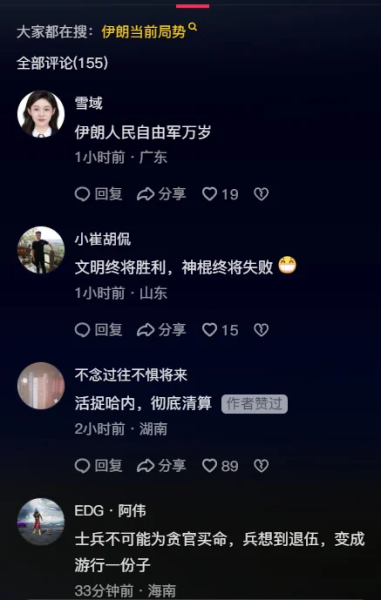
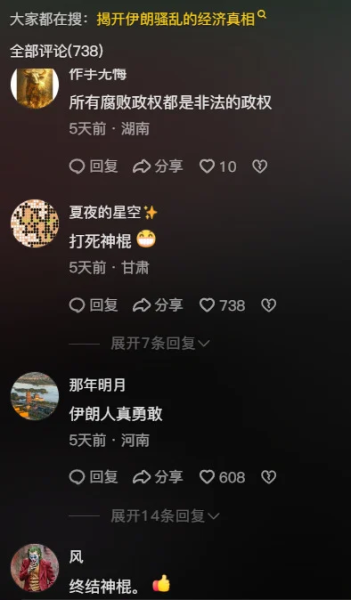
As nationwide protests in Iran enter their second week, an unexpected phenomenon has emerged on Chinese social media: Netizens in mainland China have begun overwhelmingly voicing their support for Iranian demonstrators. Comment sections beneath protest videos are filled with messages cheering on the crowds and calling for the overthrow of Iran’s supreme leader, Ali Khamenei, whom many commenters openly denounce as a “religious tyrant.”
RELATED: Merchant-Led Iran Protests Signal Deep Unrest at the End of 2025
Protests enter day 11
As of Jan. 7, Iran’s nationwide protests have entered their 11th consecutive day. The movement began on Dec. 28, 2025, when merchants at Tehran’s Grand Bazaar launched a strike over inflation and currency collapse. Since then, demonstrations have rapidly spread across major cities, drawing in shopkeepers, students, and ordinary citizens.
Protesters have clashed head-on with security forces as tensions continue to escalate. What began as an economic protest has evolved into a nationwide uprising directly targeting Iran’s ruling clerical regime.
Success
You are now signed up for our newsletter
Success
Check your email to complete sign up
Videos circulating widely on social media show demonstrators resisting security forces, chanting “Death to the dictator,” forcing police to retreat, occupying government buildings, and publicly burning portraits of Khamenei. Some protesters have reportedly taken to the streets armed. According to available reports, at least 35 people have been killed and more than 1,200 detained as of Jan. 6.
RELATED: Iran on the Brink: Protests Rage as Rial Collapses
China’s social media erupts in support
On China’s Douyin platform (a popular video-sharing and social media app), videos documenting the Iranian protests have drawn massive attention. In the comment sections, mainland netizens have expressed near-unanimous support for the demonstrators, flooding posts with encouragement:
- “Brave Iranian people, save yourselves.”
- “For the next generation to live better and with dignity, this must be done.”
- “This proves that even without guns, things can still be accomplished. Unity is strength.”
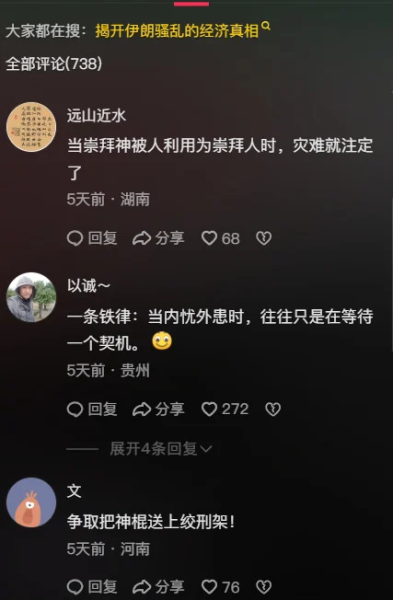
On Jan. 5, the ninth day of protests, one widely circulated protest video saw viewers repeatedly posting messages such as:
- “Go, Iranian people!”
- “We support the Iranian people!”
- “The people will win, justice will win!”
- “Liberation is coming!”
- “Interests can only be fought for by yourselves—warriors!”
- “Victory is just ahead!”
Some commentators warned bluntly that Iran’s unrest could foreshadow developments inside China itself.
Beijing moves to contain ‘contagion effect’
Political commentator Jiang Feng noted that Chinese authorities have moved quickly to suppress discussion of the protests. Keywords such as “Tehran” and “rial” have reportedly been flagged as sensitive on WeChat to prevent public association or comparison.
At the height of the protests, People’s Daily published an article citing Iranian “experts” who argued that Iran should “learn from China” and consider joining the Shanghai Cooperation Organization. Jiang described the move as “whistling in the dark” — an attempt at self-reassurance that instead reveals deep anxiety over a possible “broken-window effect.”
“If a hardline theocratic regime like Iran were to collapse,” Jiang said, “it could awaken Chinese citizens to question their own system.”
Broader implications for the CCP
Commentator “New High Ground” wrote on X that Iran demonstrates how economic hardship can instantly ignite a political powder keg. He pointed out that the Chinese Communist Party’s (CCP) own online undercurrents suggest grassroots pressure is approaching a critical threshold.
He warned that seemingly minor issues, such as tax hikes on everyday necessities, often become the final spark: “Beijing has only one response: harsher stability maintenance, denser surveillance, tighter censorship.”
He described China’s unusually muted New Year period as a visible manifestation of elite fear. “History repeatedly shows that authoritarian regimes fear internal collapse more than external pressure,” he wrote. “Iran’s street fury is sounding an alarm in Beijing. Beneath China’s surface calm, a larger storm is quietly building.”
He concluded with a warning: “If livelihood crises continue to be ignored, Iran’s present may well become China’s tomorrow.”