In the final days of 2025, the geopolitical landscape of the Middle East—and indeed the world—is experiencing a seismic shift. The once formidable theocratic rule of Iran is teetering on the brink of collapse under the extreme financial pressure imposed by the United States. The protest wave erupting at the end of 2025 has already far surpassed the 2022 “Hijab Revolution” in scale. Its driving force is no longer just social freedom, but total economic suffocation. Meanwhile, across East Asia, the Chinese Communist Party (CCP) watches Tehran with deep anxiety, fearing that the script of regime collapse triggered by inflation could soon replay in China.
Economic apocalypse: The ‘waste paper era’ of 1 USD = 1,450,000 Rials
“If you want to buy an ordinary Samsung phone in Tehran, the cash you need isn’t a few bills—it’s enough to cover the entire counter.”
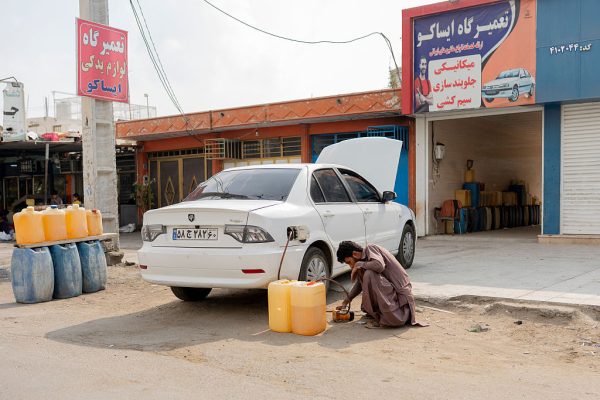
This is the magical realism of Iran in 2025. The Iranian rial has undergone a rare free-fall collapse. According to the latest black-market rates, 1 USD now exchanges for 1,450,000 rials. Compared to the 70 rials per dollar in the 1980s, the currency has lost an astonishing 20,000 times its value over 35 years.

Hyperinflation brings total social collapse
- Bank deposits wiped out: Iran’s banking system is effectively bankrupt. To salvage liquidity, banks offered 23 percent annual interest to attract deposits, but citizens would rather scatter rials on the street in protest than deposit them.
- Survival thresholds shattered: A recently retired Iranian civil servant despairingly told the camera that his planned pension “would only last 10 days” at current prices.
- Prices skyrocket: Despite being an energy-rich country, domestic gas prices have surged 60-fold. Medicine stocks are down to two months’ supply, and many elderly people face death for lack of access to drugs.
People now treat rials as garbage just to survive. Merchants, trying to preserve value, have shuttered stores because “money earned today won’t buy the same goods tomorrow; not selling is damage control.” The nation’s commercial activity has ground to a halt.
Core betrayal: Bazaari turncoat, revolutionary funding shifts
If the public’s anger is dry kindling, the defection of the Bazaari (bazaar merchant class) is the spark that ignites the revolution.
Success
You are now signed up for our newsletter
Success
Check your email to complete sign up
In Iran’s political spectrum, the Bazaari not only control two-thirds of the country’s wholesale trade but also form a traditional societal power hub. In 1979, it was Khomeini’s promise to protect their interests that secured the massive financial backing to overthrow the Pahlavi monarchy.
Today, history cruelly repeats itself. Faced with the theocratic government’s economic mismanagement and endless foreign handouts (to Hamas, Hezbollah), the Bazaari are furious.
- Allies turned enemies: Bazaar merchants, once billionaires with gold bars on display, have watched their wealth evaporate in hyperinflation. They are no longer pillars of the regime but financiers of the revolution.
- Strikes spark riots: Tehran’s Grand Bazaar has gone on full strike—not to support religious leaders, but to overthrow them. Merchants fund protesters and provide “relocation fees” to striking workers. Just as they once financed Khomeini, now they aim their resources at Hameini.
Bloody streets: ‘Iranian tank man’ and burning leader portraits
Fear has been overtaken by fury. In Tehran, Isfahan, Shiraz, and other major cities, protests have become life-or-death battles rather than peaceful marches.
- Echoing “Tank Man”: In globally shocking images, an Iranian protester stands alone in smoke-filled streets, arms outstretched, blocking fully armed soldiers and armored vehicles. Covering the retreat of fellow protesters, he creates a human shield. Dubbed the “2025 Iranian Tank Man,” he symbolizes a populace that has thrown caution to the wind.
- Extreme anger unleashed: Unlike past protests limited to chants, citizens now use homemade Molotov cocktails against giant portraits and propaganda boards of Hameini. Under authoritarian rule, this is a capital offense, but popular fury can no longer be contained.
- Royalist calls: The streets echo with the incredible slogan, “Long live the king!” Citizens recall the Pahlavi era of 1979, when Iranian women could wear bikinis, attend university, and the economy prospered. Exiled crown prince Reza Pahlavi issued a statement urging the military and law enforcement “not to oppose the people, but join them,” seen as a last warning before regime collapse.
CCP nightmare: collapse of the dictator alliance
As fires blaze in Iran, Beijing’s Zhongnanhai is gripped by a chill. Iran’s turmoil hits the CCP with a triple shock:
- “Axis of evil” broken: The CCP’s attempt to unite Russia and Iran into an anti-US alliance collapses under US financial sanctions. The US has shown that simply cutting economic lifelines (“financial nuclear strikes”) can topple a totalitarian state—an ominous warning to China, facing economic slowdown, property collapse, and local debt crises.
- Mirror maladies: Iran’s hyperinflation, pension collapse, middle-class impoverishment (Bazaari revolt), and youth unemployment are all happening or worsening in China. Images of Iranians fearlessly confronting military forces could inspire similar actions.
- Legitimacy crisis: Iran’s collapse proves that authoritarian regimes relying on force and ideological indoctrination cannot withstand economic collapse. When wallets fail, guns may rust too (as Bazaari call for military defection).

Twilight of 2025’s dictators
The U.S. government’s strategy has succeeded. Without war, precise strikes on a dictatorship’s economic lifeline have internally detonated Iran.
Students and faculty at Tehran University and Beheshti University (once party schools) have risen up; Iranian state TV even aired protest footage, showing the propaganda machine losing control. Like the prelude to the Soviet collapse, the foundations of the theocracy are rotten.
In the final three days of 2025, Iranians lit the night sky with burning rage, chanting, “Hameini must die,” “Down with dictators.” This is not only the roar of the Persian Plateau—it is a death knell ringing for all dictatorships, especially the CCP.
The world holds its breath: if Iran is today, whose tomorrow will it be?