By Yang Tianzi
Economic protests that began in Tehran two weeks ago have now evolved into a political tsunami sweeping across all of Iran. This is the largest anti-government movement since the 2022 Mahsa Amini incident, bringing the country’s healthcare system to the brink of collapse and pushing this Middle Eastern power into a dangerous intersection of domestic unrest and external military threats. When medical staff in Tehran say, “We don’t even have time for CPR,” they are describing not only the emergency room’s dire conditions but also a grim reflection of a regime facing a life-or-death moment.
‘This is not a hospital, it’s a morgue’
In Iran, which is almost completely offline, hospitals have become the only window through which the outside world can glimpse the truth. Using satellite communication, several medical staff risked their safety to reveal shocking realities to international media such as the BBC.
According to BBC reporting on Jan. 11, staff at three hospitals in Iran said their facilities are overwhelmed by the influx of dead and wounded patients, and the situation has grown increasingly severe as anti-government protests persist.
A chilling testimony from a Tehran hospital worker reads: “About 38 people have died. Many died as soon as they reached the emergency bed… Young people were shot directly in the head and heart. Many of them I couldn’t even look at—they were only 20 to 25 years old.” This pattern of “execution-style” casualties indicates that security forces have shifted from riot control to lethal suppression.
Success
You are now signed up for our newsletter
Success
Check your email to complete sign up
Conditions in the morgues are even more horrifying. In the northwestern city of Rasht, BBC Persian confirmed that 70 bodies were delivered to Poursina Hospital on Friday night alone. The morgues are overcrowded, forcing bodies to be stacked, even spilling into prayer rooms. Outrageously, authorities are reportedly demanding families pay 7 billion rials (around $7,000) as a “redemption fee” to retrieve their loved ones’ bodies—effectively inflicting a second blow on bereaved families in an economically collapsed nation.
A doctor at Tehran’s Farabi Hospital, a major ophthalmology center, told the BBC via satellite link that the hospital has entered “crisis mode,” suspending all non-emergency admissions and surgeries. This starkly reflects a brutal reality: security forces are firing shotguns at protesters’ faces, causing widespread eye injuries and permanent blindness.
Escalating crackdown: from tear gas to live ammunition
Medical testimonies reveal a shift in the security forces’ suppression methods. Unlike previous crackdowns that relied mainly on tear gas or rubber bullets, live ammunition is being used on a much larger scale. Multiple doctors confirmed that the gunshot injuries they are treating come from both live rounds and shotgun pellets, many targeting the head and chest, resulting in fatal wounds.
A physician in Kashan reported that during Friday night unrest, he and colleagues across the city treated many eye injuries caused by bullets. A doctor at a Tehran medical center described an even grimmer scene: “I saw a patient shot in the eye, the bullet exiting the back of the skull. Around midnight, a group broke in, dropped in a gunshot victim, and left. But it was too late—he was already dead upon arrival.”
Gen Z awakens
One striking feature of this protest is the key role played by Iran’s Generation Z. An eyewitness in Tehran told the BBC that young people not only took to the streets themselves but actively encouraged parents and elders to join, telling them, “Don’t be afraid.” Such cross-generational political mobilization is rare in Iranian history and gives the movement a broader social base.
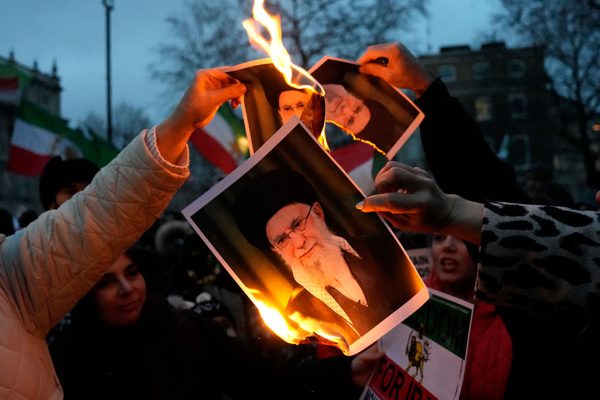
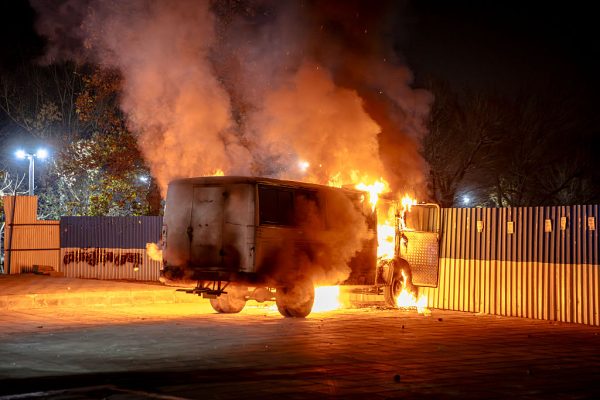
Protests have spread to over a hundred cities and towns across all Iranian provinces, from major metropolitan areas to smaller urban centers. Recent footage shows Tehran protesters taking to the streets Friday night in large numbers, setting vehicles on fire and torching government buildings near Karaj, outside the capital. Human rights organizations estimate at least 116 deaths and over 2,600 arrests, while 14 security personnel have also died.
Khamenei responds: ‘We will never back down’
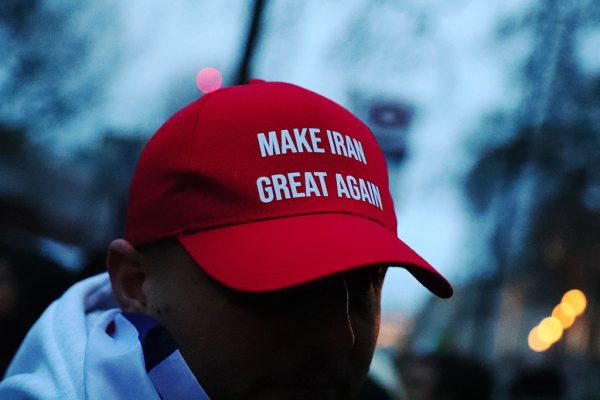
Facing uncontrollable street unrest, Iran’s authorities have intensified repression and blamed foreign forces. Supreme Leader Ali Khamenei stated on television: “The Islamic Republic was built on the blood of hundreds of thousands of honorable people. We will never back down in the face of those who deny this.” He labeled the protesters as “destructive elements” seeking to “please the U.S. president.”
Parliament Speaker Mohammad Bagher Qalibaf issued even more direct threats. Amid chants of “Death to America!” by lawmakers, he warned that if the U.S. attacks Iran militarily, Tehran would retaliate, listing Israel and U.S. bases in the Middle East as “legitimate targets” and not ruling out “preemptive strikes.”
US-Iran military confrontation: from threats to the brink of war
U.S. President Donald Trump recently stated on social media: “Iran is pursuing freedom in a possibly unprecedented way. The U.S. is ready to assist!” He also warned that if Iran’s leadership “starts killing people,” the U.S. will “deliver a very severe strike.”
According to reports in The Wall Street Journal and other U.S. media, Trump has reviewed options for military strikes against Iran but has not made a final decision. While clarifying that he will not “deploy ground troops,” the credibility of his threat is bolstered by last year’s U.S. airstrikes on Iranian nuclear facilities. The State Department issued a blunt warning: “Do not play games with President Trump. When he says he will act, he will act.”
U.S. Secretary of State Rubio held emergency talks with Israeli Prime Minister Netanyahu, with Israel raising its alert level in anticipation of potential conflict. Any direct military clash between the U.S. and Iran could engulf the entire Middle East in war.
EU supports protests, condemns violent suppression
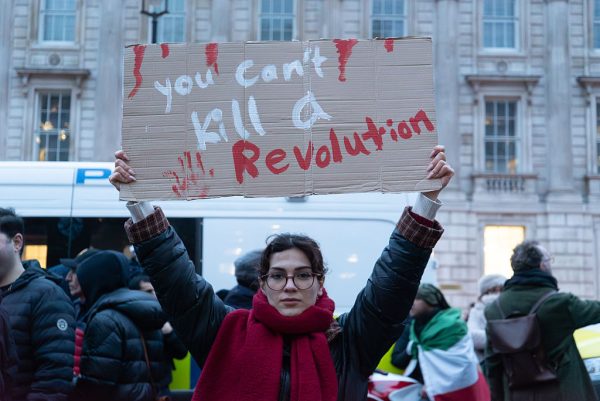
International reactions are divided. EU Commission President Ursula von der Leyen expressed support for Iranian protesters and condemned violent repression. French President Macron, UK Prime Minister Sir Rishi Sunak, and German Chancellor Olaf Scholz issued a joint statement urging Iranian authorities to “allow freedom of speech and peaceful assembly without fear of retaliation.”
UN spokesperson Stéphane Dujarric expressed deep concern over the loss of life, emphasizing that people everywhere have the right to peaceful protest. However, in a nearly completely offline Iran that bars foreign journalists, international diplomatic pressure has limited impact.
The Iranian government accuses the U.S. of turning peaceful protests into “violent subversion and large-scale destruction,” while the U.S. State Department calls this “a ridiculous attempt to distract from the regime’s challenges.”

Protests exceed 2022 scale
These protests are described as the broadest uprising since the 2022 Mahsa Amini incident. At that time, nationwide demonstrations erupted after 22-year-old Kurdish woman Mahsa Amini died while in the custody of the morality police. Human rights groups reported over 550 deaths and 20,000 arrests.
Compared to 2022, this movement shows several new characteristics: it has deeper economic roots, reflecting the devastating effects of long-term sanctions and government corruption; it spans all provinces geographically; and cross-generational mobilization gives the movement a wider social base.
Former UK ambassador to Iran, Sir Geoffrey Adams, called it a “broader movement than before,” but cautioned that Iran lacks an organized opposition and the people have no cohesive alternative leadership. He warned that discussions of regime change “should not get ahead of reality.”
Multiple uncertainties
Iran’s future is highly uncertain. Key variables will determine the trajectory:
- Intensity and duration of repression – Continued use of live ammunition will escalate casualties and deepen social fractures, possibly temporarily silencing protests but sowing seeds for larger explosions.
- Internal divisions in military and security forces – Factions unwilling to fire on civilians could dramatically shift the situation. Conversely, a fully obedient security apparatus gives the regime significant suppressive capacity.
- Feasibility of opposition alternatives – The exiled son of the last Shah, Reza Pahlavi, has called for “preparing to seize and control city centers,” but his domestic influence is limited. As political activist Taji Rahmani said, “Any lasting change must come from Iranians themselves, not external intervention.”
- Degree of international intervention – The U.S. has military options on the table, while Iran threatens attacks on U.S. and Israeli bases. Any miscalculation could merge internal turmoil with regional war, placing ordinary Iranians in double jeopardy.
Iran at a bloody crossroads
In Tehran’s blacked-out nights, the flickering lights of emergency rooms illuminate the young protesters’ shattered faces, mirroring the country’s uncertain fate. Stacked bodies in morgues, corpses in prayer rooms, grieving families forced to pay exorbitant fees—these harrowing scenes are not only footnotes to a political crisis but bloodied testimony to human dignity facing authoritarian violence.
For many Iranians, this is not merely a protest but a final wager on whether a future exists. For the regime, this is not just a wave of unrest but a stress test of its ability to continue ruling as before.
Amid medical staff crying, “We don’t even have time for CPR,” young people shouting, “Don’t be afraid,” and international diplomacy marked by caution and complexity, Iran stands at a historic crossroads. Will it slip further into dictatorial abyss, or begin a painful path toward democratic transition? No one can say for certain. The only certainty is that each day of delay increases the cost for this ancient civilization, making the consequences heavier and harder to reverse.