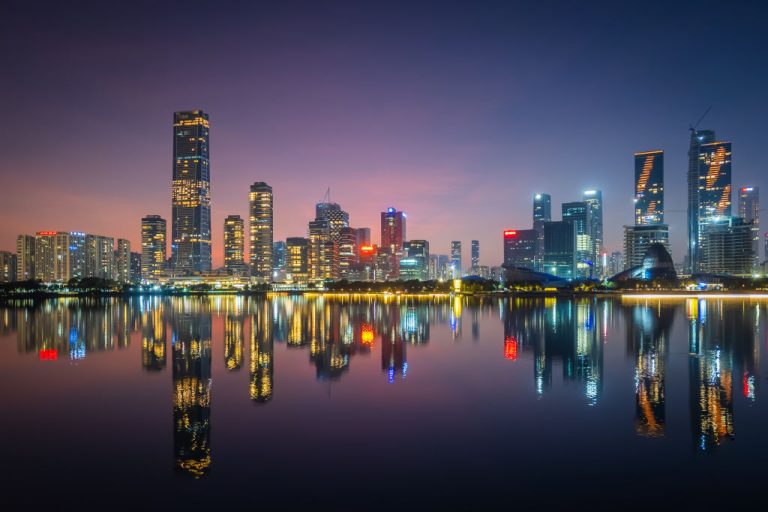
Once crowded with people and clogged with traffic, Shenzhen’s streets now feel eerily still—as if someone has pressed a pause button on a city that was never meant to slow down.
The collapse is most visible in the city’s hotel industry, which is undergoing a severe and accelerating wave of closures. Early warning signs appeared in 2023, intensified in 2024, and worsened dramatically in 2025. The damage has not been confined to budget or mid-range hotels. Even five-star luxury properties have failed to escape. The Tianjin Ritz-Carlton, the Shanghai Bulgari Hotel, and the Beijing Jinmao Westin Grand Hotel have all announced closures or entered bankruptcy restructuring.
According to industry accounts, some of these hotels were cut off from electricity after accumulating long-term rent arrears—an extreme measure taken directly by landlords. At this point, it hardly matters whether the security guards who appeared on site represented the property owner or the hotel itself. What is truly painful is watching hotel after hotel—projects that once absorbed enormous capital and were managed with care—forced to shut their doors. In Shenzhen today, closures are no longer isolated incidents. They are becoming a contagion.
In earlier years, the first hotels to fall were older properties with outdated facilities and declining competitiveness. But beginning this year, the pattern has shifted. Increasingly, the hotels being forced out of business are newly opened—less than five years old—often mid- to high-end projects with investments running into the hundreds of millions of yuan.
Many people ask the obvious question: how can such new, well-funded hotels fail so quickly?
Success
You are now signed up for our newsletter
Success
Check your email to complete sign up
The answer is simple. These businesses are not choosing to exit; they are being pushed out. In most cases, landlords cut off utilities to force rent payments. And the deeper reason rents went unpaid lies in contracts signed years earlier, when expectations were wildly inflated.
In 2018 and 2019, Shenzhen experienced the most frenzied period in the history of its mid- to high-end hotel market. At the peak, some projects saw average daily room rates speculated up to more than 800 yuan—pushing the industry beyond what operators themselves called its “ceiling.” Nearly everyone believed that the next boom would come from upscale hotels and that China’s consumption upgrade would last indefinitely. Individual investors piled in. Major hotel groups followed.
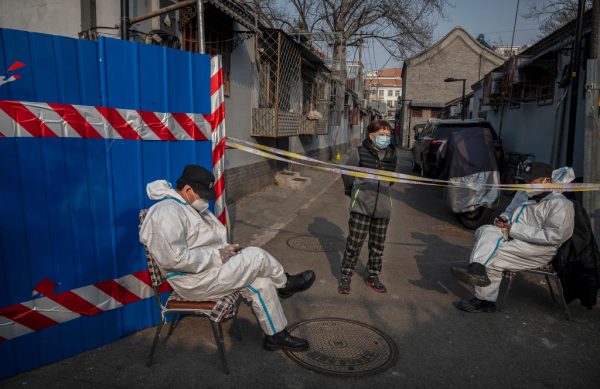
Then came the pandemic
Then came three years of pandemic disruption. Room prices stagnated while costs remained fixed. Operating pressure became unbearable. One by one, hotels were forced to surrender.
Industry insiders say this collapse cannot be separated from China’s prolonged real-estate downturn. High-end hotels depend heavily on business travel and luxury consumption—both of which have shrunk sharply. Occupancy rates have fallen. Revenues have plunged. Years of rapid expansion, combined with high fixed costs and contracting demand, have pushed even well-known brands into distress.
This wave of closures reflects not only the cyclical risk of the hotel industry, but also the deeper impact of China’s economic slowdown on its service sector. In the coming years, insiders predict that only hotels with strong cost control, prime locations, and highly refined operations are likely to survive.
A Shenzhen-based blogger has issued a blunt warning to business owners: do not rush in just to lose money.
Recently, the Yifei Hotel in Nanshan Science and Technology Park suspended operations and was put up for transfer. According to reports, it owes more than 8 million yuan in unpaid rent, while the transfer fee alone exceeds 10 million yuan. The blogger noted that the project is genuinely regrettable. Aside from location issues, crushing rent levels made sustainable operation nearly impossible.
The blogger drew a broader lesson. For leased properties, profits must come entirely from operations—you must earn back renovation and upfront investment costs through daily business. Self-owned properties, by contrast, can survive even with modest operating performance. As long as they do not lose money, owners still receive stable rental income. The advantage of ownership is simple: it preserves cash flow and prevents total loss.
Elsewhere in Shenzhen, another symbolic closure has sent shockwaves through the retail world.
At Nanshan Coastal City—a shopping district once celebrated as a showcase for China’s new tea-drink boom—Naixue Life’s first national flagship store has officially closed. On opening day, crowds and media attention created a moment of glory. But business, in the end, is not about spectacle. It is about whether popularity can be converted into steady cash flow.
“At the time, the flagship effect and Naixue’s tens of millions of members drove massive foot traffic,” said a tenant who asked not to be named. “Lines were long. But in practice, shared traffic didn’t translate into shared profits. Operating costs were high, and we simply couldn’t make money.”
Naixue did not provide a direct explanation for the closure. Mall operators said the lease had expired and was not renewed. When asked whether the brand would open another store elsewhere in the mall, they declined to comment.

Not an isolated case
The blogger emphasized that this failure is not an isolated case. It reflects both a deep restructuring of China’s new tea-drink industry and a basic truth of commerce: chasing foot traffic while burning cash on high rents creates only the illusion of prosperity. Losses remain losses.
The core of business is not foot traffic, but cash flow; not exposure, but conversion; not gimmicks, but profit.
Yet many companies remain trapped in dangerous illusions—that government subsidies will save them, or that investor money will never run out. Foot traffic without conversion is self-indulgence. Hype without profit is self-destruction. Subsidies without a closed-loop business model lead, inevitably, to collapse.
Even famous snack brands have not been spared.
“Look behind me,” one observer says. “Xiaobage Chongqing Noodles—a national chain with 1,600 stores—has gone bankrupt. This location is prime, right next to a subway entrance.”
This kind of commercial failure is no longer confined to retail. It is spreading into Shenzhen’s housing market and asset economy.
More than a thousand tenants have been forcibly evicted with little warning—living in their homes one day, homeless the next. Bo’yu (泊寓), one of the most prominent long-term rental brands under the state-linked Vanke system, has launched eviction actions across at least 13 districts, including Fuyong, Qinghu, Meilin, and Bantian.
Rents had been locked in at peak levels. By 2025, the housing market collapsed. Shenzhen’s private rental prices fell year-on-year by as much as 12 percent—well below acquisition costs. Even high-quality properties began hemorrhaging cash. A single Bo’yu project could lose 200,000 yuan per month if occupancy dropped below 85 percent. In 2024, Bo’yu Shenzhen still posted profits of 32 million yuan. In the first eleven months of 2025, it recorded losses of 89 million yuan.

Tenants were offered ‘choices’
Officially, tenants were offered “choices”: move out immediately with one month’s rent as compensation, or remain by signing new contracts directly with landlords and receiving one month of free rent. In practice, many tenants say these promises were not fully honored.
Bo’yu customer service insists that only a small number of properties are affected and that tenant rights are protected. But tenants have documented delayed approvals and opaque compensation processes. Complaints against other platforms, including Mofang Apartments, allege technical blocking and information suppression, deepening distrust.
From 2023 to 2025, housing-rental complaints exceeded 14,000 cases nationwide, with a resolution rate of just 11.83 percent. Long-term rental platforms rely on short-term capital pools to sustain long-term leases. When rents fall or occupancy declines, collapse becomes inevitable. The recurring cycle of eviction, contract replacement, and rent reduction now unfolding across Shenzhen is the market forcibly correcting a distorted model.
Even industry leaders are no longer safe. The aftershocks of the 2020 Eggshell Apartment collapse have not fully faded. Recently, Mofang Apartments has again shown signs of distress, with reports from Guangzhou alleging that some branches collected rent from tenants while failing to pay landlords for extended periods.
These events point to a deeper shift. Young people are no longer flooding into China’s top-tier cities. According to a 2025 survey of graduating students, the share choosing first-tier cities as their top destination fell from 29 percent to 26 percent. Interest in so-called “new first-tier” cities also declined. Meanwhile, preference for second-tier and smaller cities jumped to 34 percent.
This demographic shift directly impacts urban rental markets. When population inflows slow, business models dependent on constant growth and high occupancy come under immediate strain. The downturn in big-city rental markets is not a temporary fluctuation—it is the inevitable result of changing population expectations, employment choices, and economic realities.
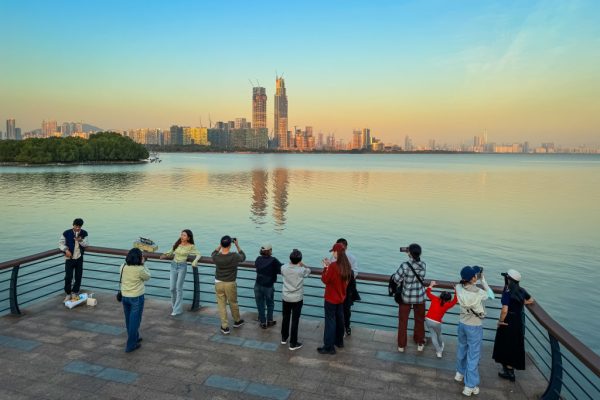
Investment risks are also surfacing
Jinya Fu Holding, a company ranked among China’s top 500 enterprises, now stands empty at its Shenzhen headquarters. Financial products issued through its closely linked entity, Boyao Chuangjin Guarantee Investment, have collapsed, leaving thousands of investors wiped out.
Despite record-high gold prices, Jinya Fu—a gold conglomerate with annual revenues of 50 billion yuan—suddenly failed to honor redemptions on its wealth-management products. Investors were drawn by promised returns of 8 to 14 percent and claims of bank backing. Nearly 4,000 people are affected. Some mortgaged their homes, investing millions.
Investigations suggest that Jinya Fu’s cash flow was not driven by jewelry sales, but by so-called “gold entrusted wealth-management” products. The structure appeared compliant but concealed serious risks. Investors purchased physical gold on paper—without taking delivery—then entrusted it to an affiliated company for “cultural gold” investment. Funds were not used as advertised, but diverted into long-cycle real-estate projects, some now stalled. Management overlap between companies created a closed loop of self-financing and self-use, leading to catastrophic maturity mismatches.
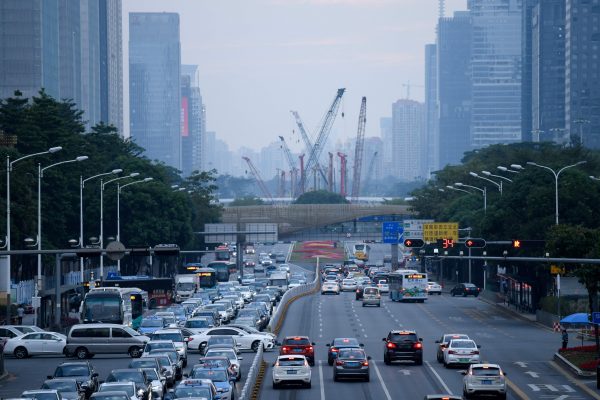
Industrial shocks are also emerging
“What happened to Shenzhen?” one resident asks. “Even the largest foreign-funded factory in Shajing has quietly left.” At its peak, the factory employed more than 30,000 workers. Entire streets depended on its presence. Established in 1982, it operated for over four decades. With its departure, the neighborhood fell silent.
Is industrial upgrading really eliminating manufacturing altogether?
What Shenzhen is experiencing today does not mean the city has failed. It means a development model has reached its limits. Shenzhen is simply confronting—earlier than most—the costs other cities may soon face.
For years, local governments depended heavily on land sales and real estate, pushing rents and asset prices far beyond what the real economy could support. Quasi-financial products flourished in regulatory gray zones, pulling household savings into high-risk cycles. Long-term rentals, industrial parks, and themed commercial districts were rapidly replicated under policy endorsement but without true market testing.
Everything appeared legal, compliant—even encouraged. But when the macroeconomic tide turned, responsibility vanished. When systems are better at promoting expansion than admitting error, and more focused on stability narratives than risk warnings, the burden ultimately falls on ordinary business owners, investors, and tenants.