By Li Muzi
India’s outbreak of the Nipah virus—a zoonotic pathogen with a fatality rate as high as 75 percent—has sent shockwaves through China. Multiple healthcare workers have been infected, quarantine orders are expanding, and public fear is spreading faster than official reassurances.
Chinese Communist Party (CCP) state media insist that no Nipah cases have been detected on the mainland. Online, however, the response has been anything but calm. Many Chinese netizens openly question whether this outbreak could spiral into another global catastrophe—while others point to a darker, unresolved issue: whether the CCP itself has been studying Nipah virus for military use.
West Bengal outbreak hits medical staff first
According to reports from CCP state media outlets including Xinhua News Agency, Red Star News, and Jiemian, at least five confirmed Nipah virus cases have been identified in India’s West Bengal state. Nearly 100 people have been ordered into home isolation.
The virus’s incubation period typically ranges from 4 to 14 days, but can extend up to 45 days—an epidemiological red flag. There is no approved vaccine and no effective antiviral treatment.
Success
You are now signed up for our newsletter
Success
Check your email to complete sign up
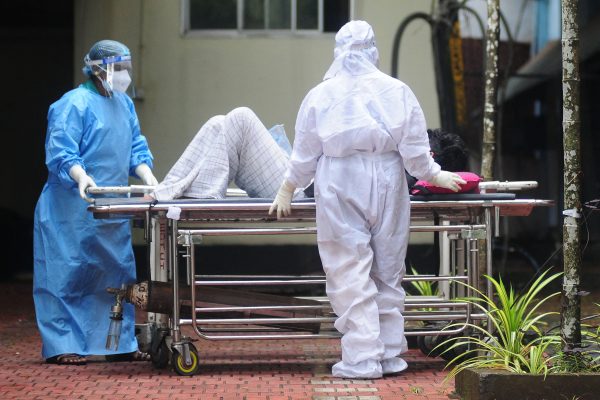
The infections are concentrated near Kolkata, West Bengal’s capital. The virus was first detected in a nurse at a private hospital, followed by three additional healthcare workers. One patient has deteriorated into critical condition and is reportedly in a coma.
A West Bengal health official said that two of the earliest confirmed cases were medical staff who likely contracted the virus from a patient with severe respiratory symptoms. That patient died before Nipah testing was conducted.
China tightens border controls—but trust Is thin
China has not reported any Nipah cases. Under revisions to the Frontier Health and Quarantine Law enacted last year, Nipah virus is now classified alongside COVID-19, HIV/AIDS, Zika, and chikungunya as a quarantinable infectious disease.
The law authorizes customs officials to impose immediate on-site containment measures for confirmed or suspected cases and to notify local disease control authorities.
Yet for many Chinese citizens, legal revisions offer little reassurance. Memories of COVID-era censorship, delayed disclosures, and coercive lockdowns remain raw.
Why Nipah terrifies epidemiologists
Nipah virus infection often begins with flu-like symptoms: fever, headache, muscle pain, and fatigue. Respiratory symptoms—cough, shortness of breath, and pneumonia—may follow.
The most feared complication is encephalitis. Patients can develop confusion, altered consciousness, seizures, and fall into a coma within 24 to 48 hours.
The World Health Organization describes Nipah as a highly lethal zoonotic virus carried primarily by fruit bats. Humans may be infected through contaminated fruit, intermediate hosts such as pigs, or direct human-to-human transmission via droplets and saliva. Fatality rates range from 40 to 75 percent.
Chinese netizens: ‘this feels uncomfortably familiar’
The outbreak has triggered an explosion of fear, sarcasm, and suspicion on China’s tightly monitored internet.
“Is this going to be another COVID? This is terrifying,” one user wrote. Another asked bluntly: “Will people born in the 1980s even get to die of old age?”
Others focused on zoonotic risk. “People can be quarantined. Animals can’t,” one comment read. “Once humans and animals mix, control is basically impossible.”
Some responses veered into bitter cynicism. “Same timing, same script, same panic,” one user wrote. Another dismissed official explanations outright: “Fruit bats, civets—it’s all a cover. Human schemes are far more dangerous.”
The virus’s long incubation period intensified panic. “Forty-five days,” one comment warned. “By 2026, hundreds of millions could be dead.”
On X (formerly Twitter), overseas Chinese users were even more caustic. “This isn’t an outbreak—it’s the Grim Reaper personally issuing summons,” one post read. Another wrote: “With this death rate, it’s no different from chemical weapons.”
Allegations: CCP studied Nipah as a weapon
These fears intersect with long-standing allegations that the Chinese Communist Party has explored weaponizing viruses.
According to a June 15, 2024 report by The Epoch Times, U.S. physician-scientist Dr. Steven Quay said the SARS outbreak of the early 2000s taught the CCP a strategic lesson: viruses could be weapons.
Quay, a former Stanford University School of Medicine faculty member and current CEO of Atossa Therapeutics, stated that the CCP “began to view viruses as potential biological weapons.”
He said evidence indicates that Nipah virus research has been conducted in China, including work linked to the Wuhan Institute of Virology. Quay warned that if Nipah were engineered for efficient human-to-human transmission, the result would be catastrophic.
After the Wuhan Institute of Virology released early COVID-19 patient testing data in December 2019, Quay identified 20 cross-contamination signals associated with the lab. Among all viruses in the dataset, only Nipah resulted in no published paper.
‘Synthetic handles’ and treaty violations
Quay said the Nipah virus strains he examined contained synthetic biology “handles” capable of moving genes—tools commonly used to create infectious clones.
“This violates every biological weapons convention,” he said.
Dr. Sean Lin, former director of the viral research laboratory at the U.S. Army’s Walter Reed National Military Medical Center, echoed those concerns. He warned that Nipah’s neurological effects—severe brain damage without immediate death—make it uniquely suited for further transmission.
“That makes it a better biological weapon,” Lin said. “This is precisely why the CCP is so interested in Nipah.”

Wuhan, Winnipeg, and unanswered questions
According to NTD Television, Chinese virologist Qiu Xiangguo—dismissed from Canada’s National Microbiology Laboratory in Winnipeg in 2021—previously transported Nipah virus samples to the Wuhan Institute of Virology.
After returning to China, Qiu’s name appeared as an inventor on a Nipah virus antibody patent filed by the Wuhan institute.
For many observers, these connections raise questions Beijing has never convincingly answered.