By Li Deyan, Vision Times
According to Chinese media reports, the downfall of Chinese Communist Party (CCP) Central Military Commission Vice Chairman Zhang Youxia may have been foreshadowed well before his official removal. On Jan. 24, Zhang Youxia and Joint Staff Department Chief Liu Zhenli were officially placed under official investigation for “misconduct” and removed from their posts, effective immediately.
But an unusual development suggests preparations may have been underway earlier: The long-vacant post of Beijing Garrison Commander appears to have been quietly filled before Zhang and Liu’s downfall.
At the CCP’s Fourth Plenum military mobilization meeting, Zhang’s rhetoric carried the unmistakable aura of someone “acting like a king within the military.” But just two months later, signs of political danger had already begun to surface.
RELATED: Xi Jinping’s Military Purge Reaches the Apex of Power
A change in leadership
Success
You are now signed up for our newsletter
Success
Check your email to complete sign up
On Feb. 4, state media “Caixin” cited a report from the Beijing Daily stating that Major General Chen Yuan attended a Jan. 14 expanded plenary meeting of the Beijing Garrison Party Committee “in the capacity of a Beijing Garrison leader.”
Beijing Party Secretary and First Party Secretary of the Garrison, Yin Li, addressed the meeting, while Political Commissar Zhu Jun outlined the city’s so-called “Party control over armed forces” work. Though the report did not specify Chen Yuan’s exact title, standard practice strongly suggests he was filling the Beijing Garrison commander position, which had been vacant for nearly a year.
Public records show Chen Yuan, born in August 1972 in Dongtai, Jiangsu, spent most of his career in the Armed Police system. He previously served as deputy commander of the Jiangsu Armed Police Corps, president of the Armed Police NCO Academy, and was promoted in 2021 to commander of the Guangxi Armed Police Corps, receiving the rank of major general. By January 2023, he was serving as commander of the Shanghai Armed Police Corps before recently transferring to Beijing.
Observers have paid close attention to this appointment because of speculation that it is closely linked to the purge of Zhang Youxia and Liu Zhenli. The timing is also striking. Chen was already attending meetings as a Beijing Garrison leader by Jan. 14, meaning the reassignment likely occurred before Zhang and Liu were detained. Why, then, was it only indirectly disclosed on Feb. 4? Analysts suggest Jan. 14 was politically sensitive, falling just days before Zhang and Liu were reportedly seized.
Ongoing power struggle
The indirect disclosure on Feb. 4 coincided with the CCP’s 20th session of the National People’s Congress Standing Committee in Beijing. That day, authorities revoked the representative status of several figures, including former aviation industry chairman Zhou Xinmin. Notably, however, the Standing Committee did not remove Zhang Youxia or Liu Zhenli’s delegate status, suggesting that behind the scenes, Xi Jinping and opposing factions may still be locked in struggle.
The previous Beijing Garrison commander was Fu Wenhua, long considered one of Zhang Youxia’s protégés. Fu assumed the post in April 2020 and later became a standing member of the Beijing Party Committee. In March 2025, Fu was then transferred to deputy commander of the Armed Police and promoted to lieutenant general. By October 2025, he became deputy commander of the Army.
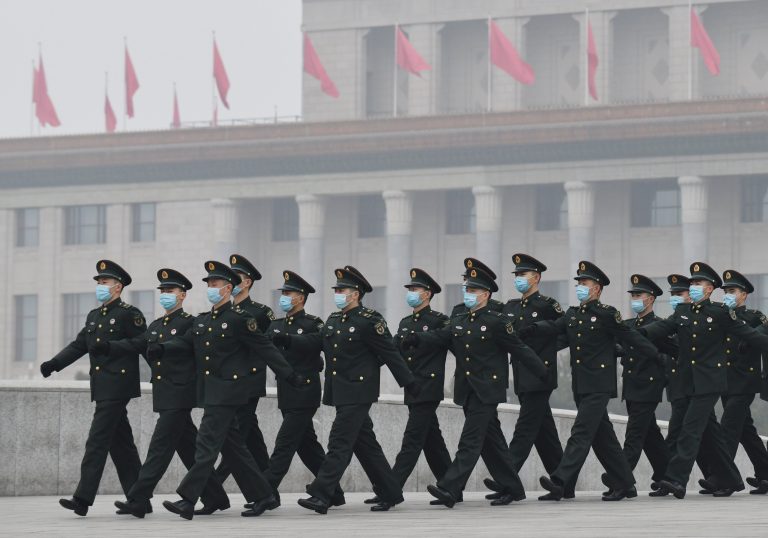
Though framed as a promotion, Fu’s reassignment moved him away from Beijing’s political center. Afterward, the Beijing Garrison commander position remained unusually vacant for nearly a year. The Beijing Garrison, sometimes called the CCP’s “imperial guards,” is responsible for securing Zhongnanhai and safeguarding the regime’s core leadership. In wartime, it would also cover the top leadership’s retreat. As one saying goes, controlling the Beijing Garrison is tantamount to holding “half of Beijing.”
This has fueled speculation that Xi Jinping removed Zhang’s loyalists well in advance and installed Chen Yuan as a trusted figure just before moving against Zhang. Commentator Li Linyi noted that factional competition over control of the Beijing Garrison has been fierce, and whoever holds the commander post serves as a key indicator of internal military power shifts.
Signs of turmoil
Military commentator Mark argued that Chen’s appointment before Zhang’s arrest shows Xi placed “reliable people” in command ahead of the purge. Mark further claimed that Chen’s earlier Shanghai post has drawn rumors surrounding the sudden death of former Premier Li Keqiang in October 2023. Although such claims cannot be confirmed, Mark suggested Chen faced no accountability and instead rose further, implying Xi may have viewed him as loyal.
Mark concluded that Xi’s goal was clear: If Zhang resisted arrest with loyal guards, the Central Guard Bureau might not be sufficient, making the Beijing Garrison a decisive backup force. Bringing Chen to Beijing was effectively having him “guard the gate.”
Taiwan defense analyst Shen Ming-shih linked the Beijing Garrison reshuffle to CCP factional warfare, suggesting Chen may belong to the faction of former vice chairman He Weidong. Shen also noted that several Armed Police figures connected to Zhang have disappeared from public view, including acting Armed Police commander Cao Junzhang, who was absent from a December 2025 promotion ceremony.
By late 2025, Zhang appeared to be the only military leader remaining in the Politburo, and his posture at the Fourth Plenum mobilization meeting was widely seen as “acting like a king within the military.” Yet the mysterious disappearance of his associate Cao only two months later indicated Zhang’s position was already precarious.
Commentator Du Zheng argued that Zhang’s influence extended beyond the military and was backed by CCP elders. Xi Jinping, fearing that Zhang’s growing stature could threaten his leadership at the 21st Party Congress, saw Zhang’s removal as a critical “power struggle red line.”
Editorial note: This article is based on publicly circulating reports and commentary from independent analysts. The claims described have not been independently verified by Vision Times, and relevant authorities have not publicly confirmed the allegations.