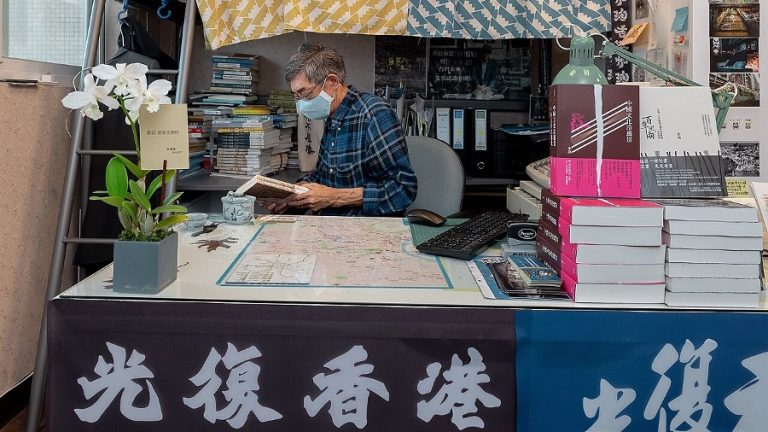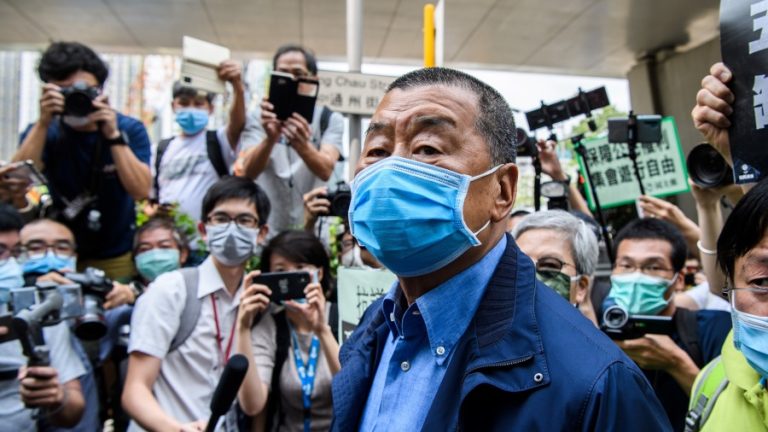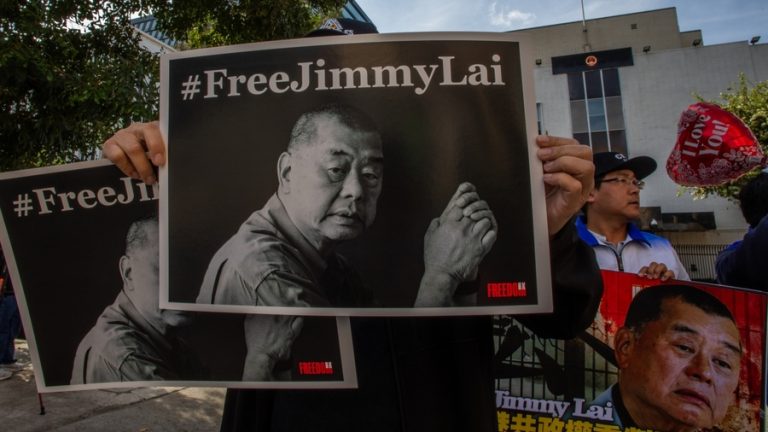
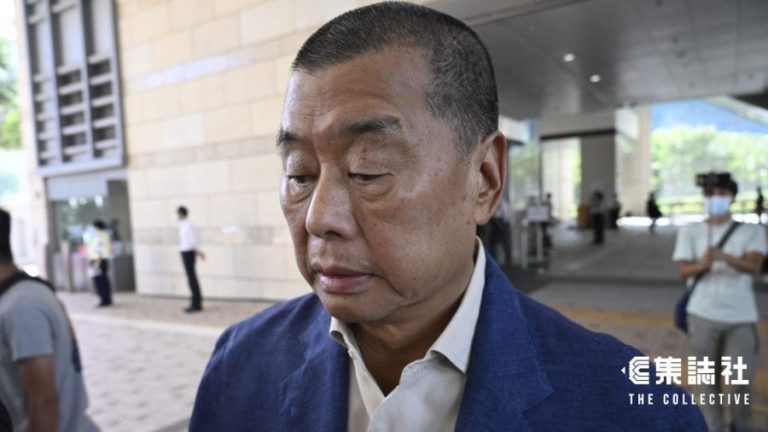
Hong Kong courts are scheduled to sentence Jimmy Lai, the 78-year-old founder of Apple Daily and a British national, on Feb. 9 under the Hong Kong National Security Law (NSL). The court has allocated just one hour for the proceeding.
Few observers believe the outcome remains in doubt. The three handpicked national security judges are widely expected to impose life imprisonment, the harshest penalty available under the law. Since the NSL was imposed by Beijing in 2020, no prosecution has carried greater political weight—or clearer intent.
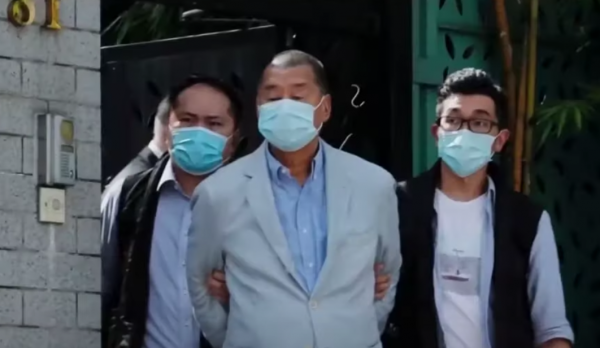
Lai was convicted on Dec. 15, 2025, of “collusion with foreign forces” and “sedition,” charges that critics argue criminalize journalism, advocacy, and peaceful political expression. He refused to submit any plea in mitigation. Several former Apple Daily executives and opinion writers were convicted alongside him after pleading guilty to a single count of “collusion.”
Legal observers have repeatedly noted that the trial bore little resemblance to a normal criminal process. From its compressed timetable to its circular evidentiary logic and foregone conclusion, the case functioned as a political sentencing exercise, not an adjudication of facts.
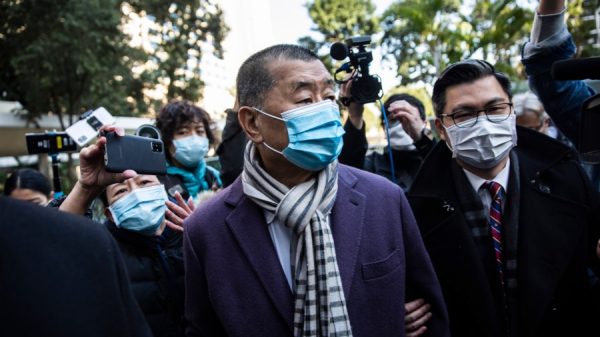
Britain’s citizen, Beijing’s prisoner
The case has generated sustained international reaction, particularly in the United Kingdom, where it has evolved into a test of whether British citizenship carries any real protection when confronted with Chinese political power.
Success
You are now signed up for our newsletter
Success
Check your email to complete sign up
Members of Parliament from across party lines have openly criticized Prime Minister Keir Starmer for failing to secure any concrete assurances for Lai during his recent visit to China. The silence, critics argue, signals acquiescence.
Speaking in Parliament, Lai’s son Sebastien Lai framed the issue as a moral reckoning for Britain itself. His father’s imprisonment, he said, is not merely a legal injustice but a repudiation of the democratic values Britain claims to defend. “What is being locked away is not only my father,” he said. “It is Britain’s values.”
British media scrutiny has extended beyond government. The Times reported that multiple major international law firms—firms that publicly advertise commitments to human rights—sent senior partners to accompany officials on China visits while remaining conspicuously silent on the Lai case. The contrast has been widely condemned as an institutional double standard.
US support, and the limits of symbolism
In the United States, expressions of support have grown louder but remain largely symbolic. Former House Speaker Nancy Pelosi described Lai as “a defender of democracy imprisoned for printing the truth.”
Congress has advanced a resolution designating Dec. 8, 2025, as “Jimmy Lai Day,” calling for the release of all Hong Kong democracy advocates jailed for political reasons and reaffirming support for press freedom and democratic norms.
Yet among Hong Kong activists and legal observers, the unresolved question is whether Washington is willing to move beyond resolutions and rhetoric to actions that impose real costs.
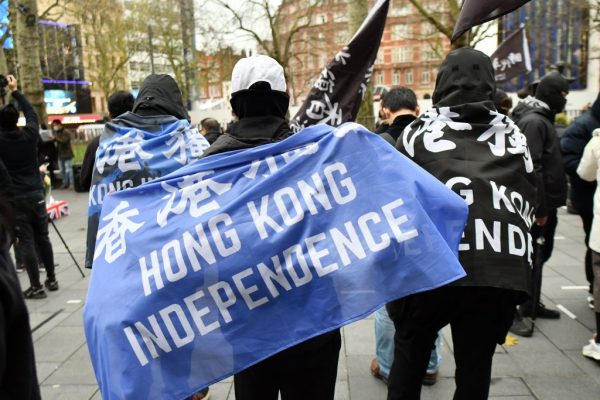
Hong Kong under total chill
Inside Hong Kong, the consequences of the Lai prosecution are already unmistakable. Multiple democracy-related cases remain pending. Student unions, civic groups, labor organizations, and advocacy networks have disbanded in waves. Independent media outlets have been prosecuted, shuttered, or forced into exile.
The chilling effect is no longer emerging—it is complete.
Analysts warn that the Lai sentence will not merely close a chapter but formalize a new reality: Hong Kong’s transformation from a city governed by law into one governed by political discipline.
As sentencing approaches, human rights organizations have urged governments to take clearer positions. But even supporters concede that the case has already become the most definitive indicator yet that “one country, two systems” has collapsed in practice.
Overseas Hong Kong groups: justice has been replaced by obedience
Overseas Hong Kong organizations interviewed by Vision Times (Kan Zhongguo) described the Lai case as unmistakable proof that Hong Kong’s judiciary now operates under political command.
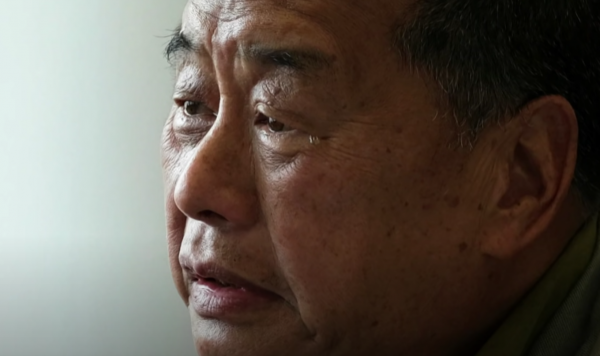
Wong Koon-nang, president of the Hong Kong-Canada Alliance, said the trial and impending sentence amount to an official declaration that judicial independence no longer exists. The message to society, he said, is blunt: journalism, dissent, and independent thought are intolerable.
Wong noted that despite Lai’s British citizenship, expectations of meaningful intervention from London have largely vanished. “There have been international voices of concern—even condemnation,” he said. “But there has been no action. The Chinese Communist Party has clearly decided on a heavy sentence. The outlook is bleak.”
‘Law violating law:’ a constitutional rupture
Keung Ka-wai, Speaker of the Hong Kong Parliament-in-exile, described the Lai case as “conclusive evidence” that Hong Kong has lost all judicial independence.
He argued that the city has entered a phase in which executive power overrides the courts, and that both the National Security Law and Article 23 of the Basic Law—the local national security legislation enacted in 2024—directly contradict the Basic Law’s original guarantees of press and speech freedom.
“In legal terms,” Keung said, “this is new law negating constitutional law—law violating law.”
He emphasized that the case functions as internal intimidation, aimed at silencing media and civil society. In democratic systems, the press exists to scrutinize power. The Lai prosecution, he said, demonstrates that the Chinese Communist Party is systematically dismantling Hong Kong’s institutional and moral foundations.
A conveyor belt of political trials
George Liu, secretary-general of the Toronto Alliance in Support of Patriotic Democratic Movements of China, stressed that the Lai case is not exceptional but part of a systematic campaign of political prosecutions.
From the Stand News case to prosecutions involving the Hong Kong Alliance, Chow Hang-tung, Lee Cheuk-yan, and others, Liu said the judiciary has been repurposed as a mechanism of political enforcement. “This system no longer serves justice,” he said. “It serves power.”
The result, Liu noted, is a transformed society: media dismantled, civil organizations erased, unions dissolved, political parties eliminated. Despite repeated statements from the UK, Canada, and the United States, no intervention has meaningfully altered this trajectory.
‘The verdict was written long ago’
Chin Po-fan, a Hong Kong legislator now living in exile in the UK, said Hong Kong “lost judicial independence long ago,” and that the Lai verdict has been politically predetermined from the start.
She criticized the UK Labour government’s response as “deeply cowardly” and fundamentally inconsistent with its professed human rights commitments.
“The script was written long ago,” Chin said. “I don’t believe outside pressure will decide the verdict—but silence is not an option.” She stressed that press freedom in Hong Kong no longer exists in reality, and that the forced closure of Apple Daily remains its clearest symbol.
The last visible act of defiance
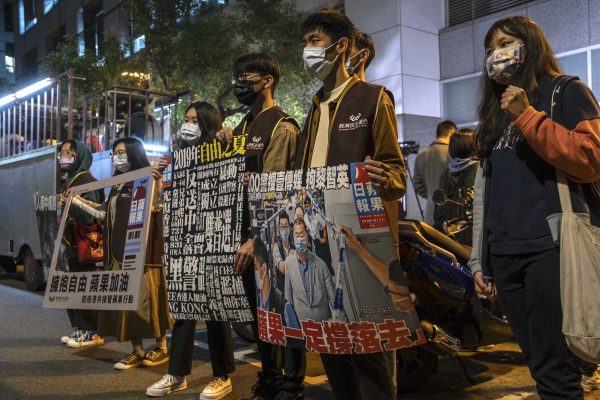
Despite the pervasive climate of fear, Hong Kong society has not been completely extinguished. Social media reports indicate that in the days leading up to sentencing, residents queued outside the courthouse for more than 24 consecutive hours, seeking to bear witness simply by being present.
Some described the vigil as the last remaining public space under authoritarian pressure.
On international dynamics, Chin said many Hongkongers still hope U.S. pressure might matter. Recent phone talks between the U.S. president and Xi Jinping, General Secretary of the Chinese Communist Party, have drawn attention to whether the Lai case might be raised. Britain, she added, appears effectively absent.
A final message—to Hong Kong and beyond
Few analysts now view the Jimmy Lai case as judicial. It is strategic: a warning to Hong Kong society that dissent ends here, and a test of how thoroughly international outrage can be ignored.
As sentencing approaches, there is little disagreement on one point. Whatever the formal judgment, the prosecution has already inflicted permanent damage on Hong Kong’s rule-of-law credibility, its press freedom, and the world’s trust in the city.