By Jin Yan
Yaoning “Mike” Sun, a Chinese American man in Southern California, has been sentenced to four years in federal prison by the U.S. District Court for the Central District of California for illegally acting as an agent of the Chinese Communist Party (CCP). The case has not only shaken the Chinese American community but has once again brought the issue of China’s political infiltration in the United States into the spotlight.
Ciaran McEvoy, spokesperson for the U.S. Attorney’s Office, emphasized that U.S. law enforcement will not allow hostile foreign powers to infiltrate the American political system and will respond to such threats with unwavering vigilance.
The 65-year-old Sun resides in Chino Hills, California. According to prosecutors, between 2022 and 2024 he carried out political influence operations in the United States at the direction of Chinese government officials. These activities included promoting pro-CCP candidates for local public office, operating pro-China media platforms, and reporting sensitive political developments to Chinese consular officials.
McEvoy stated, “When a foreign government — especially one that is not friendly to the United States — attempts to influence local American politics and help specific individuals get elected as city council members, that in itself poses a significant risk.” He warned that local politicians who rise with foreign backing could later advance to state legislatures, governorships, or even Congress, creating far-reaching national security implications.
Success
You are now signed up for our newsletter
Success
Check your email to complete sign up
Prosecutors presented evidence that Sun wrote reports to Chinese officials seeking additional funding and assignments. He claimed that during the 2022 U.S. midterm elections he successfully organized a team to help “Individual One” win a city council seat, describing the person as a “rising political star.” The Department of Justice has not disclosed the identity of the politician, but the Los Angeles Times previously reported that Sun assisted Eileen Wang in winning a seat on the Arcadia City Council; the two were formerly engaged. Wang denied the allegations last year and said she had ended her engagement with Sun. She took office as Mayor of Arcadia in February of this year.
According to a Los Angeles Times investigation, Sun brought in resources from EDI Media Group — an entity registered as a foreign agent — and used its subsidiary, iCity News, to publish multiple articles promoting Wang before the election. Prosecutors stated that Sun’s violation stemmed from failing to register under the Foreign Agents Registration Act (FARA) while acting in the United States as an agent of the Chinese government to advance its political messaging.
Intelligence gathering and cross-border monitoring: From Tsai Ing-wen’s transit to ‘overseas anti-China forces’
Another key aspect of the case involves intelligence collection and transnational political monitoring. According to prosecutors, during then–President Tsai Ing-wen’s transit through Los Angeles in 2023, Sun reported her itinerary and related information to Chinese consular officials.
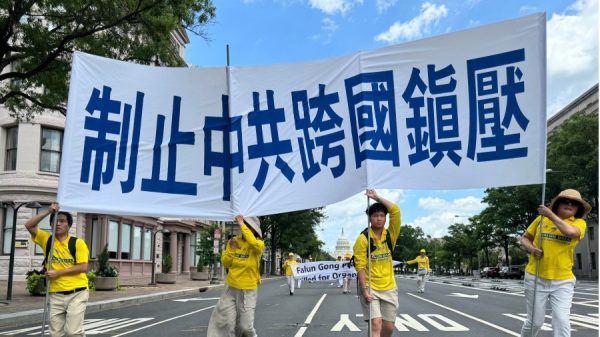
He also reported to Chinese authorities on the activities of so-called “overseas anti-China forces,” including groups supporting independence for Taiwan, Tibet, and Xinjiang, as well as Falun Gong organizations. He suggested mobilizing local groups in Los Angeles to counter these forces.
Sun even applied for $80,000 in funding from Chinese officials to organize a pro-China demonstration in Washington, D.C., on U.S. Independence Day (July 4). Prosecutors stated that such actions went beyond ordinary speech or political expression and constituted providing intelligence and carrying out political assignments on behalf of a foreign government.
McEvoy noted that the People’s Republic of China’s activities in the United States have long been under law enforcement scrutiny and are taken very seriously. “Most troubling,” he said, “is when someone helps elect a city council member while concealing their status as a foreign agent and fails to inform voters.” He stressed that democracy is built on transparency and integrity; when voters are unaware of whether a candidate has foreign backing, democratic legitimacy is undermined.
Political commentator Heng He observed that the CCP’s overseas infiltration “is not an isolated case, but part of a long-term united front and influence operation.” He analyzed that the CCP often uses Chinese communities as entry points, cultivating “agents” through business, media, and community organization networks, gradually expanding influence at the local political level.
Heng He believes local elections are targeted because “the threshold is relatively low and oversight mechanisms are looser,” making it easier to operate unnoticed. Once such politicians advance to state or federal levels, their influence multiplies — which he says is the core concern of U.S. law enforcement.

A warning for democracy: Institutional loopholes and community awareness
The Sun case raises not only legal accountability issues but also questions about the resilience of democratic systems. Heng He (the following reflects his views) noted that the CCP’s infiltration strategy often operates under a “legal veneer,” such as running media outlets, serving as election consultants, or engaging in community service while actually carrying out political missions. Although FARA exists, he said enforcement is difficult, and some communities lack sufficient awareness of the law, making them vulnerable to exploitation.
Heng further stated that within the Chinese American community, such cases are sometimes misunderstood as being “targeted at Chinese people,” when the core issue is whether someone serves a foreign government while concealing that status. “The key is not ethnicity, but whether U.S. law has been violated and whether democratic procedures have been undermined.” He noted that the Department of Justice has repeatedly emphasized that enforcement targets unlawful conduct, not specific ethnic groups.
From a broader perspective, Heng characterized the CCP’s overseas infiltration strategy as an “asymmetrical political warfare” approach — using low-cost, long-term efforts to influence other countries’ policies and public opinion environments. Rather than traditional espionage, such tactics often appear in the form of media manipulation, community mobilization, and election interference.
McEvoy reiterated that the United States will respond with equal determination. He said law enforcement’s goal is not to suppress political viewpoints but to uphold legal transparency and national security. Anyone who serves a foreign government without registering and attempts to influence the U.S. political process will be prosecuted under the law.
The Sun case is one of the few recent convictions involving foreign agents at the local election level. Analysts suggest that amid intensifying U.S.–China competition, similar cases may not be the last. For the United States, this represents both a law enforcement victory and a warning: in a globalized and immigrant society, balancing openness with protection against hostile infiltration will remain a long-term challenge.
In a democratic system, ballots symbolize sovereignty, and transparency symbolizes trust. When foreign forces covertly intervene in elections, they threaten not only national security but also public confidence in institutions. The sentencing of Yaoning “Mike” Sun may be only a beginning, but it sends a clear message: in the American political system, foreign agents who attempt to operate in the shadows will ultimately face legal judgment.