By Li Deyan
Xi Jinping, China’s president and chairman of the Central Military Commission (CMC), the body that controls China’s military, has not left Beijing for three months. The extended stay is a departure from his recent practice of conducting inspection tours around the Lunar New Year and visiting frontline military units in person.
This year, following the reported arrest of CMC Vice Chairman Zhang Youxia, Xi delivered his New Year greetings to the armed forces by video from Beijing. He also instructed the entire military to “maintain the prescribed state of alert,” language that analysts and online commentators described as unusual for the holiday period.

Xi tells troops to ‘maintain the prescribed state of alert’ in unprecedented Lunar New Year language
According to the state news agency Xinhua, Xi used a video link on Feb. 11 from the Bayi Building, the military’s main headquarters in central Beijing, to inspect combat readiness and extend Lunar New Year greetings. Zhang Shengmin, a CMC vice chairman, attended the event.
During the address, Xi told troops that “all military units must strengthen combat readiness duty, maintain the prescribed state of alert, and promptly and effectively handle various possible sudden situations.”
Success
You are now signed up for our newsletter
Success
Check your email to complete sign up
A review of Xi’s public remarks over the two previous years suggests this is the first time he has explicitly instructed the entire armed forces to “maintain the prescribed state of alert” ahead of the Lunar New Year. Observers said the phrasing signaled heightened sensitivity to potential instability within the ranks.
In January 2025, Xi traveled to the Northern Theater Command headquarters in Shenyang, Liaoning province, accompanied by Zhang Youxia. At that time, he urged units to strengthen combat readiness and respond effectively to emergencies. He also posed for group photos with officers and soldiers.
In February 2024, Xi visited troops stationed in Tianjin, accompanied by He Weidong, who was then serving as CMC vice chairman. He called on units to strengthen combat readiness duty and met with service members in person.
A sparsely attended video address sparks online speculation about military morale
This year’s event unfolded differently. Footage broadcast by state television showed three tables arranged in a large room at the Bayi Building. Xi sat at the central table, flanked by two senior generals, one believed to be Zhang Shengmin. The room appeared sparsely occupied.
Online reactions were swift. Some users described the atmosphere as tense and unusually restrained. Others wrote that the video format gave the impression of distance between the commander-in-chief and frontline troops. Several posts contrasted the scene with previous years, when Xi visited military bases in person and shared meals with rank-and-file soldiers.
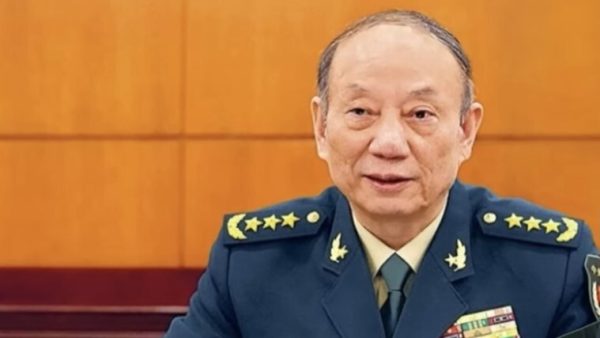
Commentators linked the shift to recent turbulence in the senior military leadership. Following the reported detentions of Zhang Youxia and Liu Zhenli, the former chief of the Joint Staff Department, analysts have argued that morale within the armed forces has been affected by ongoing anti-corruption investigations and personnel reshuffles.
Cai Shenkun, a U.S.-based independent commentator, wrote on the social media platform X that Xi had broken with past practice by remaining inside the heavily guarded Bayi Building and conducting only a remote inspection. In Cai’s assessment, the video address reflected heightened caution following the cases involving Zhang and Liu.
Cai further argued that Xi’s continued emphasis on “revolutionary tempering” in the anti-corruption campaign signaled that investigations would continue and that senior officers remained under pressure. He characterized the New Year message as both reassurance and warning.
Another social media account, “No King No Emperor (Australian Special Operations Brigade),” suggested that Xi’s decision to avoid visiting troops in person reflected concerns about internal stability. The account speculated that the leadership was wary of face-to-face appearances with active-duty soldiers under current circumstances.

Xi Jinping has not traveled outside Beijing since November 2025, the longest such stretch in recent years
Publicly available state media reports show that since inspecting Guangzhou on Nov. 7 and 8, 2025, Xi has not left Beijing through Feb. 12, 2026. During that period, no overseas trips were reported.
In previous years, Xi’s schedule around the New Year included multiple domestic inspections. Ahead of the 2025 Lunar New Year, he inspected the Information Support Force headquarters in early December 2024, attended events in Macau marking the 25th anniversary of its return to Chinese rule, and visited Liaoning province in January 2025, where he also inspected the Northern Theater Command.
The year before, he traveled to Shanghai from late November to early December 2023, visited Guangxi in mid-December, and went to Tianjin in early February 2024 to greet stationed troops.
Why Xi has remained in Beijing this winter has prompted speculation among overseas commentators. Du Wen, a former Inner Mongolia official now based in Europe, said in an online program that Xi may be reluctant to travel amid continuing military purges and uncertainty within the officer corps. He cited three factors: the reported arrest of Zhang Youxia, ongoing investigations within the military, and what he described as rival factions waiting for political openings.
The state media has not publicly linked Xi’s travel schedule to internal security considerations.