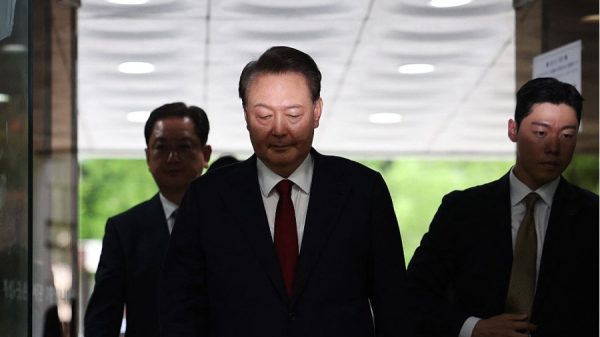
On the afternoon of Feb. 19 local time, the Criminal Division 25 of the Seoul Central District Court handed down a ruling that has shaken South Korean politics: former President Yoon Suk-yeol was sentenced to life imprisonment as the ringleader of an insurrection.
This marks the first time since former President Chun Doo-hwan was convicted in 1996 that another former South Korean head of state has received such a severe sentence for insurrection. The entire trial was broadcast live, with millions of South Koreans witnessing the historic moment on screen.
The events trace back to the night of Dec. 3, 2024, which reshaped South Korea’s political landscape. Then-President Yoon Suk-yeol declared emergency martial law and ordered troops into the National Assembly, attempting to block what he called the “infiltration of pro-communist forces” into state institutions.
However, the martial law order lasted only six hours. The move ultimately turned the former prosecutor-turned-president into a criminal defendant. Prosecutors had sought the death penalty.
- South Korean President Yoon Defends Martial Law as Warning Against Communist Infiltration
- South Korea Sentences Military Officer to 20 Years for Spying for China
According to comprehensive reports, the court’s verdict — spanning hundreds of pages — determined that Yoon’s declaration of emergency martial law and deployment of troops met the legal criteria for insurrection under criminal law, constituting the “use of violent means to disrupt the constitutional order.”
Success
You are now signed up for our newsletter
Success
Check your email to complete sign up
The ruling stated:
“The defendant ordered the military to seal off the National Assembly, attempting to paralyze constitutional institutions. Objectively, this constitutes the execution of insurrection.”
However, the judgment also noted mitigating factors in sentencing: Yoon had no prior corruption record; the action ultimately failed; it did not result in fatalities or bloodshed; and he had a long career in public service. Considering his age of 65, the court imposed life imprisonment rather than capital punishment.
Several other former senior officials were also sentenced:
- Former Defense Minister Kim Yong-hyun — 30 years in prison
- Former intelligence commander Noh Sang-won — 18 years
- Former police chief Cho Ji-ho — 12 years
The motive behind martial law
Understanding why Yoon chose the path of martial law requires looking beyond a simple narrative of “undermining democracy.”
At the time, South Korea was deeply polarized. Yoon believed the National Assembly was effectively controlled by the opposition Democratic Party of Korea (DP), which held an overwhelming majority and which conservatives often viewed as soft on North Korea and China.
In a prison statement titled “To the Nation,” Yoon argued that the opposition had systematically paralyzed the government through:
- Budget cuts — Slashing key administrative and national security funding.
- Excessive impeachments — Filing nearly 30 impeachment motions against prosecutors and government officials, disrupting judicial and administrative systems.
- Blocking revisions to the National Security Law — Yoon claimed existing law mainly targeted North Korea and failed to adequately address espionage for other countries such as China.
From Yoon’s perspective, this was no longer ordinary political competition but a “civil war without gunfire.” He claimed state institutions had been infiltrated by “anti-state forces,” and that without extraordinary measures, South Korea would gradually slide toward communism.
In his view, the “12·3 Emergency Martial Law” was not about seizing power but about “defending the Constitution” and protecting South Korea’s liberal democratic system.
Reaction and support
Yoon showed no visible remorse at the verdict. His defense team compared him to Galileo, arguing that he was being judged for speaking uncomfortable truths, and that the trial reflected “the tyranny of the majority.”
“History will prove that I was right,” Yoon reportedly declared.
In prison writings, he accused “pro-communist, anti-state forces” of undermining the U.S.–South Korea alliance. Supporters echoed these concerns, pointing to polling data from Pew Research Center showing high levels of unfavorable views toward China among South Koreans.
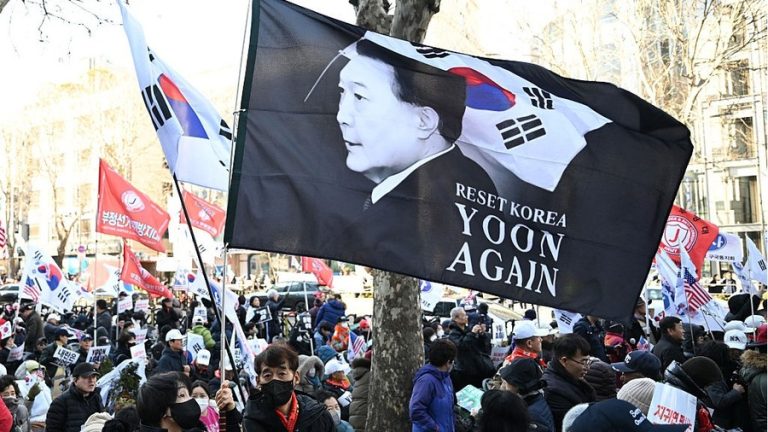
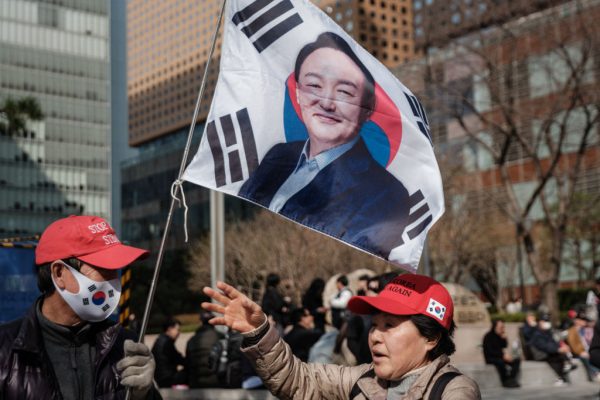
At rallies in Seoul’s Gwanghwamun Square, demonstrators waved South Korean and U.S. flags, chanting “Free Yoon Suk-yeol” and denouncing leftist ideology. To them, he is not a criminal but a politician who confronted what they see as China’s growing “sharp power” influence.
The ‘Blue House Curse’
Yoon’s downfall adds another chapter to South Korea’s so-called “Blue House curse” — the pattern of former presidents facing disgrace or imprisonment.
The presidential residence, Blue House (Cheong Wa Dae), has long symbolized both power and peril. Past presidents have met tragic or troubled ends, including:
- Park Geun-hye — imprisoned
- Lee Myung-bak — imprisoned
- Roh Moo-hyun — died by suicide
Ironically, Yoon himself once prosecuted former presidents as a high-profile prosecutor. Now he stands convicted of an even more serious charge, insurrection.
Geopolitical implications
Yoon’s imprisonment is not only a domestic political earthquake but also a geopolitical event.
During his presidency, he strongly promoted closer ties with Japan and deepened trilateral cooperation among the U.S., Japan, and South Korea. He was regarded in Washington as a reliable ally in countering North Korea and China, while the leftist opposition is seen as courting both China and the United States — something critics say risks bringing South Korea into Beijing’s oribit.
With his removal from power, conservatives fear South Korea may shift leftward again, possibly softening its stance toward North Korea and China and slowing revisions to espionage laws.
On Feb. 19, 2026, Yoon Suk-yeol was sentenced to life imprisonment. The court settled his legal responsibility — but it did not settle the political divide. To supporters, he is a tragic patriot who sacrificed himself to prevent the “communization” of South Korea. To opponents, he is an authoritarian who violated constitutional order.
By Yang Zizong