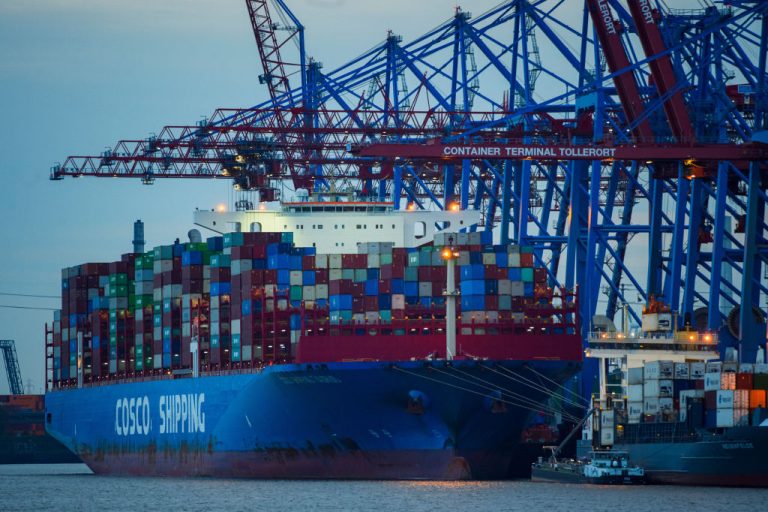
On Feb. 20, the U.S. Supreme Court ruled 6–3 that the Trump administration had exceeded its authority in imposing sweeping tariffs under the 1977 International Emergency Economic Powers Act (IEEPA). The decision nullified a series of measures introduced on that basis, including the 2025 “reciprocal tariffs” affecting multiple countries and the so-called “fentanyl tariffs” targeting Canada, Mexico, and China.
The response from the White House was immediate. President Donald Trump said he would turn to alternative legal tools. Invoking Section 122 of the Trade Act of 1974, he announced a 10 percent global tariff layered on top of existing baseline duties, raising that rate to 15 percent the following day. Tariffs imposed under Section 232 and Section 301 remain unchanged.
The Court closed one channel. The administration shifted to others.
Some countries face higher effective rates
While the ruling restricted the use of IEEPA, it left intact other statutory authorities. On Feb. 21, Trump confirmed that the baseline import tariff on nearly all countries would be raised to 15 percent for an initial 150-day period beginning Feb. 24.
Close U.S. allies are among those affected. The United Kingdom, Australia, the European Union, Japan, and South Korea had previously negotiated a 10 percent rate. They now face an additional 5 percent.
Success
You are now signed up for our newsletter
Success
Check your email to complete sign up
On Feb. 23, Trump wrote on Truth Social that any country attempting to “game” the Supreme Court’s decision would encounter tariffs “far higher than the levels recently agreed to.” The message was later shared by the U.S. Embassy in China. While widely interpreted as directed at Beijing, the warning applies more broadly to countries subject to the new baseline rate and to those facing sector-specific tariffs under Sections 232 or 301.
Canada and Mexico continue to face penalties linked to fentanyl-related disputes. India remains subject to reciprocal tariffs of roughly 25 to 26 percent. More than ten countries, including Cambodia, Laos, Indonesia, and Pakistan, face rates above 19 percent under supply chain policies tied to “China+1.”
Steel and aluminum remain under particularly heavy pressure. Steel products face an average effective tariff of approximately 39.6 percent. Canada and Brazil are the largest steel suppliers to the United States, followed by Mexico, South Korea, Vietnam, Germany, Japan, and Taiwan. Although China is the world’s largest steel producer, it accounts for about 1.8 percent of U.S. steel imports due to duties imposed since 2018.
The United States relies more heavily on imported aluminum, with roughly half of domestic demand supplied from abroad. Canada provides about 58 percent of U.S. aluminum imports, followed by the United Arab Emirates and Mexico. China ranks among the top five suppliers, particularly in downstream aluminum products.
Additional measures may follow. According to The Wall Street Journal, the administration is considering national security tariffs on six industries, including large-scale batteries, cast iron and fittings, plastic pipes, industrial chemicals, and power grid and telecommunications equipment. China is a leading supplier in each category.
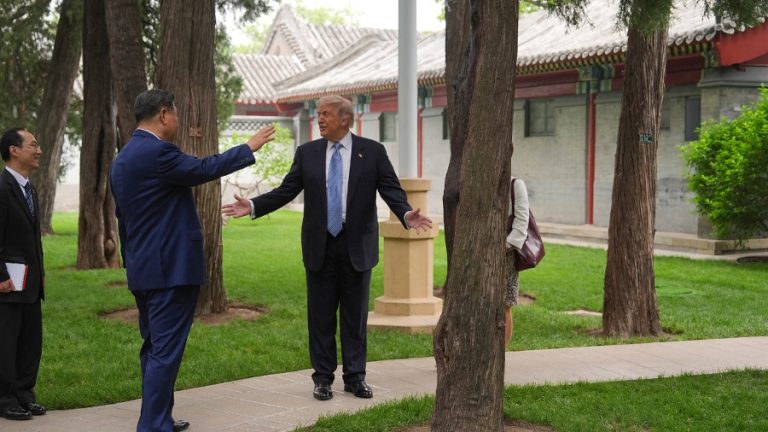
These developments unfold as Trump prepares to visit Beijing from March 31 to April 2.
Summit planning amid continuing distrust
The Supreme Court ruling invalidated tariffs imposed under IEEPA, including the 20 percent fentanyl-related tariff on China. For now, the global baseline rate applies. However, sectoral tariffs under Sections 301 and 232 — covering steel, aluminum, copper, automobiles, trucks, and auto parts — remain in force.
At a Feb. 24 hearing of the House Foreign Affairs Committee, Under Secretary of State for Economic Growth, Energy, and the Environment Jacob Helberg said the administration seeks a “stable, constructive relationship” with China, while making clear that Washington does not trust Beijing.
Both sides are preparing for the late-March summit under conditions of competition rather than détente.
Beijing assesses its room to maneuver
Some U.S. commentary holds that the Feb. 20 ruling provides Beijing with additional leverage ahead of the summit.
A Feb. 24 Wall Street Journal article, “Trump’s Tariff Weapon Falters, Beijing Finds an Opening in the U.S.-China Trade War,” noted that the effective tariff rate on Chinese goods could fall from 32 percent to 23 percent. While still higher than rates applied to many other U.S. trading partners, the narrower gap may reduce immediate pressure for supply chain relocation.
The timing also matters. The ruling came just over a month before Trump’s scheduled visit, giving Beijing space to incorporate the legal shift into its negotiating strategy. Trump is reported to be seeking commercial agreements and expanded access to rare earth minerals.
Agricultural trade remains another variable. As midterm elections approach, farm-state constituencies carry political weight. U.S. soybeans are currently priced above those from Brazil and Argentina. Under an October 2025 agreement, China committed to purchase at least 25 million tons of U.S. soybeans annually from 2026 through 2028.
U.S. Department of Agriculture data released on February 20 show that China completed 12 million tons of purchases in the first quarter of 2026 and is considering increasing that figure to 20 million tons. To reach 20 million tons this year, China would need to order an additional 8 million tons in the coming months — approximately 6.8 percent of total annual U.S. soybean production of about 118 million tons. That volume corresponds to the output of roughly 34,000 U.S. soybean farmers.
Possible outcomes in Beijing
The Wall Street Journal cited Myron Brilliant, former head of international affairs at the U.S. Chamber of Commerce, as saying that Xi Jinping is unlikely to offer what Trump has described as a “big, beautiful” deal, though limited concessions are possible.
Any outcome in Beijing is likely to reflect constrained expectations on both sides. Purchase memoranda or phased easing statements could be presented domestically as progress in Washington, particularly amid concerns over price pressures linked to tariffs. For Beijing, even modest adjustments could ease short-term strain on parts of its manufacturing sector.
Trump has framed his tariff strategy as part of a broader effort to rebuild U.S. manufacturing capacity. He has repeatedly tied economic security to national independence. At the same time, the United States remains politically divided over trade policy and globalization. Industrial hollowing-out and reliance on China for certain goods continue to shape debate in Washington.
The Supreme Court ruling altered the legal foundation of recent tariffs. It did not remove tariffs as an instrument. As preparations continue for the March summit, tariff pressure remains in place alongside diplomatic engagement.
(This article is exclusively authorized to Vision Times by Up Media. Please do not reproduce without permission. Original link.)
The views expressed are solely those of the author.
By He Qinglian