The 21-year-old had just led Team USA to team gold. Every major outlet called him “the Quad God.” Then he fell on his first jump, fell again on his second, and watched the medal he was supposed to win go to a skater with a simpler, steadier plan.
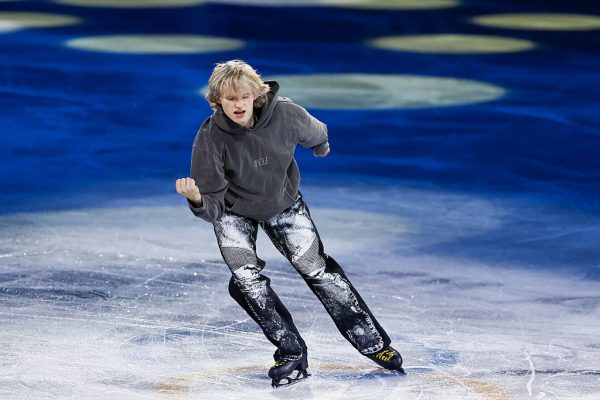
At the 2026 Milan Winter Olympics, American figure skater Ilia Malinin entered the men’s singles free skate as the most dominant favorite the sport had seen in years. He was the first skater in history to land all six types of quadruple jumps in competition. He held the world record for seven quads in a single program. Social media fans had been celebrating his individual gold for days before he took the ice. On Feb. 13, the music started, Malinin launched into his opening quad axel, and he crashed.
He got up. He attempted his second quad. He fell again. Eight thousand spectators went silent. In the mixed zone afterward, his voice shaking, Malinin told reporters: “I blew it.” He placed eighth.
His program was designed to win by a huge margin or fail completely
Malinin’s competitive strategy has always been to attempt the hardest possible content: two quad axels, a quad-triple combination jump, a back-counter quad loop. When every element lands, the resulting score puts an unbridgeable gap between him and the rest of the field. When even one element misses, the scoring system punishes him just as severely in the other direction. There is no middle ground. The approach either produces a historic performance or a historic collapse.
This is a recognizable pattern far beyond figure skating. A student fixates on the hardest exam problem and runs out of time for the ones worth easy points. A designer reaches for a spectacular thesis project and realizes three days before the deadline that the scope is unfinishable. The drive to attempt the maximum every time, without a fallback, turns ambition into fragility.
The gold medalist chose a different strategy entirely
Success
You are now signed up for our newsletter
Success
Check your email to complete sign up
The man who won gold in Milan was Mikhail Shaidorov of Kazakhstan. His program contained no quad axels. He performed five quadruple jumps, all types he could land consistently, and he executed every one cleanly. His approach was to stay within the range of what he could reliably control, then perform each element as close to flawlessly as possible. He accumulated his score steadily, jump by jump, and finished with 291.58 points, a historic gold.
The contrast is straightforward. Malinin tried to win by being superhuman. Shaidorov won by being dependable. On that night, dependability beat spectacle.
The tension between maximum ambition and strategic patience shows up repeatedly in the careers of people who eventually achieve lasting success. At 30, Steve Jobs was so rigidly committed to his vision for the Macintosh that he clashed with Apple’s board until the company he had co-founded voted to remove him.
The twelve years that followed reshaped how he worked. At NeXT, he dealt with the grinding frustrations of a startup that struggled to find a market. At Pixar, he learned the discipline of slow, careful refinement. When he returned to Apple, the products he built, the iPod, the iPhone, were developed through steady iteration rather than single revolutionary leaps. In his 2005 Stanford commencement address, Jobs said that getting fired from Apple was the best thing that had ever happened to him. The weight of being successful was replaced by the freedom of starting over, and it opened one of the most creative periods of his life.
Jobs moved from being someone who would accept nothing less than a world-changing breakthrough to someone who understood pacing, trade-offs, and the compounding power of getting fundamentals right before reaching higher.

The most effective challenges are just beyond your current reach
Psychologist Lev Vygotsky formalized this idea with his concept of the “zone of proximal development”: the most productive challenges are the ones slightly beyond what you can currently do, close enough to reach with effort, not so far that failure is almost certain.
A practical application is the three-tier goal method. The baseline goal is what you can accomplish even on a bad day; on an exam, that might mean simply passing. The ideal goal is what a solid performance produces; that might mean scoring 85. The stretch goal is what requires everything to go right; that might mean 95.
This structure provides a buffer. Missing the stretch target while hitting the ideal goal does not feel like catastrophe. The same logic applies to learning to code (first write something that runs, then optimize, then explore advanced features) or preparing for a job interview (first master the standard questions, then develop standout examples, then prepare for surprises).
Malinin’s experience on the ice in Milan, Jobs’s experience getting fired from Apple, and Vygotsky’s research all point to the same conclusion. Ambition without calibration is brittle. The people who sustain high performance over time are the ones who learn to set their targets just past what they can reliably do, then steadily expand that range, rather than betting everything on a single spectacular attempt.