Commentary
After the United States and Israel launched Operation Epic Fury against Iran, Spain refused to allow American forces to use its military bases, citing violations of international law and the United Nations Charter. France’s president, Emmanuel Macron, voiced support for Spain’s position. The episode exposed a fault line within NATO and highlighted a tension the author examines throughout: international law binds the countries that follow it while leaving rogue states free to operate as they please.
Spain’s decision to deny the United States access to its bases is within its sovereign rights. No one disputes that. Spain’s position reflects dissatisfaction with the Trump administration and a desire to maintain neutrality in the U.S.-Iran conflict, projecting an image of restraint and rationality.
The problem is that restraint and rationality accomplish nothing when the other side operates without either. Iran is a principal backer of Islamic extremist activity across the Middle East, a supplier of weapons and technology to groups that oppose democratic nations, and a regime that has pursued nuclear capabilities with backing from the Chinese Communist Party, Russia, and North Korea. A regime like this does not respond to diplomatic norms. It exploits them.
The United Nations Charter is reasonable in principle, and international law should exist. But rules only function when every signatory state observes them. When countries invoke international conventions when it suits them and ignore those conventions when it does not, the rules become ceremonial: they constrain the law-abiding while the lawless operate freely.

Success
You are now signed up for our newsletter
Success
Check your email to complete sign up
Rules that only bind the law-abiding
The 20th century provides the evidence.
When Nazi Germany began its conquest of Europe, Britain’s Neville Chamberlain and France’s Philippe Pétain argued for accommodation: satisfy Hitler’s initial ambitions in exchange for peace. The result was that Nazi Germany used the breathing room to consolidate its military strength and ultimately occupied nearly the entire European continent. Britain, France, and even the Soviet Union all signed peace agreements with Germany. Before the ink dried, German troops were advancing. By the time the rule-following nations recognized what had happened, they had lost the capacity to resist and could only watch as their territory was carved up.
When the Soviet Union collapsed, Ukraine inherited the world’s third-largest nuclear arsenal. In 1994, under international pressure, Ukraine signed the Budapest Memorandum on Security Assurances with Russia, the United Kingdom, and the United States. Ukraine agreed to give up its nuclear weapons in exchange for security guarantees from all three countries. The first country to invade Ukraine was Russia. If Ukraine had kept its nuclear arsenal, it is worth asking whether Vladimir Putin would ever have launched that war.
When China and Britain signed the Sino-British Joint Declaration governing the handover of Hong Kong, the CCP was at a low point and appeared close to collapse. The Party solemnly promised “one country, two systems” and “Hong Kong people ruling Hong Kong.” The declaration was filed with the United Nations. Once the CCP grew wealthy and powerful, it treated the document as scrap paper and imposed authoritarian rule on Hong Kong. The declaration provided no protection whatsoever. International law, once again, bound the side that honored it and meant nothing to the side that did not.
The struggle between good and evil will never disappear from human history. When one authoritarian regime collapses, another often takes its place. As long as human society exists, this pattern will continue, because it reflects the darker side of human nature. Only if every individual became morally flawless could the communist vision of a perfected society be realized, and that remains a permanent fantasy, as disconnected from reality today as when Marx first proposed it.
Rules cannot restrain regimes that have no intention of following them. Doing wrong is in their nature. When such regimes appear to accept international norms during moments of weakness, the acceptance is camouflage, not conversion. The moment they regain strength, the rules are discarded. If rogue states possessed a conscience, the world would already look very different.
The case for destroying Iran’s regime
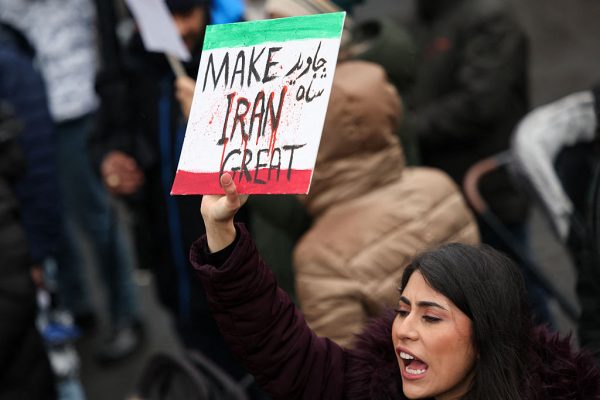
Iran, backed by authoritarian states including China, Russia, and North Korea, has spent decades transferring weapons and technology to extremist groups while pursuing nuclear capabilities that raise the risk of nuclear conflict across the region. As long as this regime exists, it remains a direct threat to the international order and to the safety of people across the Middle East and beyond.
The purpose of the U.S.-Israeli campaign against Iran, regardless of the immediate legal arguments surrounding it, is to dismantle the theocratic regime, liberate the Iranian people, establish lasting peace in the Middle East, and eliminate Iran’s capacity to threaten global security. Under that premise, the objective is just.
When rogue regimes ignore the United Nations Charter while law-abiding nations agonize over whether their own actions might violate some procedural standard, that is not prudence. It is folly. It gambles with the safety of citizens and relies on the conscience of regimes that have repeatedly demonstrated they possess none.
International law without enforcement is meaningless
If all states observed international law, countries could coexist through mutual respect. The problem is that violations happen constantly, and the mechanisms designed to punish them do not work. The United Nations increasingly functions as a forum shaped by the vetoes and influence of China and Russia. When democratic nations face coercion from authoritarian regimes, international law alone cannot protect them.
What upholds international order is not persuasion, appeasement, or diplomatic favors. It is strength sufficient to stop those who break the rules. The capability demonstrated by the United States and Israel in forcing Iran’s regime into submission is what secures justice in a world where authoritarian states respect nothing else.
Those who oppose war reflexively and advocate peace without principle should be treated with caution. They do not defend freedom. They provide cover for the regimes that threaten it.
Spain, France, and Turkey are all NATO member states bound by mutual defense commitments. Iran’s recent escalation of tensions in the region, including actions affecting Turkey, raises difficult questions. If open conflict between Turkey and Iran were to occur, NATO’s mutual defense obligations would be tested directly. Spain’s refusal to support U.S. operations against Iran, and France’s alignment with that position, suggest that some alliance members may not honor those obligations when the moment arrives.
The question is whether NATO’s commitment to collective defense means anything when individual members refuse to confront the threats the alliance was built to contain. If the answer is no, then the alliance, like international law itself, binds only those who choose to be bound.
Republished with authorization from the author’s Facebook page. The views expressed are solely those of the author.
By Yan Chungou