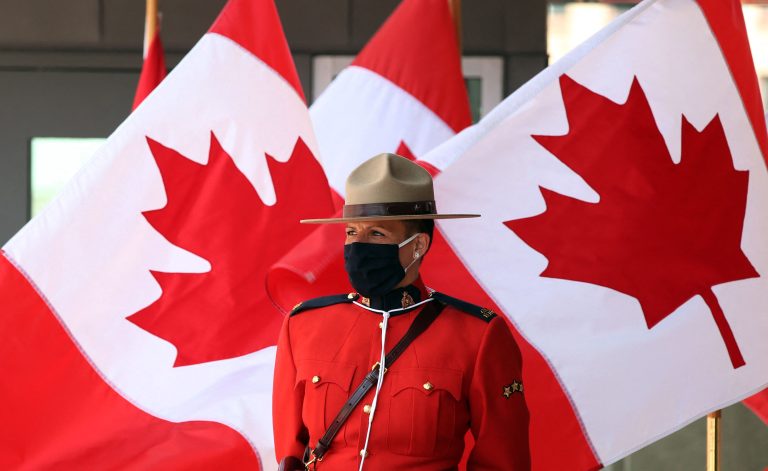
On March 13, the Federal Court of Canada ruled that the immigration application of the former Deputy Director (First-Level Police Commissioner) of Yuhua Branch, Shijiazhuang Public Security Bureau, Hebei Province, was denied. The court found that during his 30-year police career, he knowingly participated in systemic torture, constituting conspiracy to commit crimes against humanity. Social media commentator Gongzi Shen commented: “This is a historic Western assessment of the CCP police. If you enjoy the system’s privileges, you must bear responsibility for its atrocities. ‘I didn’t know’ doesn’t work; objective evidence outweighs personal defense.” He added that the family’s appeal only exposed the truth further and thanked them for “exposing the CCP police’s underwear to the West,” signaling that immigration pathways for officials within the system will increasingly narrow.
Canadian court’s first ruling: high-ranking Hebei police official involved in systemic torture, family denied immigration
On March 13, the Federal Court in Saskatchewan issued a landmark ruling: the permanent residency applications of the former Criminal Police Captain of Shijiazhuang Qiaodong Branch and Deputy Director (First-Level Police Commissioner) of Yuhua Branch, along with his wife Li Li and their children, were officially rejected. Immigration officers and judges unanimously concluded that the official, who worked in Hebei’s public security system for over 30 years, had overseen hundreds of officers, and, since 2013 as Deputy Director of Yuhua Public Security Branch, was directly responsible for investigation, interrogation, and detention. The court found there was reasonable cause to believe he “knowingly and voluntarily participated” in systemic torture, constituting conspiracy to commit crimes against humanity. This ruling not only shattered Li Li’s family’s immigration dream but was also described by commentator Gongzi Shen as “a historic factual recognition by Western democracies of the CCP police system.”
According to Canadian Federal Court documents and the Immigration, Refugees and Citizenship Canada (IRCC) refusal letter dated Sept. 16, 2024, the official served as Captain of the Criminal Police Division of Shijiazhuang Qiaodong Branch from 1993 for 20 years, and after 2013 was promoted to Deputy Director of Yuhua Branch, supervising 120–150 officers. In responding to the immigration office, he claimed he had “never abused or mistreated any suspect,” only “ensured interrogations were conducted according to law.” The immigration officer completely rejected this claim.
The officer cited numerous reports from international NGOs, academic papers, and official Chinese documents showing that China’s police interrogation system involves “widespread and systemic” torture and abuse nationwide, including in Hebei. Notably, according to a 2014 report by Minghui.org, the Yuhua District public security, prosecution, and court system were involved in 73 cases of persecution against Falun Gong practitioners, resulting in at least 1 death, 9 unlawful imprisonments, and 24 illegal labor camp sentences. These specific cases further reinforced the court’s determination of systemic human rights abuses in the region. As a high-ranking official responsible for supervising interrogations, he could not have been unaware of the human rights violations committed by subordinates.
Under the three criteria for “conspiracy to commit crimes against humanity” established by the Supreme Court of Canada in 2013—voluntary participation, knowing participation, and significant contribution to criminal acts or objectives—the official fully qualifies. Even without directly committing acts, knowingly contributing to an organization carrying out crimes constitutes conspiracy.
Success
You are now signed up for our newsletter
Success
Check your email to complete sign up
The judge further listed six assessment factors: organizational scale and nature, department affiliation, personal responsibilities and activities, position level, time remained after learning of crimes, recruitment method, and opportunity to leave. The immigration officer analyzed strictly according to this framework and concluded that the official, holding a long-term key position amid widespread documented torture in Hebei, could not claim “I didn’t know.” Li Li’s side raised multiple defenses, including questioning the sufficiency of evidence and whether detainees constituted an identifiable civilian group. The judge rejected these arguments, citing precedents clarifying that temporarily detained civilian groups are still protected under international criminal law; as long as torture is widespread, systemic, and targets civilians, it forms the basis for crimes against humanity. Crucially, the court emphasized that “objective third-party reports are far more persuasive than the applicant’s personal statements”—even without evidence of direct participation, holding a senior position in an institution committing systemic human rights abuses could constitute grounds for inadmissibility. Judge Shirzad S. Ahmed upheld the original ruling, and Li Li’s judicial review failed.
Gongzi Shen noted that the ruling “sets an important precedent.” It was precisely because Li Li appealed and entered the judicial process that the Canadian court was forced to publicly recognize that China’s police interrogation departments, at least in Hebei, are effectively organizations committing crimes against humanity. “We should thank Li Li! She sued the immigration office to immigrate to Canada and ended up exposing the CCP police system’s underwear to the West,” he said. He believes this case will serve as a reference for future applications, making immigration increasingly difficult for high-ranking officials within the system.
Sheng Xue, Vice Chair of the Global Civil Rights Movement, also stated that the case highlights Canada’s special attention to potential human rights liabilities when reviewing immigration applications from foreign security or law enforcement personnel. She hopes the Canadian government strengthens vigilance in this area.

UK exposes ‘double-agent police’ case: CCP infiltrates law enforcement, threatens exiled Hongkongers
Meanwhile, in the same week, a UK court is hearing another case: 38-year-old Peter Wai Chi Leung, a dual Hong Kong-UK national and special police officer in London’s financial district and border force, along with 65-year-old former Hong Kong Superintendent Yuen Chung Biu, are charged under the UK National Security Act for assisting Hong Kong intelligence agencies in illegally collecting intelligence, surveilling, and threatening exiled Hong Kong pro-democracy activists in the UK.
Prosecutors allege the two labeled overseas Hong Kong protesters as “cockroaches,” tracked democracy activists including Nathan Law (who had a £100,000 HKD bounty in Hong Kong), and Wai Chi Leung even displayed a UK police badge off-duty to intimidate protesters and accessed Home Office databases without authorization. Another accomplice, Matthew Trickett, died suddenly in May 2024 and could not testify, fueling further speculation.
Gongzi Shen commented on both cases: “Canada refused CCP police who ‘haven’t arrived yet but want a peaceful retirement’; the UK arrested police who ‘already came and continue doing dirty work for the CCP.’” He condemned the CCP’s full infiltration of Western law enforcement, using UK police authority to intimidate freedom-of-speech protesters and forcibly enter exiles’ homes. “This is not an isolated incident but a systematic, transnational repression.”
He further analyzed that both cases send a clear signal to all Chinese system insiders: enjoying power and promotions under the Party-State now comes with consequences when seeking to immigrate or work in the West. “If you serve that system for 30 years and enjoy its benefits, you must bear responsibility for its systemic atrocities. Foreign police may not prosecute you, but at least they can prevent you from enjoying a comfortable retirement in a free country.” He mocked CCP propaganda: “A police officer who spent a lifetime cracking down on ‘foreign forces’ ends up having the whole family trying to become ‘foreign forces’ abroad—this is the ultimate irony.”
Although the two cases fall under different legal contexts—immigration review versus national security criminal trial—they point to the same trend: Western democracies are shifting from reactive case-by-case measures to systemic countermeasures against Chinese security institutions. “Following orders” is no longer a defense, “I didn’t know” is no longer easily accepted, and “non-interference” cannot block the West from upholding law and human rights on its own territory. Canada’s ruling “makes a significant contribution to protecting the security and human rights of free democratic countries and reflects genuine rule of law,” while the UK case exposes the depth and danger of CCP infiltration. Together, the two cases suggest that the era of Chinese officials being able to “have it both ways” may be ending.
By Yin Hua