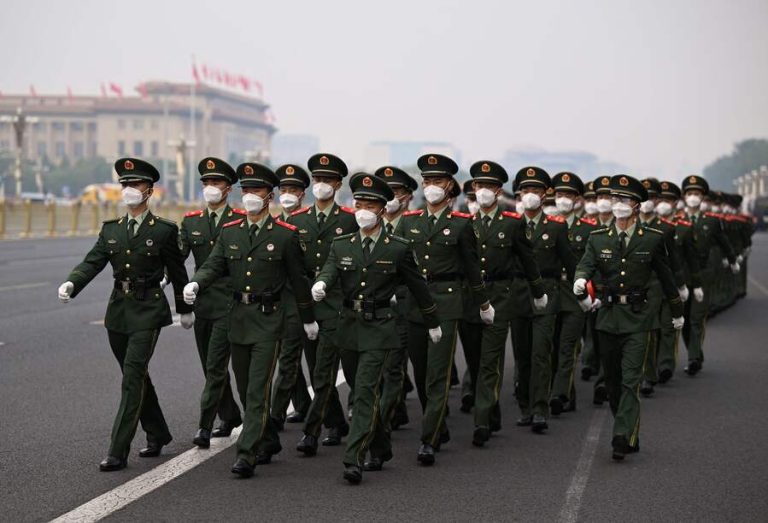
A former Chinese Armed Police serviceman who served in Xinjiang is drawing attention after describing what he portrays as deeply entrenched corruption across China’s military system, from everyday living conditions to decision-making at the command level.
Identified as Sam, he spoke in the United States during an interview with Taiwanese influencer “Ba Jiong,” recounting his experience in Yili, Xinjiang, in 1998. His account describes a system in which money, connections, and hierarchy shaped nearly every aspect of military life.
For new recruits, the costs began early. Enlisting required payment. Joining the Chinese Communist Party required payment. Learning to drive, obtaining licenses, and securing promotions—each step came with a price. In his unit, Party membership cost about 500 yuan, roughly $70, while driver training ranged from 500 to 1,000 yuan, about $70 to $140.
Recruits without money or connections were quickly singled out. Within days of arrival, soldiers were asked whether they had ties to senior officers. Those who did not became targets.
Sam recalled that his platoon leader demanded that new recruits “lend” him money. Everyone in his squad complied except him. The refusal drew immediate consequences. In a meeting room, under orders, more than a hundred soldiers beat him.
Success
You are now signed up for our newsletter
Success
Check your email to complete sign up
Such treatment, he said, was routine. Videos circulating online showing beatings inside paramilitary units reflected daily reality, and in some cases were less severe than what recruits actually endured. Some soldiers fled after repeated abuse, climbing over compound walls to return home, only to be detained and imprisoned for desertion.
Three years in uniform, he said, felt like confinement. Leave was rare, fewer than ten times over the entire period. Physical punishment was frequent. In one case, a soldier in his unit was beaten to the point of mental illness and assigned to the harshest labor, shoveling coal.
Under such conditions, tensions between veteran soldiers and new recruits hardened into open hostility. “How can a unit like this be sent into combat?” he asked.

The problems extended beyond discipline. According to Sam, most soldiers came from rural areas with limited opportunities, and military service functioned as a form of hidden employment. Within each unit, a steady flow of payments moved upward through the ranks, especially around major holidays, when senior officers expected contributions.
Those funds had to come from somewhere. In practice, he said, they came out of the soldiers’ food budget.
At the time, the daily food allowance was just over seven yuan, about $1. Roughly half, he estimated, never reached the dining hall.
Meals reflected the shortfall. Weekday food was consistently poor. Friday evenings were meant to be different, designated as communal meals under official policy, with whole chickens and fish provided to each company. What arrived instead was scraps—chicken necks and tails, fish trimmings—stretched with potatoes and cabbage. Portions intended for soldiers were diverted upward, while officers took the best cuts.
“We couldn’t even eat enough,” he said. “How can an army that doesn’t get enough food fight a war?”
In vehicle units, a similar pattern emerged. Positions in automotive companies were not assigned freely. Entry required payment. Once inside, soldiers looked for ways to recover what they had spent.
Fuel became the easiest target.
During one training exercise, troops assembled on schedule, but vehicles failed to appear. The fuel had already been siphoned off and sold.
At the time, Sam assumed such practices were confined to Xinjiang. Later, while visiting a friend at another unit in inland China, he watched a vehicle leave the compound. His friend explained its purpose: “To sell fuel.”
The same system, he realized, extended beyond a single region.
He also described encounters with civilians that blurred the line between military activity and coercion.
In one instance, soldiers were ordered to secure construction materials without any allocated funds. Villagers were told troops would assist with local labor the following day. That night, using borrowed vehicles, soldiers removed bricks from outside villagers’ homes. No one protested. The soldiers were armed.
On another occasion, a unit was sent out with weapons under the pretext of clearing snow. Partway through, most of the group withdrew. When Sam continued working, a superior told him to stop. The purpose, he was told, was not to clear roads but to make a show of force.
Such experiences shaped his view of the system. Military deployments, he said, were not primarily about external threats. In Xinjiang, they were aimed at preventing separatism. In other regions, at deterring public unrest.
After leaving the military, Sam entered foreign trade and later took part in protests in China, including opposition to a waste incineration project in Guangzhou. Over time, he said, the environment tightened. Under China’s top leader Xi Jinping, participants in protests were detained, and some disappeared.
He described what he said was a list of tens of thousands of individuals flagged for scrutiny, each required to report and undergo questioning.
Looking back, he traced his shift in perspective to a small device. While still in the military, he received a shortwave radio from his girlfriend. Scanning frequencies, he came across broadcasts from Voice of America.

Later, as internet controls expanded, he used circumvention tools developed by Falun Gong practitioners to access overseas information, initially for business purposes. The impact, he said, went beyond commerce.
Asked what could help people inside China access outside information today, he pointed to those same tools. If such technologies were supported more openly, he suggested, large numbers of people could bypass censorship.
In his view, that kind of access carries strategic implications.
“Only when ordinary people in China become aware and clear-headed,” he said, “will Taiwan be safe.”
He described the military’s weaknesses in two areas.
First, personnel. Across ranks, he said, service was often treated as a way to make money rather than prepare for war. Advancement depended on payments. Positions offered opportunities for profit. A regiment commander, he said, could control contracts and expenditures across the unit, generating at least 1 million yuan, about $140,000, in a year.
Construction projects followed similar patterns, with contracts directed to associates or relatives. The goal, he said, was income, not readiness.
Second, equipment. He argued that corruption affected production and procurement, with oversight focused more on satisfying superiors than ensuring quality. Equipment sold abroad underwent inspection. Equipment for domestic use did not face the same scrutiny.
Whether in logistics, discipline, or procurement, he described a system in which appearance often took precedence over function.
“If Taiwan is not intimidated,” he said, “if people don’t give up at the first sign of pressure, there is no problem.”
Editor’s Note:
This article is based on media reports, publicly shared online videos, and personal testimony cited by overseas media. The claims described have not been independently verified.