By Vision Times TV
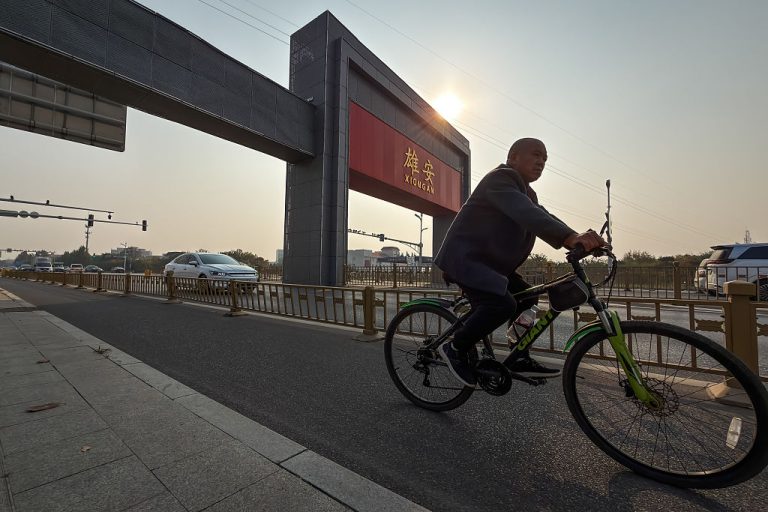
“My god, I just went downstairs to pick up a package, and it felt like I had entered a no-man’s land. There’s no one here. Where are the people in this city?” The remark, captured in a widely circulated online video, reflects growing public unease over the state of Xiong’an New Area, also known as Beijing’s flagship urban project launched under Chinese President Xi Jinping.
On March 23, Xi made a high-profile visit to Xiong’an alongside three members of the Politburo Standing Committee (China’s top ruling body). During a symposium that afternoon, he reaffirmed that “the Party Central Committee’s decision to build Xiong’an New Area is completely correct, and all work has been carried out in a solid and effective manner.”
Yet online footage and firsthand accounts paint a very different picture.
Empty streets, dwindling foot traffic
Videos circulating on social media show vast residential blocks and wide avenues with little visible human activity. Despite reported investments exceeding 800 billion yuan (over USD $110 billion), parts of the city appear largely uninhabited.
Success
You are now signed up for our newsletter
Success
Check your email to complete sign up
RELATED: Xi Jinping Backs Xiong’an Development Despite Heavy Backlash From Residents
“This is the other side of our neighborhood… the roads are still empty, most shops are closed,” one resident said, pointing to shuttered storefronts and sparse traffic. Even Xiong’an’s flagship infrastructure projects, including its massive high-speed rail station, appear underutilized.
“Looking across all of Asia, only Xiong’an could build a train station this big… but there are barely any passengers,” another video narrator observed.
Jobs scarce, wages low
For many newcomers, the economic reality has proven discouraging. “I came here after graduating because I saw how well Xiong’an was supposed to be developing,” one young job seeker said. “But the only jobs I can find are cleaners, retail clerks, or positions that require a master’s degree in state-owned enterprises or government.”
Even when opportunities arise, compensation remains low. “I finally found a job that seemed okay… but the salary was only 3,500 yuan a month with just one day off a week. I was stunned,” she said. Residents describe a mismatch between living costs and income levels. “Xiong’an has first-tier housing prices and consumption, third-tier city conditions, and fourth-tier wages,” one person remarked.
Others note broader economic pressures. “Big companies are cutting pay and laying off staff. Smaller ones are shutting down entirely,” said a local vendor. “Many people are relying on loans or credit cards just to get by.”
Structural challenges
Xiong’an was established in April 2017 as a “millennium plan,” intended to absorb non-capital functions from Beijing and relieve pressure on the capital. However, nearly nine years later, its development has lagged behind expectations.
While the official population is estimated at around 1.4 million, this falls far short of the long-term target of 5 million residents. Only a limited number of major state-owned enterprises have relocated, and progress in relocating universities and public institutions has been slow.
Four universities, including Beijing Jiaotong University and China University of Geosciences, were among the first designated to move. Yet construction delays and resistance from faculty have hindered the process. “The city looks clean, and basic amenities are there, but it lacks a sense of life,” said one university administrator. “If it were truly a good place, would people need to be forced to relocate?”
As a signature initiative closely tied to Xi’s leadership, Xiong’an carries significant political weight. Criticism of the project is often interpreted as criticism of the leadership itself. Xi’s recent visit, his second high-profile inspection in recent years, has been viewed by some observers as an attempt to reaffirm control and confidence amid ongoing internal pressures.
But on the ground, skepticism persists. “You can’t even set up a street stall here,” one vendor lamented. “The city is huge, but it can’t accommodate a small food cart.” For many residents, the question remains unresolved: Where are the opportunities and where are the people?