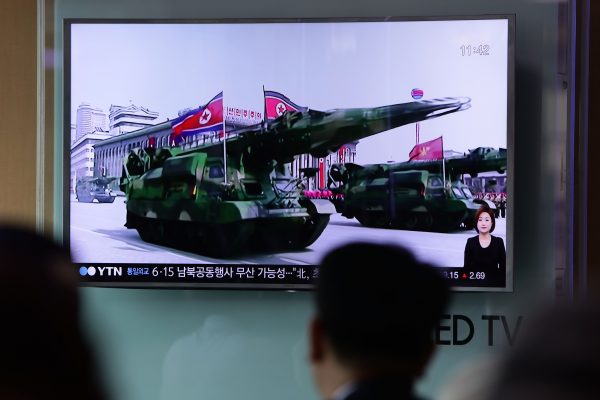
Iran’s missile arsenal owes its existence overwhelmingly to North Korea, a regime Washington has designated a state sponsor of terrorism. Bruce E. Bechtol Jr., a professor of political science and recognized expert on North Korea’s military and proliferation networks told Fox News that the two countries have sustained a deep partnership in missile technology, weapons systems, and related military capabilities for decades. The arrangement is straightforward commerce: Pyongyang supplies weapons platforms, engineering expertise, components, and underground facility construction. Tehran pays in cash and oil.
The U.S. State Department classifies Iran as one of the world’s most active state sponsors of terrorism. Knowing where Iran’s missiles come from, Bechtol argued, is the starting point for understanding where this war goes next.
The missiles Iran recently fired at Diego Garcia, the remote U.S. military base in the Indian Ocean some 2,500 miles from Iranian territory, were Musudan intermediate-range ballistic missiles. North Korea delivered 19 of them to Iran in 2005. Tehran has had this capability for twenty years. None of this should have come as a surprise.
Fox News Digital previously reported that Iran launched two medium-range ballistic missiles at Diego Garcia, a sharp escalation in Tehran’s willingness to hit U.S. forces directly.
Ballistic missiles are Iran’s most dangerous weapon in this war
Bechtol identified ballistic missiles as the most threatening weapons Iran is fielding in the current conflict. These missiles have hit U.S. military facilities, Israeli cities, and targets across neighboring countries. Iran’s Qiam short-range ballistic missile, a workhorse of its active arsenal, was developed and progressively upgraded with direct North Korean help.
Success
You are now signed up for our newsletter
Success
Check your email to complete sign up
“A lot of the technology we are seeing on the battlefield right now was previously proliferated to Iran by North Korea,” Bechtol said.
North Korean involvement goes well beyond hardware sales. Bechtol cited research from the Wisconsin Project on Nuclear Arms Control showing that North Korea built a large missile testing facility in Emamshahr, in Iran’s Fars Province, and a separate missile tracking system in Tabas, in South Khorasan Province. Both gave Tehran the infrastructure to test and guide missiles over long distances, a prerequisite for the long-range strike capability Iran now uses in combat.
North Korea delivered about 150 No Dong missile systems to Iran in the late 1990s. Iran reverse-engineered these into the Shahab-3, a near-exact copy. The two countries then kept working together to push the design’s range and accuracy further, setting a pattern of joint development that produced increasingly capable weapons over the following two decades.
Iran’s longest-range missiles are North Korean derivatives
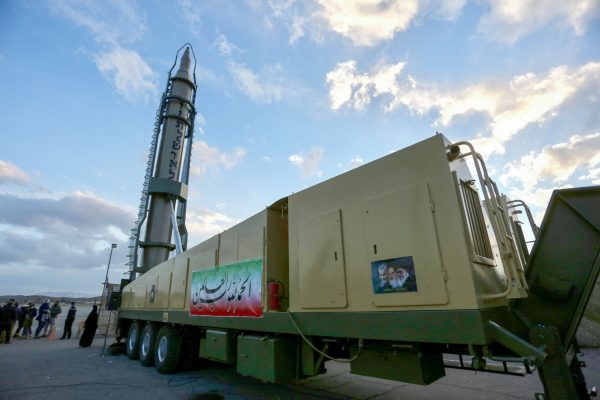
With continued North Korean technical support, Iran developed the Emad missile (range: roughly 1,750 km) and the Ghadr missile (roughly 1,950 km). Bechtol confirmed both types have been fired in the current war at targets in Israel and neighboring Arab states, including American bases.
He also flagged the Khorramshahr-4 as especially dangerous. It can carry warheads weighing 1.5 to 2 tons and may be loaded with cluster munitions. It is among the most lethal delivery systems in Iran’s inventory.
Bechtol warned that stopping the North Korea-Iran missile trade requires stronger enforcement of sanctions that already exist. “The United States and its allies need to enforce them more aggressively, targeting banks, shell companies, and cyber financial channels to cut off the supply chain at its source,” he said.
He also called for more active use of the Proliferation Security Initiative, a multinational framework for intercepting weapons shipments before they reach rogue states and terrorist groups.
“Once the supply chain is severed, the proliferation stops,” he said.
Trump sets an April 6 deadline after striking 13,000 targets
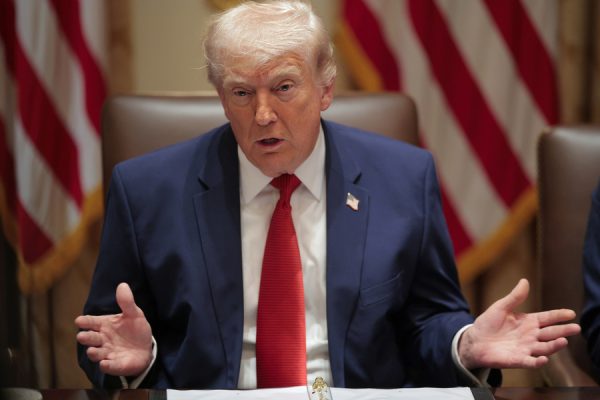
President Donald Trump has given Tehran until April 6 to reach a deal ending the war. Without an agreement, the United States will begin hitting Iranian energy infrastructure. The open question is whether this ultimatum produces a ceasefire that reopens the Strait of Hormuz. Trump said the military had already struck about 13,000 targets with roughly 3,000 remaining, and added that “a deal may come together very soon.”
American forces continue to build up across the region. Beyond the roughly 3,500 Marines who arrived March 27, another 2,200 are being mobilized along with several thousand 82nd Airborne Division troops.
Trump described indirect U.S.-Iran contacts through Pakistan as “going well.” Tehran publicly rejected Washington’s 15-point ceasefire proposal, but speaking aboard Air Force One on March 29, Trump claimed Iran had accepted most of the terms and called the new Iranian leadership “quite rational.” He added: “I think we’ll get a deal, but it’s also possible we won’t.”