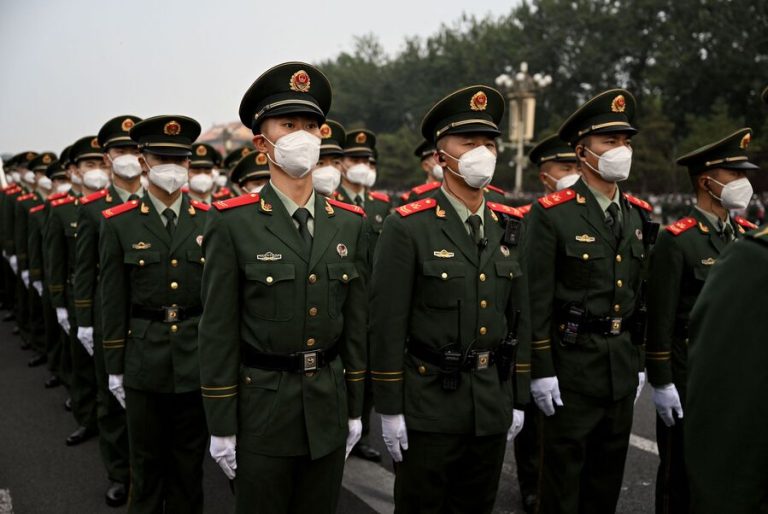
China’s military has not fought a major war since 1979. What the world knows of it comes almost entirely from what the Party chooses to show.
Sam, a former People’s Armed Police soldier who served at the Ili garrison in China’s far-western Xinjiang region from 1998 to 2001, describes something the Party does not show: an institution built for plunder rather than combat, where every promotion, every posting, and every holiday ritual serves the same function, moving money upward.
Sam left China in 2023 after years of harassment by Chinese state security following his participation in domestic protest activity. He entered the United States through the informal overland migration route used by Chinese nationals who cannot obtain legal immigration status, making the dangerous journey through Latin America to reach the U.S. border. He has since received political asylum and has been speaking publicly about what he witnessed inside the People’s Armed Police, the paramilitary force responsible for internal security and border control that operates alongside China’s conventional military. His account was published in a video interview on a Taiwan-based dissident YouTube channel with a significant following among overseas Chinese audiences.
How military commanders turn recruitment into a revenue stream
The biggest money-maker inside China’s armed forces, Sam says, has nothing to do with defense.
Every year, military units send officers to towns and villages across China to sign up young men. Families who want their sons to serve pay fees to the recruiting officer. The officer passes a share up the chain of command. The money flows upward through platoon commander, company commander, battalion commander, regimental commander, and finally to division commander, each level skimming its cut before passing the remainder along.
Success
You are now signed up for our newsletter
Success
Check your email to complete sign up
“In my time, taking in one soldier cost a few thousand yuan,” Sam said. “Now I understand the price has risen to tens of thousands. If you go to a place and recruit several hundred soldiers, think about how much money that is.”
The division commander never handles recruitment personally. The multiple layers of delegation create distance between the top and the transaction, while ensuring the money arrives reliably. By the time it reaches the division level, a single recruitment cycle can yield tens of millions of yuan.
The same structure governs officer promotions. Sam described a promotion quota of 100 slots, of which 90 are quietly reserved for the children of senior officers. The remaining ten are available for purchase by recruits from ordinary families. The going rate for a company commander’s post, which once cost a few thousand yuan, has risen to 100,000 or 200,000 yuan. Every step up the ladder requires a payment.
This pattern of selling military appointments has persisted across the tenures of three CCP general secretaries: Jiang Zemin, who led the Party from 1989 to 2002; Hu Jintao, who followed him until 2012; and the current CCP general secretary, Xi Jinping. Xi has made his so-called “anti-corruption campaign” a signature of his rule, presenting it publicly as a purge of bad actors. The results tell a different story.
He Weidong, a former vice chairman of China’s Central Military Commission, the Party body that controls the armed forces, was removed on corruption charges after Xi personally elevated him. So was Miao Hua, the former head of the military’s political work department. Both men were Xi’s own appointments. At a military delegation session on March 7, 2026, Xi presided over a gathering where only four active and two retired generals were present. Roughly 80 generals Xi promoted over the course of his tenure have since been purged or have disappeared from public life.
The bribery does not stop with promotions. Holiday gift-giving has become an institutionalized tribute. Sam described the routine at the division level during China’s Lunar New Year, the country’s most important annual holiday: “All the officers in our division would line up outside the homes of the division commander and political commissar to hand over cash. As you approached the door, someone would tell you: go in fast, get it done, don’t take more than five minutes. Everyone goes in, hands over the money, and leaves.”

Female soldiers are assigned by appearance and expected to provide sexual compliance
In most militaries, female soldiers are recruited through the same process as male soldiers and assigned roles based on qualification and need. In the People’s Armed Police, Sam says, the logic is different from the start.
A standard recruitment drive might bring in several hundred male soldiers from a region. The same drive would recruit only a single female soldier. The women who make it through come almost exclusively from wealthy or politically connected families.
Once inside, female soldiers are sorted by appearance rather than by physical ability or training performance. The most attractive are assigned to the military’s song-and-dance troupes, performance units that exist primarily to entertain senior officers at official functions. Those considered moderately attractive are assigned to division-level hospitals, where they attend to the personal needs of commanders and their families. Those considered least attractive are assigned to communications units as telephone operators.
Female soldiers are stationed at division headquarters rather than in frontline units. Sam said he knew one female soldier personally, and that she described advancement in the military in terms that made the implicit arrangement explicit: it meant accompanying officers to drinking sessions when commanders visited the base, and sexual compliance with those commanders.

Male recruits are beaten routinely, and the violence follows them after they leave
The CCP’s state media routinely describes China’s armed forces as a nurturing institution that builds character in young recruits. Sam’s account is a direct refutation.
“The most common experience of male soldiers in the military is being beaten,” he said. Many of his fellow soldiers developed symptoms consistent with post-traumatic stress disorder. Some experienced dissociative episodes. Others were beaten severely enough to suffer lasting psychiatric damage. Sam described one man whose psychological breakdown was so severe that his own parents effectively abandoned him, leaving him institutionalized for decades. The abuse goes unreported because reporting conditions within the military to anyone outside the chain of command constitutes leaking state secrets, a charge that can result in imprisonment or worse.
The violence also propagates outward into civilian life. Sam described one comrade who, as a new recruit, was beaten until his mouth filled with blood. By his second year of service, the same man was inflicting identical treatment on the recruits beneath him. After leaving the military, he beat his girlfriend. “Violence transfers,” Sam said. “He already had psychiatric problems. He already had trauma syndrome.” The military had made him into something. When he came home, that something did not switch off.
An officer class of political heirs commands soldiers who have no interest in fighting
China’s military presents itself to the world as a modern force preparing for high-intensity warfare. Sam’s account of its internal structure suggests otherwise.
When he served, the regimental commander, deputy regimental commander, and deputy division commander at his unit were all children of senior Party or military officials, a class of political heirs sometimes called “princelings.” The actual work, and the actual physical danger, fell to soldiers from ordinary families, because the safe assignments and the privileges flowed to the politically connected. The princelings did not rise through demonstrated competence or battlefield performance. Their positions came through family connections. “They all suddenly parachuted into command positions when they grew up,” Sam said. “They simply cannot fight a war.”
The weapons systems are no more reliable than the commanders. Sam described a missile research institute in his home city of Luoyang, in central China, and the military factories attached to it. Contracting worked through a shell arrangement: a 500,000-yuan contract would be handed to a subcontractor, who would skim half for himself and pass the remainder further down the chain. The actual production, at the end of the process, was carried out by migrant workers with no specialized training in weapons manufacturing.
“The military-industrial subcontracting system in China is the same as the infrastructure system,” Sam said. “It’s shoddy construction all the way through.” The weapons displayed at military parades represent the best the system can produce. The weapons that would actually be issued to soldiers in a real war are something else. Sam pointed to Chinese-made weapons deployed by Venezuela and Iran as evidence: they have largely become scrap.
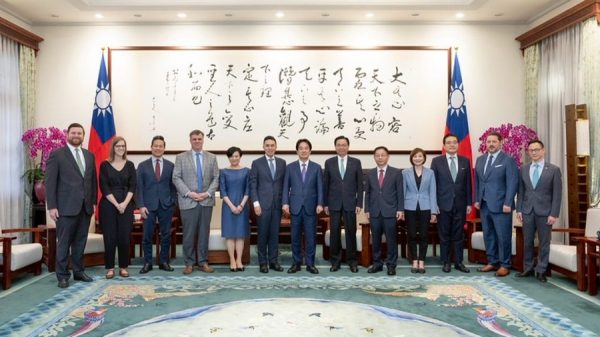
China’s intelligence services have built detailed surveillance files on Taiwan’s political elite
Sam’s warning to Taiwan does not rest on the combat capabilities of China’s military alone. The CCP’s campaign against Taiwan is already underway through intelligence penetration, and most people have not registered its scope.
Sam described a conversation he had during an earlier period in the southern Chinese city of Guangzhou, where he met a senior official from China’s military general staff, the body that oversees military operations and intelligence. That official had previously helped the family of former defense minister Ye Jianying, one of the founding generals of the People’s Republic, control elements of the military intelligence apparatus, and had played a role in facilitating visits to the mainland by Taiwanese military veterans after China opened that channel in the late 1980s.
That official told Sam that China’s military intelligence had compiled detailed profiles on every influential family and senior official in Taiwan. When those individuals traveled to mainland China, their hotel accommodations were pre-arranged with surveillance equipment and audio recording devices installed in advance.
The CCP’s “cross-strait family” messaging, promoted for years through cultural exchanges, business forums, and political outreach, is an intelligence operation dressed as a cultural exchange program. The framing presents Taiwan and the mainland as one family separated by history, seeking reunion. The operational reality behind it is surveillance, blackmail, and the systematic purchase of political influence.
“You are now in a wartime situation, not a peacetime situation,” Sam told his Taiwanese audience. “The CCP is deploying enormous resources, enormous money, buying off enormous numbers of people, including those blocking Taiwan’s weapons procurement. It is preparing for war. How can you collaborate with the enemy while your country is preparing for war? How can you sell out Taiwan?”
Most Chinese soldiers have no desire to invade Taiwan, but that changes nothing
Sam acknowledged that most soldiers in China’s military have no personal desire to invade Taiwan and no real enthusiasm for the mission. The CCP regime does not require its soldiers to want to fight. It requires them to follow orders. The question of what soldiers personally desire is irrelevant to the question of what they will do when commanded. And the Party has been preparing those commands for years.
“As a Taiwanese person, you have to understand that you cannot have any entanglement with the evil CCP regime,” Sam said. “The CCP is a cult-like system. Everything about it is evil. It is like a devil: wherever it points its finger, that place gets destroyed. It has now pointed its finger at Taiwan.”
His recommendations are specific. Taiwan should build a universal military service system along the lines of Israel’s, where both men and women receive combat training and maintain reserve obligations throughout their working lives. Taiwan should invest in the most advanced defensive weapons available, including systems that can deter or degrade a naval invasion before it reaches the shore. And Taiwan should run systematic counter-influence operations against the CCP’s infiltration networks rather than treating political compromise as a domestic matter.

Xi Jinping has chosen the Party’s survival over China’s future, and that choice will destroy the Party
Sam draws a historical parallel that illuminates Xi’s position with unusual clarity. The “reform and opening” era launched by Deng Xiaoping in the late 1970s followed the same internal logic as the Self-Strengthening Movement of the late Qing dynasty in the nineteenth century: an attempt to modernize a failing system without touching its political foundations. The Qing reformers imported Western technology while preserving the emperor’s absolute authority. It was not enough. The dynasty fell in 1912, within a generation of the reform attempt’s collapse, and the conservative officials who had crushed those reforms turned out to be the last government the dynasty ever had.
Xi Jinping, the CCP’s general secretary and China’s top leader since 2012, came to power as the Party’s conservative counter-punch against a liberalizing tendency that, if left to continue, would have ended the Party’s monopoly on power. His response was to halt reform, prioritize the Party’s organizational survival over economic development, and accept the consequences for ordinary Chinese people. Sam puts the internal calculus in terms he attributes to the Party leadership itself: “I don’t need economic development. I don’t need reform and opening. If this continues, the Communist Party will cease to exist. My priority is to protect the party, protect the system. As for the people, look at North Koreans, they’re still alive, aren’t they? You can survive eating grass. Whether you live or die is not my concern. It doesn’t stop me from eating sea cucumber, squid, and lobster.”
Sam believes Xi will be the CCP’s last general secretary, for the same reason the Qing conservatives turned out to be the dynasty’s last government. He closed with a comment on the generation born after 2000, some still teenagers, who have begun acts of open defiance inside China that carry severe personal risk. Their existence, he said, makes the Party’s survival impossible regardless of how long Xi remains in power.
“So, Xi Jinping, whether you live to 150 or 100, as long as these young people exist, as long as this new generation keeps coming, this system cannot sustain itself. The tide of history moves in one direction. No one can stop it.”