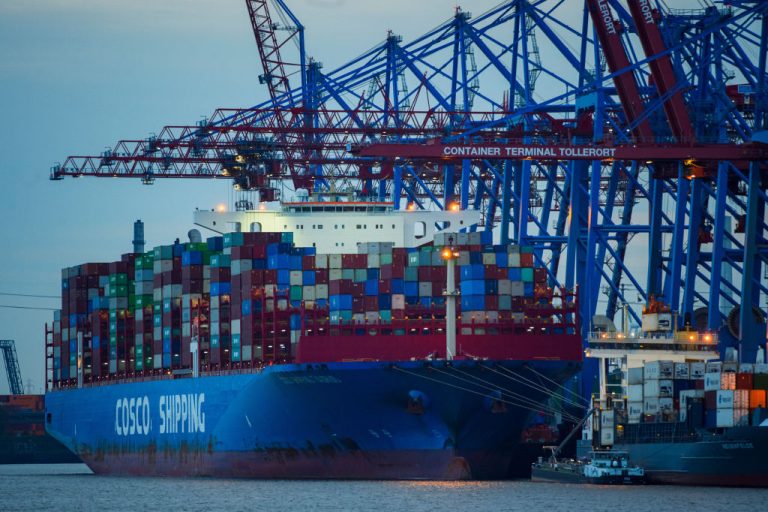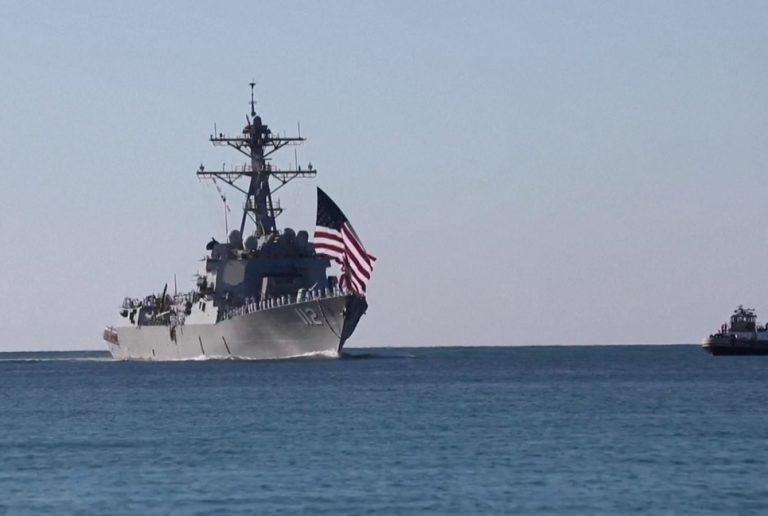
U.S. President Donald Trump announced April 13 (Monday) that the United States would begin blockading ships entering or leaving Iranian ports later that day — a move a Middle East expert said may signal an effort to wind down the conflict.
The announcement came more than 24 hours after U.S.-Iran talks in Islamabad failed to produce a breakthrough. The two sides met Saturday, April 11, in Pakistan’s capital Islamabad, but negotiations ended without agreement. Tensions persisted, and early Monday Trump said the U.S. would move forward with its own blockade of the Strait of Hormuz.
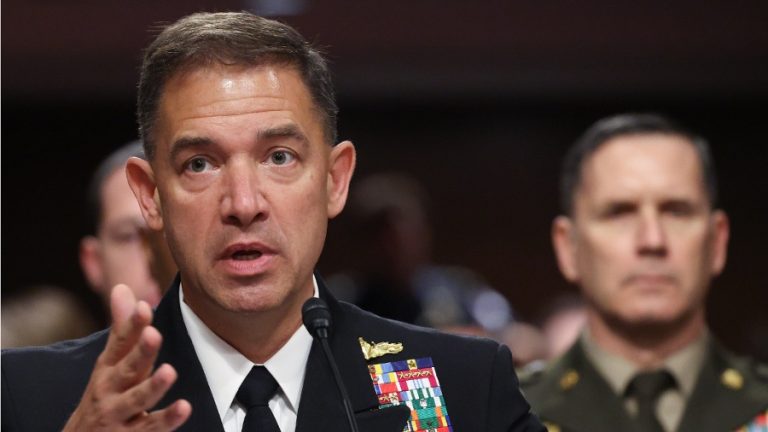
After Trump’s deadline for Iran to lift its own blockade of the Strait elapsed, U.S. Central Command said it would block ’vessels of all nations entering or departing Iranian ports and coastal areas, including all Iranian ports.’
“The United States to Blockade Ships entering or Exiting Iranian Ports on April 13 at 10.00 A.M. E.T. Thank you for your attention to this matter!” Trump wrote on Truth Social.
RELATED COVERAGE
- What the US Iran Ceasefire Means as Geopolitical Tensions Continue
- US-Iran Ceasefire Under Pressure as Leaders Prepare for ‘Islamabad Accord’ Talks in Pakistan
- How China Uses the Iran Conflict to Test AI-Driven Warfare
Iran responded with warnings. Mohsen Rezaee — a former commander-in-chief of the Islamic Revolutionary Guard Corps who has returned to work with Supreme Leader Mojtaba Khamenei — said Iran would resist any such move and warned against foreign military presence in the Strait.
Success
You are now signed up for our newsletter
Success
Check your email to complete sign up
“The United States, just as it suffered a historic defeat against Iran in attempting to open the Strait of Hormuz, is also doomed to fail in any naval blockade,” Rezaee said, according to CNN.
Expert says blockade signals shift in strategy
Dr. Joseph A. Kéchichian, a senior fellow at the King Faisal Center for Research and Islamic Studies in Riyadh, Saudi Arabia, said the move suggests Trump is seeking an alternative to prolonged conflict.
“Trump does not want to continue with the war, which is why he now prefers to impose a blockade—a rather mild rebuke with which the Iranians can live sine die,” Kéchichian told Vision Times in an email April 13.
Trump wrote in a separate post April 12 that disruptions in the Strait of Hormuz had already caused “anxiety, dislocation, and pain” globally.
“Iran promised to open the Strait of Hormuz and they knowingly failed to do so,” he wrote. “They say they put mines in the water… what ship owner would want to take the chance?”
The Iranian state-run Tehran Times described the move as U.S. “pressure” tactics and an attempt to “internationalize enforcement of a potential blockade.” It added that vessels not affiliated with the United States, Israel, or countries involved in recent hostilities could coordinate with Tehran to pass safely.
Kéchichian noted that much remains unclear about the 21 hours of talks in Islamabad, suggesting backchannel progress may have occurred.
“It seems that there is a desire to continue discussions … One suspects that economic concerns will top these talks, as a way for Washington to entice Tehran to make substantive concessions,” he said.
- Putin Asks Russian Oligarchs to Help Fund the Ukraine War
- The F-35 Tutorial That Went Viral in China—and May Have Reached Iran’s Military
- India Advances Its Civil Nuclear Program With Prototype Breeder Reactor
Vice President JD Vance declined to provide details on the talks, specifically where the U.S. and Iranian sides remained in disagreement.
“I won’t go into all the details because I don’t want to negotiate in public after we’ve negotiated for 21 hours in private,” Vance said in Islamabad.
Iran’s top negotiator, Mohammad Bagher Ghalibaf, signaled openness to further discussions in a post on X: “America has understood our logic and principles, and now it’s time for it to decide whether it can earn our trust or not?”
Blockade strategy echoes past playbook
On his Truth Social, Trump on Monday shared an op-ed published in Just the News, titled “The Trump card the president holds if Iran won’t bend: a naval blockade.” It said before capturing Nicholas Maduro, Trump demolished the Venezuelan economy with a naval blockade that stopped the South American nation’s oil revenues and the same could happen with Iran.
The piece, by John Solomon, suggested a blockade could significantly restrict Iran’s oil exports while increasing pressure on countries such as China and India that rely on Iranian crude.
Kéchichian said the blockade is unlikely to be fully effective in the near term.
“There will most likely be very modest changes, with certain ships passing while others are denied access,” he said.
He added that smaller, fast-moving units of Iran’s Revolutionary Guard remain active despite losses to larger naval assets, while the U.S. Navy is working to clear mined waterways to maintain traffic.
“The next two weeks will see a good deal of activity in the straits,” he said.