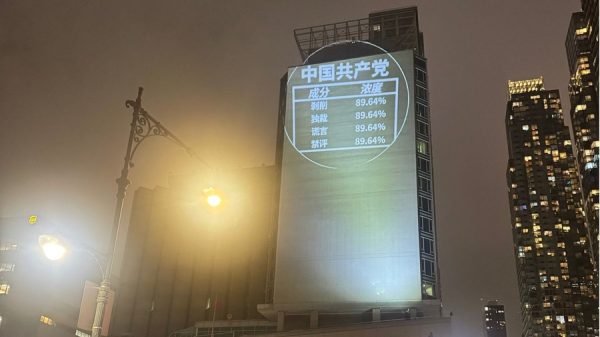
Under the cover of night, a form of political expression using light and imagery quietly unfolded in Canada’s largest city, Toronto. On the evening of April 11, several volunteers from the “China Action” global projection-based peaceful protest group carried out projection actions on the exterior walls of the Chinese Consulate General in Toronto and the Hong Kong Economic and Trade Office in Toronto. This marked the first time the “April Fools’ series projections” landed in Canada, and signaled the campaign’s expansion into a new region of North America.
China Action stated that the projections continued the series’ consistent visual and narrative structure: using official Chinese Communist Party (CCP) rhetoric as titles, then deconstructing it through satirical imagery to expose the gap between political slogans and reality. All works were uniformly tagged with “#NationwideResistanceMovement” to reinforce the coherence and mobilizing power of their message.
The projections focused on “One Country, Two Systems” and the Sino-British Joint Declaration. In the imagery, the CCP’s symbolic hammer and sickle tear apart Hong Kong’s bauhinia flag, visually presenting accusations that Beijing has “torn up its promises.” The press release noted that the 1984 Sino-British Joint Declaration promised that after Hong Kong’s 1997 handover, its existing social system, way of life, human rights, and freedoms would remain unchanged for 50 years. However, in recent years Beijing has referred to the declaration as a “historical document,” and in 2020 implemented the Hong Kong National Security Law—moves widely criticized as fundamentally altering Hong Kong’s legal system and freedoms.
Vision Times interviewed spokesperson Su Yutong. She said Toronto was chosen as the first stop in Canada because local volunteers took the initiative to organize the effort, and because of its symbolic significance. “The Chinese Consulate in Toronto has in recent years been regarded as one of the more active ‘wolf warrior’ diplomatic institutions engaged in transnational repression. We hope to express our stance in this way,” she said.
Compared with similar projection actions previously carried out in the United States and Europe, the Toronto action encountered almost no interference. Su attributed this to differences in security strategies across regions. “Chinese diplomatic missions in the U.S. are typically under heightened, counterterrorism-level security, whereas security at the Toronto consulate was relatively weaker this time. That doesn’t mean they had no contingency plans—only that they didn’t anticipate we would act at this moment.” She added that future actions would be more random, continuing in a way designed to “catch them off guard.”
Issue is directly relevant to Canadian society
Success
You are now signed up for our newsletter
Success
Check your email to complete sign up
Regarding the choice of topic, Su emphasized that focusing on Hong Kong is directly relevant to Canadian society. She noted that in the past, around 300,000 Canadian passport holders lived in Hong Kong, many of them Hong Kong immigrants who had previously moved to Canada and later returned. However, following the implementation of the National Security Law, many were forced to leave Hong Kong and return to Canada due to the changing political environment. “We hope to bring renewed attention within Canadian society—especially among Chinese communities—to the breakdown of the ‘One Country, Two Systems’ promise and its real impact on ordinary people’s lives.”
She further explained that the visual symbolism in the projections is explicit: the hammer and sickle tearing apart the bauhinia flag symbolizes what they describe as the CCP’s “brutal tearing up” of international commitments, and suggests a trend toward the “Xinjiang-ization” of Hong Kong’s political environment. While this characterization is controversial, it reflects deep concern among some overseas Chinese communities about Hong Kong’s current situation.
Since launching on March 31, the “April Fools’ series projections” have been carried out in multiple countries, including both coasts of the United States, Australia, and several European cities. Unlike traditional street protests, the campaign uses light projection technology to briefly display images and slogans on building facades, enabling information dissemination at lower risk. Su believes this format is more appealing to younger participants: “A creative and visually striking project is more likely to spread on social media and generate secondary dissemination.”

Future plans
As for future plans, she made it clear the campaign will continue in Canada and expand to more countries. “Many volunteers reached out to join after seeing our project, which shows this format has a certain level of appeal.”
However, she stressed that projection actions themselves are not the ultimate goal, but rather a “spark.” “We hope to set an example and make Chinese people living in democratic countries aware that they have freedom of speech and the right to assemble, and can openly express their views—rights that cannot be exercised in China,” she said.
At the same time, the campaign also aims to send a message to people inside China. “We are speaking on behalf of those who cannot speak, letting them know the outside world is still paying attention to their situation.”
Notably, Su also mentioned that such actions often trigger “countermeasures” from Chinese authorities, including interference, threats, or intimidation of participants. She believes these reactions are revealing in themselves: “When such behavior occurs in democratic countries, it allows local societies to more clearly see how the CCP exports its stability maintenance and suppression practices overseas.”
By Meng Hao