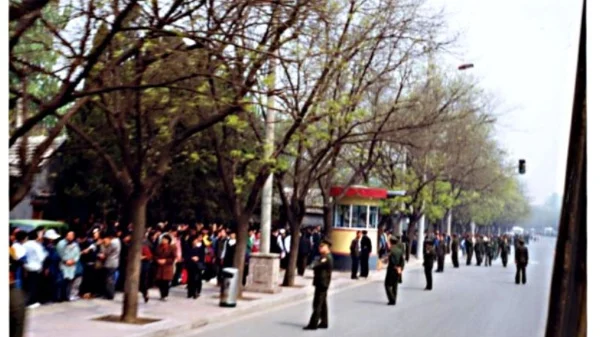
April 25, 1999, is widely regarded by participants and observers as a pivotal moment in modern Chinese history. On that day, large numbers of Falun Gong practitioners gathered along Fuyou Street near Zhongnanhai in Beijing, in what has been described as one of the largest and most orderly public appeals since the founding of the People’s Republic of China.
For years, official accounts characterized the gathering as involving approximately 10,000 people. However, some participants have since suggested that the number may have been significantly higher, reflecting a broader cross-section of society.
Falun Gong, also known as Falun Dafa, is a meditation practice rooted in the principles of truthfulness, compassion, and forbearance. Despite being peaceful in nature, the Chinese Communist Party (CCP) launched a brutal campaign to eradicate the practice in July 1999. Since then, thousands have since perished at the hands of Chinese police, with many adherents today still undergoing routine monitoring, arbitrary travel bans, and arrests.
Speaking out
One practitioner who later documented his experience recalled how the event unfolded unexpectedly. On the evening of April 24, he learned that dozens of practitioners in Tianjin had been detained after attempting to address what they described as inaccurate media coverage.
RELATED: Thousands Rally in Flushing to Mark 27 Years Since April 25 Falun Gong Appeal
Success
You are now signed up for our newsletter
Success
Check your email to complete sign up
When asked whether he would travel to Beijing the following day to appeal, he responded without hesitation: “Go.” Arriving by bus the next morning, he described a scene that left a deep impression. “There was a sea of people, yet everything was orderly,” he said.
Participants came from a wide range of backgrounds, students, professionals, and retirees, standing quietly without slogans or banners. Their stated aim was to seek the release of those detained in Tianjin and to request an environment in which they could practice their beliefs without interference.
Eyewitness accounts
Some later accounts have also included claims about heightened tensions behind the scenes. One practitioner, now living in the United States, recounted receiving a phone call from a relative who worked within a military-affiliated office, warning of the possibility of escalation if the gathering did not disperse.
According to her account, the relative conveyed what was described as a highly sensitive message, “If the practitioners do not leave before midnight, they will be fired upon.”
Despite concerns, the situation was ultimately resolved without violence. Then-Premier Zhu Rongji reportedly met with representatives of the practitioners, initiating dialogue that led to a temporary resolution. Participants recall that several representatives were invited for discussions with government officials. By the evening, after learning that those detained in Tianjin would be released and that authorities had reiterated a non-interference stance, the crowd began to disperse.
Around 9 p.m., practitioners left the area in an orderly manner. Eyewitnesses note that the streets were left in pristine condition, with no visible signs of disruption or littering.
Enduring significance
Though the gathering ended peacefully, it is often viewed as a precursor to subsequent developments. In July 1999, a nationwide campaign targeting Falun Gong practitioners was launched, marking a significant shift in policy. Since then, the April 25 event has been interpreted in different ways—by participants as a peaceful appeal grounded in personal belief, and by authorities as a politically sensitive incident.
According to Minghui, A U.S.-based website that tracks and documents the persecution of Falun Gong, over 4,365 practitioners have since died as a result of torture and abuse at the hands of Chinese authorities. However, based on first-hand accounts from those living under perpetual harassment by the Party’s various security organizations, the practice’s adherents speculate the real number of deaths to be in the hundreds of thousands, or even millions.
Over time, April 25 has come to symbolize differing narratives about civil society, governance, and individual rights in China. For participants, it represents an act of conscience and collective restraint. For others, it highlights the complexities of state-society relations at a critical moment.
One participant reflected that the significance of the day extends beyond the immediate outcome: it remains a point of reference for discussions about how individuals respond to perceived injustice, and how such moments can shape broader historical trajectories.
Editorial note: This article reflects translated accounts and perspectives drawn from participant recollections.