By Cai Siyun, Vision Times
Recent local government data from Shanghai’s Jinshan District has got netizens abuzz about China’s demographic future, with analysts warning that the country may be facing a far more severe population decline than official figures suggest.
According to a statistical report jointly released by Jinshan District’s public security, human resources, and civil affairs departments, the district recorded 108 births and 453 deaths in January 2026, meaning deaths outnumbered births by more than four to one. With a registered population of 534,675, the district’s natural population growth rate fell to negative 7.75 per thousand.
RELATED: The Brunt of a Nation: How China’s One-Child Policy Affected Thousands of Families
The figures drew attention after they were discussed by commentator Jiang Feng in a recent episode of his program Jiang Feng Commentary. Jiang argued that the numbers illustrate a dramatic demographic shift, even in one of China’s most developed regions. “If even Shanghai, the most prosperous city in China, has fallen into a situation where deaths far exceed births,” Jiang said, “then the situation in rural regions with weaker medical resources and severe out-migration may be far more serious.”
Dubious stats
Success
You are now signed up for our newsletter
Success
Check your email to complete sign up
China’s official statistics have long stated that the country has a population of roughly 1.4 billion people, but some demographers and analysts have questioned whether the real number may be significantly lower. Among them is U.S.-based scholar Yi Fuxian, author of Big Country with an Empty Nest, who has argued that demographic indicators such as vaccination data and hospital birth records suggest the population may have been overstated.

Other researchers have attempted alternative calculations. According to Jiang, some foreign analysts have examined China’s historical salt consumption data as a proxy for population size, estimating the actual population could be between 800 million and 1 billion.
Another frequently cited incident was the 2022 leak of a Shanghai police database, which reportedly contained identity records for hundreds of millions of Chinese citizens. Analysts reviewing the dataset estimated that the number of individuals represented in the records ranged from 970 million to about 1 billion.
RELATED: Facing Population Decline, China Introduces 3-Child Policy
Jiang suggested that discrepancies between official statistics and these estimates may be linked to long-standing incentives within China’s bureaucratic system. “Local governments, family planning offices, schools, and hospitals all receive funding based on population counts,” he said. “This created strong incentives over decades to inflate household registration numbers with so-called ‘ghost residents.’”
A demographic turning point
Jiang used Jinshan District’s statistics to illustrate the potential scale of demographic change if similar patterns were replicated nationwide. Applying the district’s birth-to-death ratio across China’s official population base would theoretically produce about 3.4 million births and 14.3 million deaths annually, implying a net population decline of more than 11 million people per year.
“This is no longer simply an aging problem,” Jiang said. “It would represent a demographic avalanche rarely seen in peacetime.”
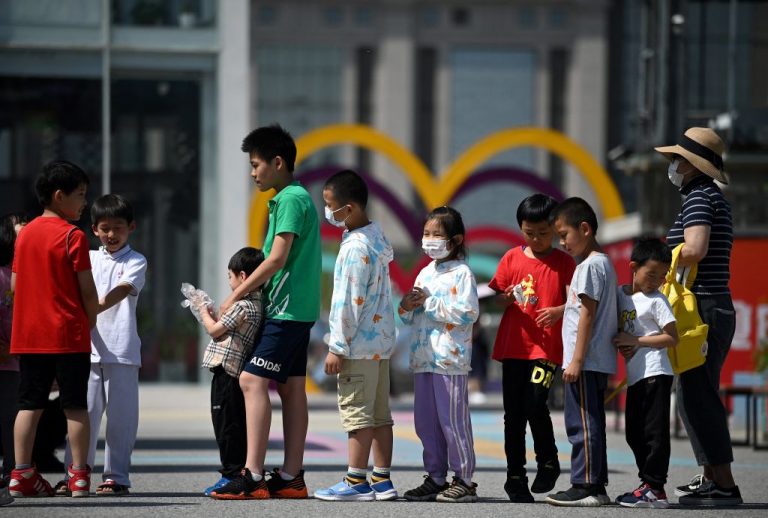
China has already acknowledged a population decline in recent years. Official statistics show the country’s population began shrinking in 2022, the first drop in six decades, largely due to falling birth rates and rapid aging. High housing costs, intense educational competition, and economic uncertainty have been cited as major factors discouraging young couples from having children.

Jiang argued that these pressures have fundamentally reshaped social attitudes among younger generations. “The era of the demographic dividend is over,” he said. “Faced with expensive housing, costly healthcare, and limited upward mobility, many young people see ‘not marrying and not having children’ as a silent form of protest.”
Economic and social pressures
The Jinshan data also included information on social security participation. According to the report, about 67,000 residents were contributing to urban and rural social insurance programs, while roughly 60,000 were receiving benefits.
RELATED: Nearly 13 Million Graduates Enter China’s Job Market as Employment Crisis Deepens
Jiang interpreted the figures as a warning sign for China’s long-term pension sustainability. “For every 10 participants, more than nine are already drawing benefits,” he said. “That means fewer working-age people are supporting a growing number of retirees.”

China’s official policy experts have previously warned about the long-term strain on the country’s pension system. Some projections from Chinese academic institutions have suggested pension funds could face deficits in the coming decades as the population ages.
RELATED: Growing ‘Lying Flat’ Movement Threatens to Derail China’s Ambitions
The demographic debate has also fueled a wave of speculation online. In January, a former Chinese journalist living overseas, Zeng Jieming, wrote on the social media platform X that an anonymous source within China’s civil affairs system claimed the country’s population was far lower than official figures. The whistleblower alleged that China’s population dropped significantly between the 2010 and 2020 censuses, and claimed authorities delayed publishing the latest census results while revising the data.
Despite the controversy, many analysts agree on one point: China is entering a period of profound demographic change. With declining birth rates, a rapidly aging population, and a shrinking workforce, the country now faces the challenge of sustaining economic growth while supporting an expanding elderly population, an issue likely to shape China’s future for decades to come.