By Zheng Zhiqiao
Tamsui Taiwan historic sites reward any visitor willing to walk slowly. The town sits at the mouth of the river that shares its name, about 30 minutes by metro from central Taipei. Its old name, “Hobe” (滬尾), survives in the names of some of its monuments. Getting there is easy; leaving is harder. The town rewards slow, unhurried walking, and the concentration of well-preserved historic sites along its main streets is unlike anywhere else in Taiwan.
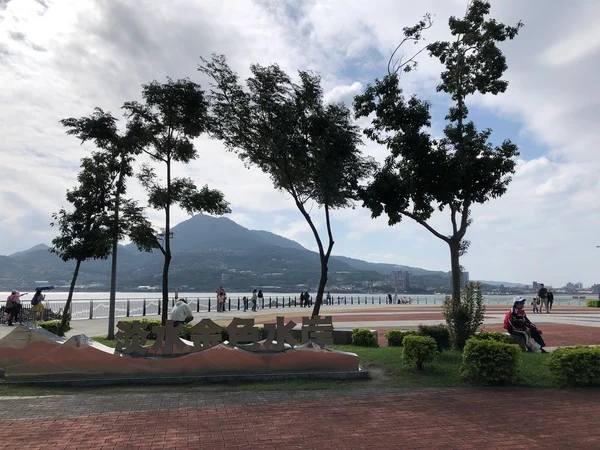
I visited on the occasion of an annual family gathering, using the trip as a pretext for a half-day tour of Tamsui’s historic sites. The route I took was simple: out of Tamsui MRT station, along the riverside promenade, up through the old streets to the hilltop forts and colonial residences, then back down to the waterfront for the evening.
Fort San Domingo and the British consulate: 300 years of foreign ambition in a single compound
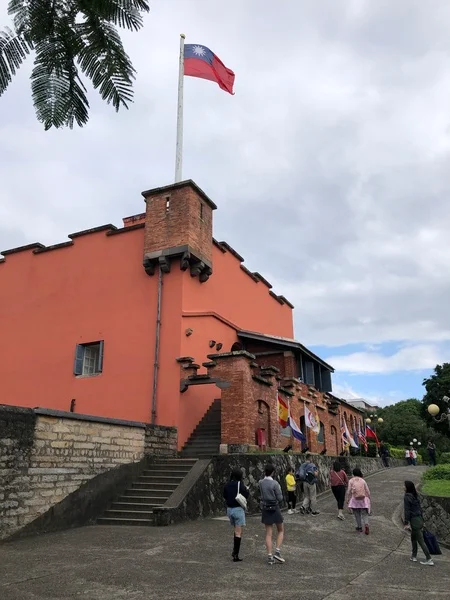
The most recognizable landmark in Tamsui is Fort San Domingo, a red-walled stronghold that has flown the flags of nine different nations over its long history. Nine flags hang from the battlements today, a frank acknowledgment of the fort’s complicated past.
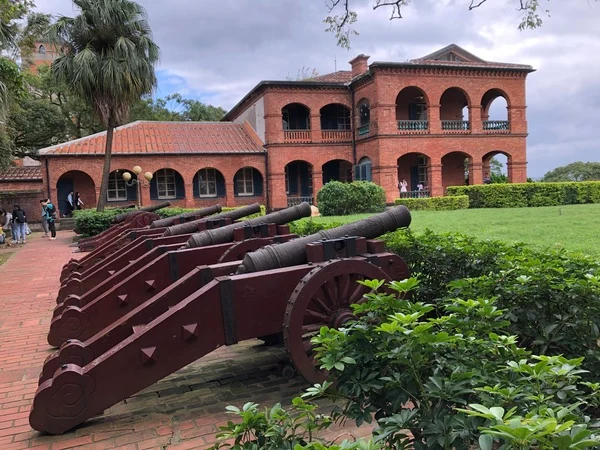
The original structure was built by the Spanish in 1628 and was then called Fort Santo Domingo. The Dutch destroyed it and rebuilt a stronger fortification on the same site, calling it Fort Antonio. In 1867, Britain leased the compound and used it as a consulate; a separate consular residence was later added alongside. Between the two buildings, a pair of bronze cannons manufactured during the reign of the Qing emperor Jiaqing sit on open display.
Success
You are now signed up for our newsletter
Success
Check your email to complete sign up
The fort’s position gives it commanding views of the surrounding area. Its main tower is square in plan, with exceptionally thick walls built in a technique that layers stone on the outside and brick within. The outer walls were originally grey-white; British administrators later painted them the deep red they bear today and added a viewing terrace, crenellations, and gun ports. The fort’s name, incidentally, has nothing to do with its color. Local residents called the Dutch colonizers “red-haired foreigners” (紅毛番, hong mao fan) because of their lighter hair, and the fortification they built became known by the same epithet: Red Hair Fort.
The British consular residence next door occupies a different architectural register entirely. It is an elegant two-story red-brick building with a southern Fujian-style red-tile roof, its interior fitted out to evoke a Victorian-era British household, with a sitting room, dining room, pantry, and study restored with period furniture and personal effects.
Oxford College, Tamsui: the first Western-style school in Taiwan, built with money from Canada
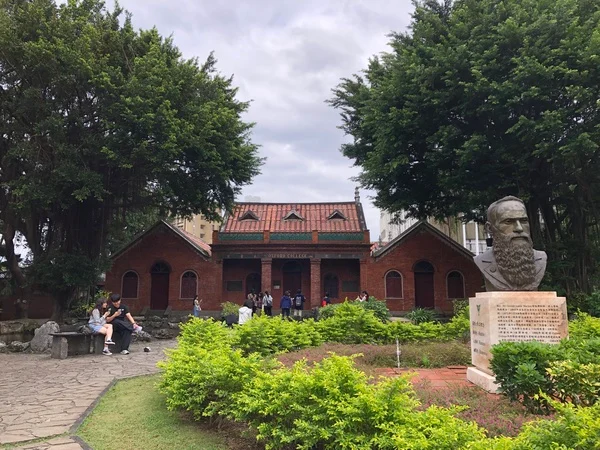
A short walk from the consular compound brings you to Aletheia University, widely regarded as the most beautiful campus in Taiwan. Just inside the grounds stands Oxford College (理學堂大書院), the first institution of Western-style education on the island.
The college owes its existence to Dr. George Leslie Mackay, a Canadian Presbyterian missionary who landed at Tamsui in 1872 and began preaching and teaching in the open air with almost no resources. He later returned to Canada to raise funds, and the residents of Oxford County, Ontario responded generously. Mackay used that money to design and personally oversee construction of this school, naming it in honor of his donors’ home county. He dedicated nearly 30 years of his life to Taiwan, and his motto, “Rather burn out than rust out,” still appears in the institution’s literature.
The building itself is a hybrid of East and West. The bricks and roof tiles were shipped from Xiamen, on the coast of Fujian province across the Taiwan Strait. The mortar was mixed from glutinous rice, brown sugar syrup, lime, and sand, a traditional Taiwanese construction technique that predates Portland cement on the island. The college courtyard is beautifully landscaped, shaded by mature trees, and the whole compound has a quiet, timeless quality. Film director and pop star Jay Chou chose it as the primary location for his 2007 film Secret, which he wrote, directed, and starred in.
The Tada Eikichi residence: a Japanese colonial mayor’s house with Taiwan’s first domestic running water
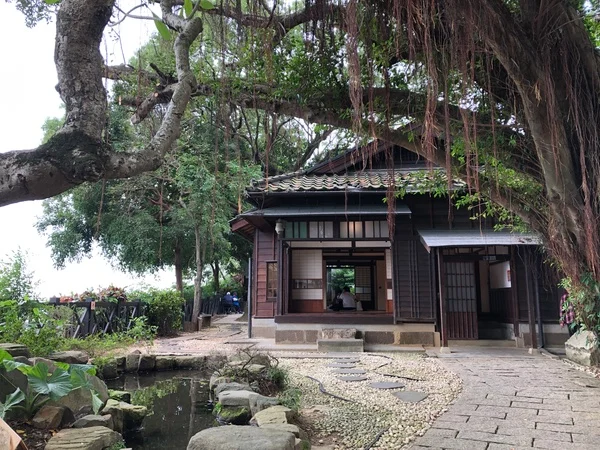
The lane leading to the Tada Eikichi residence is one of the most attractive stretches of the entire walk: tree-canopied, gently curving, and almost entirely free of traffic. The house sits partway up a hillside, surrounded by greenery, with a steep retaining wall at the front and wide views of the Tamsui River and Guanyin Mountain below.
Tada Eikichi served as mayor of Tamsui Township during the Japanese colonial period. His private residence, completed in 1937, is a traditional Japanese-style house with no Western-influenced additions. The structure is built from red cypress; the roof is covered in black tiles; the outer walls are constructed in the “rain-board” style, with horizontal planking; and the interior walls are made of bamboo-weave plastered with mud, a technique common in traditional Japanese residential architecture. The house has the particular stillness that old wooden buildings acquire over time.
Beyond its architectural interest, the Tada residence holds a practical distinction: it was the first private home in Taiwan to have indoor running water. For that reason alone it was designated a heritage site, and it remains the first Japanese-style house in Tamsui to receive official historic monument status.
The Ichiteki Memorial House: a Japanese farmhouse reassembled in Taiwan as a gesture of solidarity between earthquake survivors
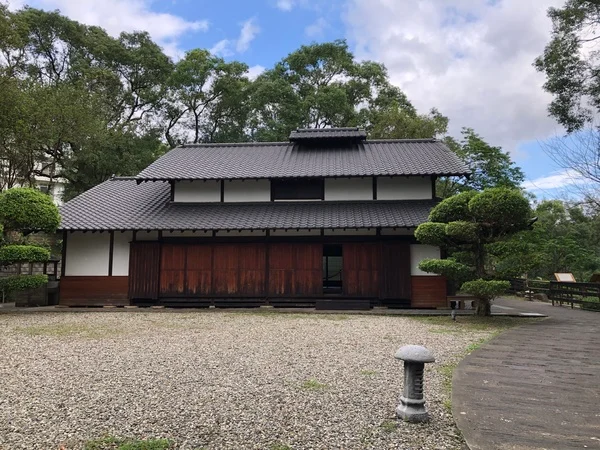
From the Tada residence, the walk leads back down to Zhongzheng Road and into the Peace Park, a large, well-maintained public green space built to commemorate the Taiwanese and French soldiers who died in the Sino-French War of 1884–85. Within the park stands one of Tamsui’s most quietly moving sites: the Ichiteki Memorial House, a traditional Japanese farmhouse that traveled from Fukui Prefecture to Taiwan as an act of solidarity between two disaster-hit communities.
The house was built in 1915 in the town of Obama, in Fukui Prefecture, by Kakuji Mizukami, the father of the celebrated Japanese author Suiin Mizukami. The structure survived the Great Hanshin Earthquake of January 1995, which registered magnitude 7.3 and killed more than 6,000 people in the Kobe and Osaka region. In the wake of that disaster, the owner donated the house to serve as a communal gathering place for survivors.
When Taiwan’s own magnitude-7.3 earthquake struck Nantou County in September 1999, killing more than 2,400 people and destroying tens of thousands of homes, Hanshin earthquake survivors felt an immediate kinship with the victims. They crossed the ocean to help with reconstruction efforts and, as a gesture of solidarity, gave the house to Taiwan.
A joint Taiwanese and Japanese team spent roughly five years carefully dismantling the structure in Fukui, transporting every component, and reassembling it on its current site in Tamsui. The house was built entirely without metal fasteners; its framework of beams, mortise-and-tenon joints, and bamboo-weave earthen walls is held together by the skill of the carpenters alone. Standing inside it, you feel the weight of that fact.
Hobe Fort: the largest surviving Qing-dynasty artillery battery in Tamsui
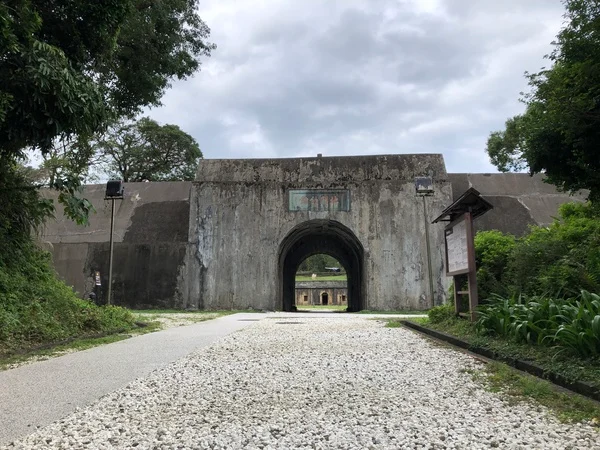
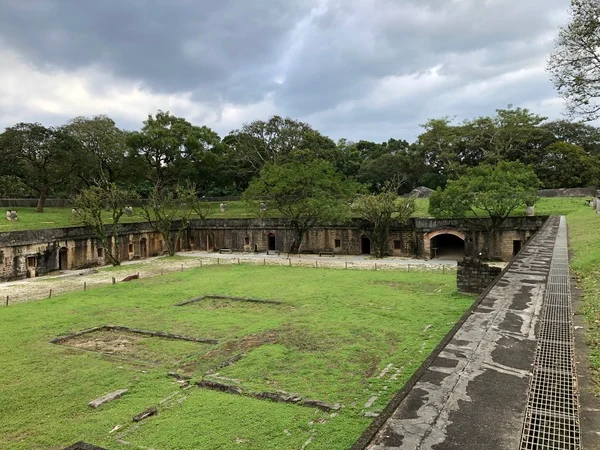
A short uphill walk from the Peace Park leads to Hobe Fort (沪尾礮台), the largest and best-preserved of Tamsui’s historic fortifications. The fort was constructed in 1886, after the conclusion of the Sino-French War, by Liu Mingchuan, the first governor-general of Taiwan under the Qing dynasty, who undertook a systematic strengthening of the island’s coastal defenses. Hobe Fort’s specific mission was to guard the port of Tamsui and the approaches to northern Taiwan.
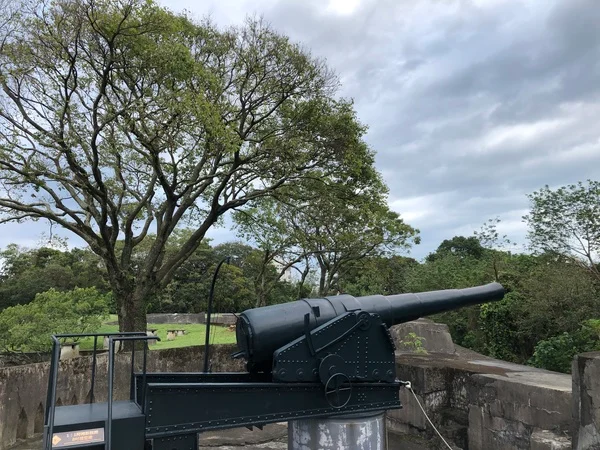
The battlements are worn and mottled with age but impressively solid, and the arched main gate retains the inscribed stone tablet bearing Liu Mingchuan’s own calligraphy: “The Key to the Northern Gate” (北門鎖鑰). The fortified enclosure is square, thickly walled, and overgrown with greenery, with an internal network of passageways that connects the various defensive positions. Visitors can walk through the tunnels and emerge on top of the walls, where a full-scale replica of an Armstrong 8-inch breech-loading cannon, seven meters long, stands on display.
A century and more of peace has settled over it like the weather.
Fisherman’s Wharf and the Danjiang Bridge: a sunset boardwalk and a record-breaking new crossing
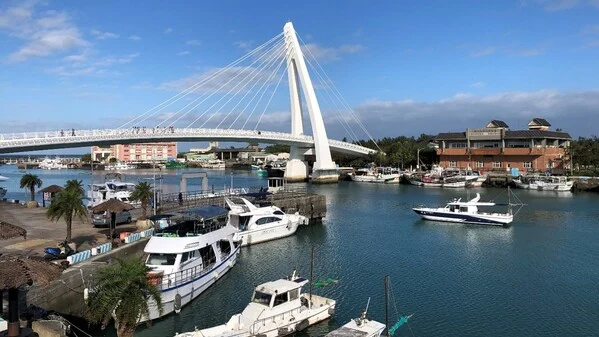
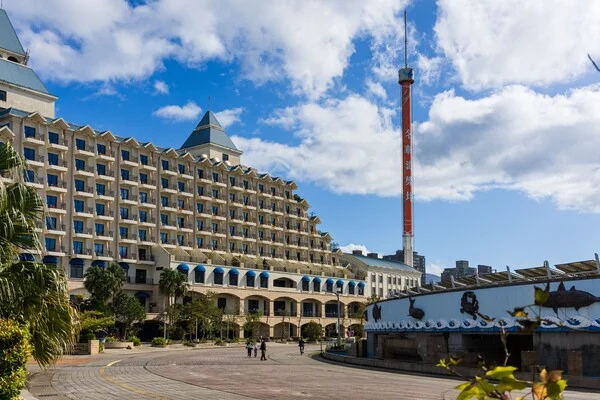
By the time I had worked my way through the fort, my legs were genuinely tired. With the afternoon running short, I boarded a bus for Fisherman’s Wharf, where the family gathering was to take place at the Fullon Hotel, a striking building designed to resemble an ocean liner.
From the bus window, I caught sight of the Danjiang Bridge, a new crossing now nearing completion that will link Tamsui on the east bank with Bali on the west, spanning 920 meters at its main section. When complete, it will be the longest single-tower asymmetric cable-stayed bridge in the world and the first bridge of any kind designed to carry motor vehicles, motorcycles, bicycles, pedestrians, and light rail simultaneously.
The bridge design was selected through an international competition held in 2015. One criterion in the judging was the impact on Tamsui’s celebrated sunsets, which have been a tourist draw for generations and rank among the “Eight Views of Tamsui” recorded in historical documents. The winning design, by the late Iraqi-British architect Zaha Hadid, draws its flowing silhouette from the image of a Cloud Gate dancer poised to leap. The bridge’s curves are calibrated to frame rather than obstruct the view of the sun going down over the river.
Fisherman’s Wharf itself is built on a floating dock that rises and falls with the tide. The boardwalk observation deck and the white sail-shaped pedestrian bridge known as Lovers’ Bridge are both popular vantage points for watching the sunset. The sky that evening was overcast, and the famous view would have to wait for another visit.
The family arrived gradually at the Fullon Hotel as dusk came on. The sea wind picked up off the river.