According to the Taipei Times, Taiwan’s Executive Yuan (the central executive branch of the government) proposed the Special Act on the Procurement of Domestically Developed Defense Drones on Friday, June 18. The bill would allocate $6.6 billion USD (NT$210 billion) to support domestic drone development and offset funding cuts made by the opposition Blue-White alliance to defense-related spending.
The Blue-White alliance defines a political partnership between Taiwan’s two main opposition parties, the Kuomintang (KMT) which represents the color blue and the Taiwan People’s Party (TPP) which is represented by the color white. During the central government budget review, the Blue-White alliance temporarily blocked the special act from being placed on the Legislative Yuan’s agenda.
The KMT party plans to submit its own version of the bill this week, incorporating tax incentives and other measures to support the industry, the Taipei Times reported on Tuesday.
Executive Yuan’s drone bill temporarily shelved
The Executive Yuan approved the draft Special Act on the Procurement of Domestically Developed Defense Drones at its June 18 cabinet meeting and submitted it to the Legislative Yuan for deliberation, according to a statement released on the same day.
Under Article 83, Paragraph 1 of the Budget Act, the bill authorizes a special budget with a ceiling of NT$210 billion. The proposed spending period would run from Aug. 1, 2026, through Dec. 31, 2031, with domestically developed military drones to be procured on a year-by-year basis.
Success
You are now signed up for our newsletter
Success
Check your email to complete sign up
However, when the Legislative Yuan handled committee reports on June 25, lawmakers from the Blue-White alliance—the Kuomintang (KMT) and the Taiwan People’s Party (TPP)—proposed postponing the bill from being formally placed on the legislative agenda. Leveraging their majority, they passed the motion by vote, the Taipei Times wrote.
The media reported that KMT plans to draft its own bill which would increase total funding to $7.54 billion USD (NT$240 billion).
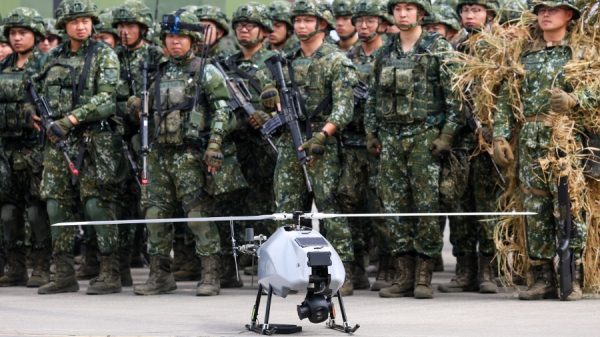
Executive Yuan: ‘There can be no gap in national defense’
Executive Yuan spokesperson Lee Hui-chih said in a written statement that, amid rapidly evolving geopolitical conditions and changes in the nature of modern warfare, building asymmetric defense capabilities has become a race against time. However, the annual budget process—constrained by preparation and legislative review timelines—cannot fully keep pace with the rapid evolution of unmanned systems technology.
She added that the central government’s budget for this year has been before the Legislative Yuan for 302 days without completing its review, further highlighting the current system’s inability to respond promptly to national defense needs.
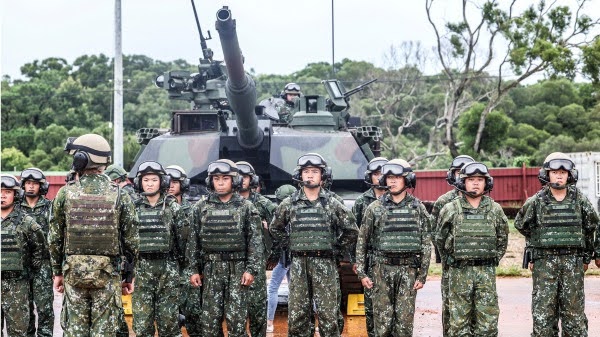
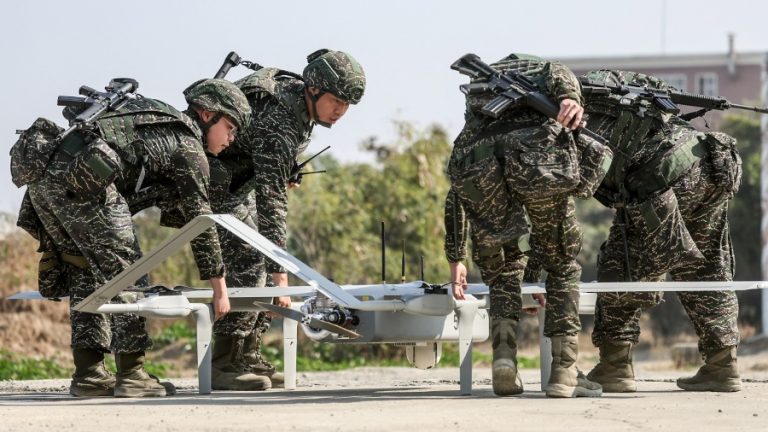
Lee said the Executive Yuan’s proposed special act and special budget are intended to concentrate resources on the indigenous research and development, local production, maintenance capacity, and establishment of a non-China supply chain for unmanned systems.
She noted that drones have become a key component of military capability-building worldwide, demonstrating low-cost, high-efficiency intelligence, surveillance and reconnaissance (ISR) and precision strike capabilities in international conflicts. They are also essential to strengthening national defense resilience. Opposition lawmakers, she said, have previously introduced proposals to promote Taiwan’s drone industry and supply chain, indicating that both the ruling and opposition camps recognize the importance and urgency of developing unmanned systems.
Lee stressed that “there can be no gap in national defense,” adding that force modernization “cannot wait even a single day.” National security, she said, “should not be a partisan issue.” She urged lawmakers across party lines to prioritize the national interest by swiftly referring the special act to committee for review, jointly strengthening Taiwan’s asymmetric defense capabilities and demonstrating the country’s determination to safeguard democracy and defend itself.
“Defense self-reliance and the development of the nation’s critical industrial supply chains should not be obstructed by political maneuvering,” she said.
Addressing criticism that the Executive Yuan was using a special act to circumvent legislative oversight, Executive Yuan spokesperson Lee Hui-chih said the government fully respects the Legislative Yuan’s oversight authority. She explained that both the proposed special act and the accompanying special budget must still undergo legislative review in accordance with the law and remain subject to public scrutiny. Claims that the proposal is intended to “bypass oversight,” she said, are “inconsistent with the facts.”