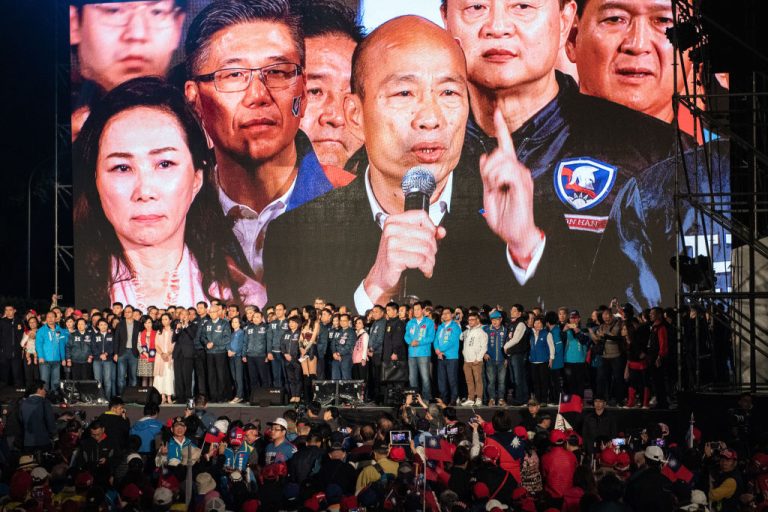
A Taiwanese cross-party delegation of lawmakers led by Legislative Speaker Han Kuo-yu met with officials from the U.S. Department of Defense and the White House on June 25.
The two sides exchanged views on issues including joint Taiwan-U.S. research and production, assistance for Taiwan’s development of the unmanned vehicle industry, delays in U.S. arms deliveries, and U.S. cross-Strait policy, reported Taiwan’s Central News agency.
The U.S. side reiterated that its policy toward Taiwan remains unchanged and that it will continue supporting Taiwan in strengthening its self-defense capabilities.
US reaffirms its commitment to Taiwan during meeting with White House officials
The Han Kuo-yu led eight-member bipartisan delegation reached the United States for a six-day trip on June 21. Following a stop in Phoenix, the group traveled to Washington, D.C. on June 25 and met with seven Democratic U.S. senators before attending a welcome reception hosted by Taiwan’s Representative Office in the United States, where they interacted with more than 30 members of the U.S. House of Representatives.
According to a press release issued by Taiwan’s Legislative Yuan, the delegation, accompanied by Taiwan’s Representative to the United States, Alexander Yui (俞大㵢), met separately on June 25 (U.S. Eastern Time) with officials from the U.S. Department of Defense and the White House.
Success
You are now signed up for our newsletter
Success
Check your email to complete sign up
Han Kuo-yu briefed the U.S. side on the current state of Taiwan’s legislature, noting that the Legislative Yuan has only 113 lawmakers, yet is responsible for reviewing major national legislation and budgets. Under the current parliamentary structure, where none of the three major political parties holds a majority, differing views on policy issues often lead to diverse and vigorous debate. However, he stressed that all parties share a strong consensus on strengthening Taiwan’s self-defense capabilities.
Han emphasized that the people of Taiwan cherish democracy and freedom, saying that safeguarding democracy is “embedded in the DNA of all Taiwanese people.” He added that peace and stability across the Taiwan Strait are not only vital to Taiwan’s security but also have significant implications for regional and even global stability and development.
Therefore, in the face of serious challenges, preventing conflict is a key responsibility of Taiwan’s leaders and the Speaker of the Legislative Yuan. He said the Taiwanese people recognize that U.S. assistance is crucial to safeguarding Taiwan’s security, expressed gratitude for Washington’s long-standing support, and voiced hope for deeper cooperation with the United States.
Han also said that, given Taiwan’s difficult international situation, many Taiwanese inevitably feel isolated. As the current security environment grows increasingly severe, he said, the more friends Taiwan has and the greater its international visibility, the safer Taiwan will be. He expressed hope that the United States would continue helping ensure that the world sees Taiwan.
According to the Liberty Times, during two separate meetings with officials from the U.S. Department of Defense and the White House, the two sides exchanged views on issues including joint Taiwan-U.S. research and production; U.S. assistance in developing Taiwan’s unmanned systems industry; Delays in U.S. arms sales and deliveries; and U.S. policy toward cross-Strait relations.
U.S. officials welcomed the visit by the bipartisan Taiwanese legislative delegation and reaffirmed that U.S. policy toward Taiwan remains unchanged, adding that the United States will continue to support Taiwan in strengthening its self-defense capabilities.
Exchange at the heritage foundation
In addition, the delegation attended a luncheon discussion with the Heritage Foundation, where Executive Vice President Derrick Morgan led a group of scholars and experts in the exchange.
The delegation also took advantage of a break in its official schedule to visit the U.S. National Archives. The Archives specially arranged for the delegation to view several rare historical documents related to Taiwan, including the original signed copy of the Taiwan Relations Act, personally signed by President Jimmy Carter, which is normally not part of the permanent exhibition and was specially retrieved from the archives, as well as the original congressional joint resolution authorizing the president to assist in Taiwan’s defense.
These documents highlighted key milestones in the development of U.S.-Taiwan relations. The delegation also had the opportunity to view the original U.S. Declaration of Independence of 1776, commemorating the 250th anniversary of the founding of the United States.
That evening, Han Kuo-yu and the delegation hosted a banquet in the name of Taiwan’s Legislative Yuan for members of the Taiwanese community and Taiwanese business representatives in the Washington, D.C., area. Nearly 120 guests attended. Han greeted the overseas Taiwanese and business leaders, sharing highlights from the delegation’s U.S. visit. Although the trip was brief, he said the delegation had already met with 40 members of the U.S. Senate and House of Representatives, leaving him deeply impressed by the strong support for Taiwan in the U.S. Congress.
He added that the Legislative Yuan would continue working together with overseas Taiwanese communities to advance Taiwan’s diplomacy.
US lawmakers back Taiwan’s efforts to strengthen self-defense
Han Kuo-yu and the delegation met in the Senate Foreign Relations Committee’s conference room in the U.S. Capitol with seven Democratic senators on the afternoon of June 24.
These senators include: Jeanne Shaheen (D–New Hampshire), Ranking Member of the Senate Foreign Relations Committee; Tammy Duckworth (D–Illinois); Elissa Slotkin (D–Michigan), Co-Chair of the Senate Taiwan Caucus; Brian Schatz (D–Hawaii); Jacky Rosen (D–Nevada); Jeff Merkley (D–Oregon); and Andy Kim (D–New Jersey).
The two sides held in-depth discussions on strengthening U.S.-Taiwan relations and Taiwan’s national defense and security.
Participants also exchanged views on enhancing defense and security cooperation, promoting joint Taiwan-U.S. defense industrial collaboration and co-production of drones, and deepening cooperation among partners in the Indo-Pacific region.
The U.S. senators emphasized that “the U.S. Congress will continue supporting Taiwan in strengthening its self-defense capabilities. U.S. arms sales to Taiwan should not become a bargaining chip in negotiations.”
They also hoped that the United States and Taiwan would work together to “enhance security and resilience and jointly safeguard regional peace and stability.”

Seven senators issue statement: Taiwan should act immediately to invest in defense production
The seven U.S. senators issued a joint statement saying that the U.S.-Taiwan relationship is founded on shared democratic values and a common commitment to peace and stability in the Indo-Pacific.
They said they have maintained close and friendly ties with Taiwan, remain committed to providing Taiwan with the weapons it needs for self-defense, and support Taiwan’s efforts to deter the growing threats posed by the Chinese Communist Party (CCP).
The senators said they were encouraged by the bipartisan effort in Taiwan’s Legislative Yuan to advance a US$25 billion special defense budget, noting that the package would strengthen Taiwan’s self-defense capabilities, including through the acquisition of U.S.-supplied weapons.
The senators further stressed that Taiwan’s commitment to investing in its own defense is essential. They encouraged Taiwan to act immediately to make additional investments in domestic defense production.
The senators also urged the Trump administration to stop delaying approximately US$14 billion in arms sales to Taiwan, noting that the package had already been approved by Congress six months earlier.