As the Russia–Ukraine war continues, Taiwan’s drone exports to Europe surged more than 40-fold in 2025, with equipment being transshipped through European countries to Ukraine, reported Nikkei Asia.
Taiwan’s “Center for Technology, Democracy and Society” stated that Ukrainian recognition of Taiwanese technology represents an opportunity.
As the war in Ukraine continues, Kyiv is working to rebuild its defense industry with a core goal of reducing dependence on Chinese drone components, said a report by The Guardian. In this context Ukrainian officials are concerned that Beijing could further tighten export controls.
The Ukrainian independent think tank Snake Island Institute (SII) noted that Taiwan is known for its strong technological capabilities, particularly in microelectronics, navigation systems, and battery technology — areas where Western suppliers are less competitive. As a result, Taiwan has become a preferred alternative supply source for Ukrainian drone manufacturers, according to the media report.
Data shows that Taiwan’s drone exports to Europe surged more than 40-fold in 2025. Poland and the Czech Republic were the main markets, and export volumes in the first quarter of 2026 have already surpassed the total for the previous year. It is reported that these systems are being transshipped through European countries to Ukraine.
Success
You are now signed up for our newsletter
Success
Check your email to complete sign up
However, Taiwanese drones still face pricing challenges. Thunder Tiger General Manager Su Sheng-chieh told The Guardian the company had sent drone systems to Ukraine for testing. The results were satisfactory to the Ukrainian side, but large-scale procurement ultimately stalled due to cost.
The report notes that Chinese-made components still hold a dominant advantage in both price and supply volume. In the short term, Ukraine finds it difficult to fully replace Chinese components, including batteries and magnets produced elsewhere, because the supply of related raw materials still heavily depends on China.
However, Bohdan Diorditsa, a senior executive at Ukrainian drone manufacturer Vyriy, told the media that the local industry is increasingly inclined to use Taiwan-made components.
The report also noted that Taiwan itself faces difficulty reducing its dependence on China. Most drones are still purchased from China, including civilian, commercial, and even some military systems.
Taiwan hopes to establish a completely “non-red” drone industry — meaning free of Chinese supply chains — by 2027, and aims to produce one-third of its required rare-earth magnets domestically by 2030.
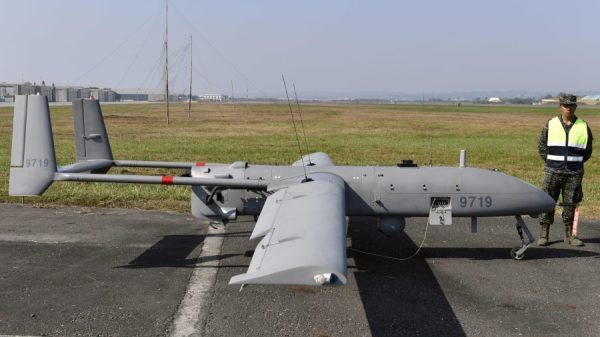
Taiwan’s technological strength recognized by Ukraine
According to a report by the Central News Agency (CNA), Taiwan’s Center for Technology, Democracy and Society(DSET) released a report showing that Taiwan exported 136,010 drones to Europe in the first quarter of 2026.
This figure already exceeds Taiwan’s total exports of finished drones to Europe in 2025, which amounted to 107,433 units.
Europe is the largest export market for Taiwan-made finished drones. However, DSET emphasized that most of these products are low-cost small drones and have not yet been incorporated into formal government procurement programs, meaning sales remain unstable.
Overall, the report said Taiwan’s drone industry still faces numerous constraints, including limited production capacity, reliance on foreign technology, and continued dependence on China for raw materials used in some components.
The report also noted that Ukraine continues to seek secure overseas joint-venture drone production facilities.
“For Taiwan, this represents an opportunity: leveraging its existing strengths in manufacturing, semiconductors, and other advanced microelectronics technologies, it can provide component supplies and joint-venture cooperation to Ukraine,” said the report.
Chiayi county govt. supports $39 billion defense procurement plan
In response to the business opportunities presented by the drone industry, Taiwan is preparing to capitalize on the moment. Several county governments like the Chiayi government have come on board for the defense procurement plan and have called for more investments in the county.
According to Taiwan’s Executive Yuan, the government plans to invest NT$44.2 billion to promote the development of the unmanned vehicle industry, aiming to achieve an industry output value of NT$40 billion by 2030. A major focus will be establishing an industrial cluster in Chiayi that integrates AI chips, flight-control systems, and automated production.
Taiwan’s government also hopes to cooperate with allies and like-minded countries “to make Taiwan the Asia-Pacific hub of the democratic drone supply chain.”
However, opposition parties have proposed removing the “commercial procurement” and “commissioned production” provisions from the draft special national defense bill, raising concerns that such changes could negatively affect the development of Taiwan’s drone industry.
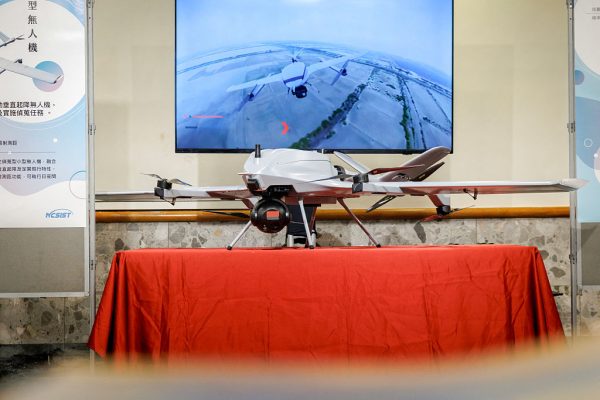
According to a report by The Liberty Times, the Chiayi County Government issued a press release on the evening of May 7 emphasizing that the development of a drone industry cluster — from research and development to testing and mass production — requires long-term, stable policy support and sustained market demand.
The county government supported the NTS 1.25 trillion ($39.3 billion) original arms procurement plan of the national government which the legislature passed on Saturday with a spending capped at NT$780 billion.
The county government expressed hope that Taiwan’s central government and legislature would continue supporting related infrastructure projects and budget allocations in order to strengthen Taiwan’s democratic supply-chain strategy and secure a key position for Taiwan in the global “non-red” supply chain.
The statement added that drones represent a convergence platform for semiconductors, electronics and communications, precision machinery, materials engineering, chemical industries, and plastics processing.
It described the drone sector as a crucial tool for transforming and upgrading Taiwan’s traditional manufacturing industries across generations. With support from the central government budget, these traditional industries could successfully enter the global dual-use military and civilian market, enabling “Made in Taiwan” products to transition from low-margin contract manufacturing into high-value strategic technology.
By Li Jingyao, Vision Times