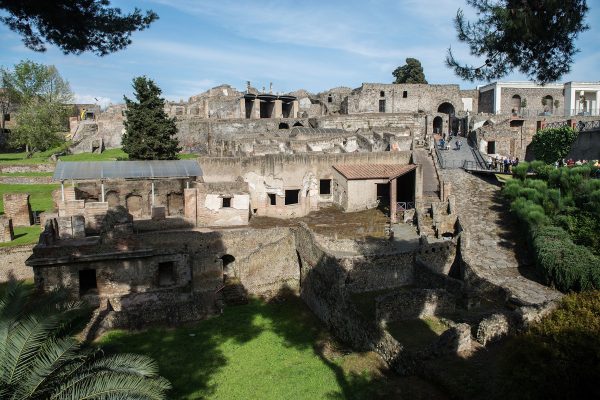
Founded in the 6th century BC, Pompeii was incorporated into the Roman Empire in 89 BC together with the nearby town of Herculaneum. As a coastal city bathed in the warm sunshine of the Italian Peninsula, Pompeii’s pleasant climate quickly made it a gathering place for Roman elites and wealthy families.
The prosperous and luxurious city of Pompeii
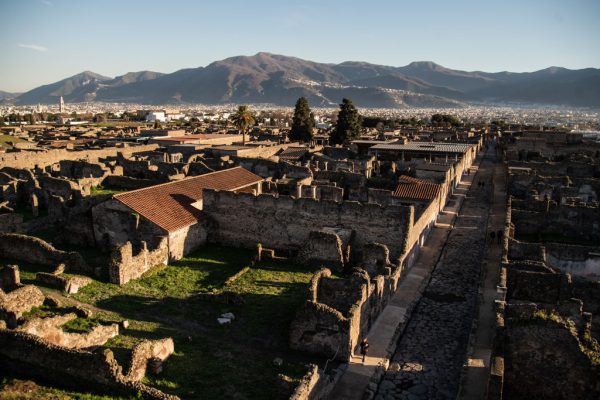
The excavated ancient city of Pompeii covers an area of about 1.8 square kilometers and was surrounded by walls approximately 4,800 meters long. Two main roads running east-west and north-south divided the city into nine districts. Narrow streets crisscrossed throughout, while buildings were arranged in an orderly fashion. The roads were paved with large cobblestones, and the deep ruts worn into the stones reveal the heavy traffic and bustling activity of the time.
Along both sides of the streets stood countless taverns, brothels, bathhouses, gold and silver workshops, bakeries, grocery stores, olive oil shops, caviar stores, weaving workshops, pottery workshops, and many other businesses, all displaying the city’s former prosperity and extravagance.
Bathing culture was one of Pompeii’s defining features. The city contained several large public baths, supplied with spring water carried from the mountains through elevated aqueducts into public bathhouses and private homes. Pompeii’s residents conducted business, chatted, and reunited with friends in the public baths. The bathhouses were carefully designed, complete with changing rooms, massage rooms, beauty rooms, and other facilities. Floors were heated, and the baths included cold, warm, and hot pools comparable to modern facilities. There were even bath areas reserved exclusively for women in the innermost sections.
In the city of Pompeii, which had a population of about 20,000, there was an arena capable of holding 12,000 spectators. There was also a theater with seating for 5,000 people, where concerts and comic performances were staged. Brothels were found throughout the city, while wealthy nobles and merchants indulged in extravagant spending. An atmosphere of unchecked pleasure and luxury permeated the entire city.
Success
You are now signed up for our newsletter
Success
Check your email to complete sign up
A catastrophic disaster
However, when history reached AD 79, the pleasure-seeking residents of Pompeii never imagined that a devastating catastrophe was quietly approaching them. In August of AD 79, Mount Vesuvius, near Pompeii, began emitting plumes of white smoke, and small earthquakes occurred continuously. Yet people preoccupied with making money and pursuing pleasure paid little attention. The extravagant life of the noisy city continued as usual.
At noon on Aug. 24, AD 79, accompanied by a deafening explosion, Mount Vesuvius erupted. The surging magma shot into the sky, while massive black clouds carrying scorching volcanic ash rushed toward the people. In an instant, the sky darkened, and the earth shook violently. Afterwards, the eruption triggered torrential rains. Rainwater swept stones, mud, and volcanic ash down the mountainside, forming enormous mudslides that thundered toward the plains below.
People fled toward the seashore, but could they escape this disaster descending from the heavens? In merely a dozen hours, the luxurious cities of Pompeii and Herculaneum vanished from human sight.
The terrifying scenes of escape
After lying buried underground for more than 1,600 years, Herculaneum was rediscovered in 1738, and Pompeii was discovered in 1748. However, archaeologists did not begin systematic excavations of the two ancient cities until the 19th century. The project was enormous, lasting for more than 200 years and still not fully completed today.
As people gradually uncovered the final day of Pompeii’s destruction, what truly shocked the heart was not the material splendor of ancient Rome, but the expressions, postures, and terrifying final moments of those fleeing for their lives as everything was destroyed in an instant.
When the scorching volcanic ash reached Pompeii, the city’s residents and animals suffocated to death almost instantly. Because their bodies were enveloped by the burning ash, the ash later solidified into hard shells around them. Although the actual remains had decayed or become incomplete, archaeologists poured plaster into these hardened cavities, recreating the appearance and postures of some of the victims.
At the ruins of Pompeii, victims of all ages—men, women, children, and the elderly—can still be seen. Some are half-kneeling, some brace themselves against walls with both hands, while others lie collapsed on the ground, creating scenes of heartbreaking tragedy. There are also groups of people frozen in their desperate flight toward the coast. Their terrifying attempts to escape, filled with cries of despair and panic, convey the hopelessness of an apocalyptic final moment.
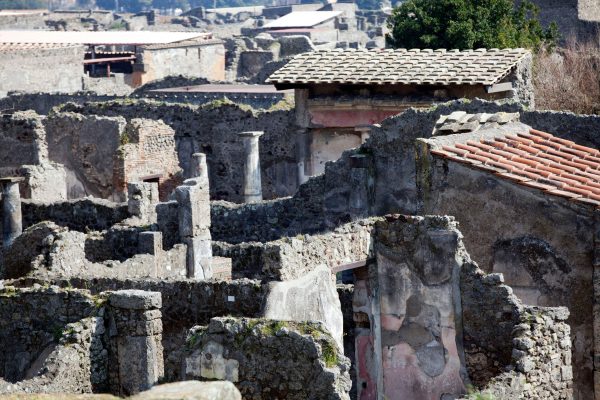
During the excavation of Pompeii, the various artifacts unearthed were preserved in the exact state they were in at the moment of destruction. Even after more than 1,900 years, they still shock people today. Through them, people gain a glimpse of the scenes during the great disaster and form many speculations about this catastrophic event in history.
Issues of moral decay
Pompeii, was a society immersed in sensual pleasure and moral decadence, according to the excavations.
Pompeii, with a population of only 20,000, reportedly had 25 brothels of various classes. The walls were covered with explicit erotic paintings. On the walls of wool dyeing workshops, shops, and inns were traces of the Pompeians’ indulgent lifestyle. Numerous images of nudity and group sexual activity were openly displayed, and depictions of homosexuality could also be seen throughout the city.
Mary Beard, an ancient historian from University of Cambridge, wrote the book Pompeii: The Life of a Roman Town. In it, she wrote that “phallic images were visible everywhere—on doorways, bread ovens, and streets.” They were considered “symbols of power, status, and good fortune.” Erotic paintings, sculptures, and artworks were widespread in brothels and villas. One sculpture depicting a human-animal sexual scene reportedly stood prominently in a garden. Ancient Roman coins unearthed in Italy and even in London, once a Roman territory, also depicted scenes of revelry and pleasure-seeking.
According to reports, in 1819, King Francis I of the Two Sicilies visited Pompeii’s murals with his wife and daughters and was so embarrassed by the erotic paintings that he ordered them closed to the public. They were not reopened until 2000.
Lack of humanity and bloodthirsty brutality
Prosperous Pompeii’s most important trade commodity in dealings with the outside world was reportedly not merchandise, but slaves. In wealthy Pompeian households, slaves handled nearly everything—from artistic decoration of homes to sewing clothes and managing daily necessities. They carried out exhausting and burdensome labor.
The wealthy people of Pompeii were described as having reached extremes of extravagance and excess in their eating habits. Processed oysters were served as cold dishes, while lobster, sea urchins, and dormice coated with honey or poppy seeds were fried in oil and eaten as side dishes. Dessert consisted of pickled moray eel with a sweet-and-sour flavor. According to accounts, after moray eels were caught, they were sometimes fed with the flesh of slaves for several days. The nobles supposedly believed that moray eels which had consumed human flesh tasted the best, with the flesh coming from newly executed slaves.
Pompeii’s amphitheater is the oldest surviving Roman arena still in existence. It could hold 12,000 spectators, even though Pompeii’s population, including slaves, was only about 20,000. The arena alone could therefore accommodate more than half the city’s residents, showing how enthusiastic ordinary citizens were about bloody spectacles involving combat between humans and beasts.
The arena in Pompeii was not for athletic competition in the modern sense, but for watching brutal fights to the death. These horrifying spectacles—filled with bloodshed, the roaring of wild animals, the screams of slaves, and starving beasts tearing gladiators apart piece by piece—did not evoke sympathy from the people of Pompeii, but rather wild cheering and uncontrollable excitement.
An excavated silver drinking cup discovered in Pompeii bore the inscription: “Enjoy life to the fullest, for tomorrow is uncertain.”
The article portrays the Pompeians as people who, despite their outward civilization, behaved with less shame and greater cruelty than beasts. Believing that “tomorrow is uncertain” and devoted to “enjoying life to the fullest,” they ultimately suffered catastrophic destruction, viewed here as punishment and elimination by heaven.
Busy commercial streets, frenzied arenas, and extravagant citizens were wiped out in an instant. According to the account, the city’s final message to later generations was a hurried sentence scrawled on a wall in stone: “This damned city of sin!”
By Chen Gang, Vision Times