By Cheng Jinglian, Vision Times
Since Xi Jinping came to power, the slogan “the East is rising while the West declines” has become one of the Chinese Communist Party’s (CCP) most frequently brandished political narratives.
From declarations that “the balance of international power is undergoing profound changes favorable to China” to claims that China can now “look the world in the eye,” Beijing has consistently projected confidence that China’s rise and Western decline are historically inevitable.
For a time, economic data appeared to support Beijing’s narrative of China’s inevitable rise. Measured in U.S. dollar terms, China’s share of global GDP climbed steadily for years and peaked at roughly 18.5 percent in 2021, according to IMF-based estimates cited by multiple international analysts. During that period, many economists and Chinese state-affiliated scholars openly predicted China would eventually surpass the U.S. as the world’s largest economy.
RELATED: G7 Pushes to Reduce China Dependency as Europe Weighs New Supply Chain Rules
A steep drop
Success
You are now signed up for our newsletter
Success
Check your email to complete sign up
According to IMF-based estimates cited by international analysts including economist George Magnus and The Wall Street Journal, China’s share of global GDP peaked at roughly 18.5 percent in 2021 before steadily declining in subsequent years, falling to around 16.5 percent by the end of 2025.
That decline represents a drop of roughly two percentage points from the 2021 high. At the same time, the relative size gap between the Chinese and U.S. economies has widened again. After reaching nearly three-quarters of the U.S. economy in 2021, China’s economy has reportedly fallen back to less than two-thirds in relative size.
To make matters worse, a weakening renminbi coupled with persistent domestic deflation pressures have further amplified concerns. Some analysts argue the deterioration may appear even more severe if questions surrounding the accuracy of China’s official economic data are taken into account.
Persistent structural problems
Analysts say the slowdown reflects the exhaustion of the “catch-up growth” model that powered China’s rise over the past four decades. Several structural challenges now weigh heavily on the economy, including:
- A shrinking labor force and worsening demographic crisis,
- Rapid population aging,
- Declining household savings,
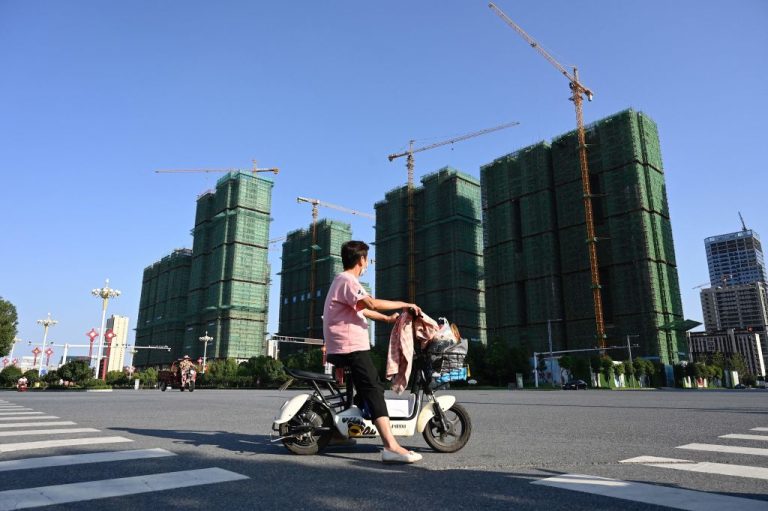
- A prolonged real estate downturn,
- Weakening private-sector confidence,
- Slowing returns on investment.
China’s property sector, which at one point accounted for nearly 30 percent of economic activity when related industries are included, has entered a prolonged correction that continues to drag down investment and consumer sentiment.
At the same time, external conditions have shifted dramatically. Growing U.S.-China technological decoupling, supply chain diversification, Western tariffs, and export restrictions have increasingly constrained China’s export-driven development model.
RELATED: Evergrande Founder Xu Jiayin Faces Trial as Case Unveils Debt Flows, Political Ties
Historical parallels
Some analysts have compared China’s current trajectory to historical examples such as Japan’s economic slowdown after the late 1980s or the Soviet Union’s decline after periods of rapid state-driven expansion. However, observers note that China’s demographic challenges may prove even more severe than those faced by Japan.
Unlike earlier phases of China’s rise, the country now faces simultaneous pressure from falling birth rates, mounting debt, declining productivity growth, and geopolitical tensions. The implications extend far beyond economics alone, analysts note.
A declining share of the global economy may gradually erode Beijing’s strategic confidence both domestically and internationally. China’s ability to sustain massive overseas infrastructure and investment projects through initiatives such as the Belt and Road Initiative could become increasingly constrained as economic growth slows and fiscal pressure intensifies.
Some developing countries have already begun reassessing the long-term sustainability of economic cooperation with China amid debt concerns and slowing Chinese demand.
At home, slowing growth has also increased pressure on the CCP’s governance model. Weak consumer confidence, high youth unemployment, stagnant income growth, and deteriorating social expectations have all contributed to growing uncertainty about China’s long-term economic trajectory.
The broader geopolitical consequences are also becoming more visible. Analysts note that growing coordination among U.S. allies in the Indo-Pacific reflects increasing caution over both China’s economic outlook and its geopolitical ambitions.
A reality check
China’s shrinking share of global GDP since 2021 represents more than a temporary economic fluctuation; it signals deeper structural weaknesses within the country’s development model. The era of rapid expansion driven by demographics, real estate, cheap labor, and globalization appears to be fading.
Whether China can reverse the trend will likely depend on its ability to achieve meaningful reforms in areas such as institutional innovation, private-sector revitalization, and demographic policy.
Without major changes, analysts warn the current downward trajectory could continue, turning the once-confident slogan of “the East rising while the West declines” into an increasingly uncomfortable contrast between political rhetoric and economic reality.
Editorial note: Views expressed in this article are the opinions of the author and do not necessarily reflect the views of Vision Times.