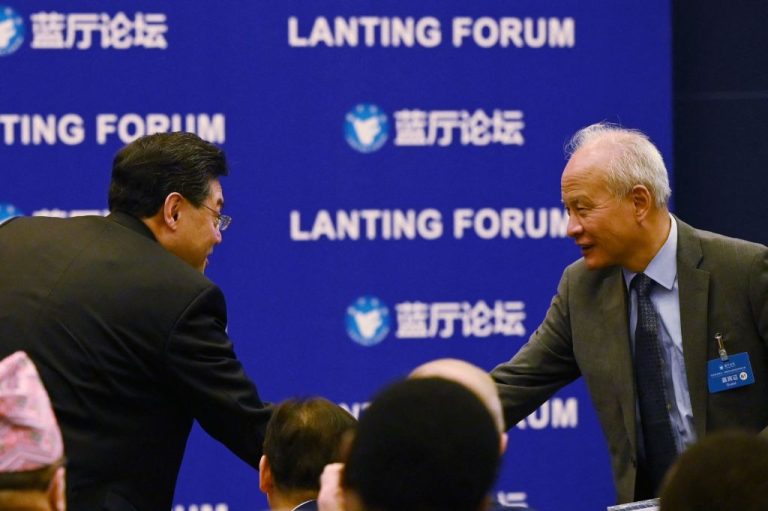
Cai Qi, the Politburo Standing Committee member who runs the Party’s day-to-day operations as head of the Secretariat and serves as Xi Jinping’s primary economic briefer, has largely stopped using figures from the National Bureau of Statistics, relying instead on an independent research team’s numbers, according to a former Inner Mongolia official with claimed access to internal Party reports. The broader economic picture those internal briefings describe matches what international institutions and Chinese state media data already show: local government finances in freefall, a consumer sector that has stopped spending, a pension system bleeding reserves, and foreign capital retreating faster each quarter.
The Party no longer trusts its own economic data
Du Wen, a former Inner Mongolia government official who now publishes political and economic analysis for overseas Chinese audiences, claims to have obtained details from the internal economic briefings that Cai Qi, the Politburo Standing Committee member who manages the Party’s day-to-day operations as head of the Secretariat, delivers to Xi Jinping, the CCP’s general secretary and China’s top leader. According to Du, Cai has largely set aside the National Bureau of Statistics’ figures and instead commissions an independent research team to supply what the Party internally considers more accurate numbers.
The claim cannot be independently verified. Du’s analysis draws on sources he says he controls but that outside observers cannot audit. His specific internal sourcing warrants skepticism. Where his conclusions overlap with data from international institutions and Chinese state media, however, the picture he describes becomes harder to dismiss.
The figures Du attributes to Cai’s briefing are severe. As of the end of April 2026, China’s Producer Price Index had been negative for 42 consecutive months, meaning factory-gate prices have fallen year over year for three and a half years running. The manufacturing Purchasing Managers’ Index, a widely used measure of factory sector health where any reading below 50 signals contraction, had spent 17 consecutive months in contractionary territory. In the first four months of 2026, 31 of 41 key industrial sectors recorded price declines. The cost per 100 yuan of revenue for large industrial enterprises had risen for 50 consecutive months, sitting at its highest level since the statistic was first compiled in 2018. Profit margins across the industrial sector had fallen to 2.1 percent; operating return on revenue had sunk to 4.8 percent, both historic lows in data going back to 2012.
Du says Cai’s briefing to Xi explicitly acknowledged that “the real economy still faces serious difficulties, operating pressure on enterprises in certain sectors is enormous, most key industries have fallen into distress, and this requires urgent attention.” If accurate, it is a remarkable admission: the Party’s number-two briefing officer telling the top leader that the official growth story is coming apart.
Success
You are now signed up for our newsletter
Success
Check your email to complete sign up
Local government finances have collapsed
The fiscal crisis at the local level makes the picture concrete. A 2023 report in Banyuetan, a publication of the Party’s official wire service Xinhua that occasionally runs reporting critical of local governance failures, described a county in Guizhou province’s Wumeng Mountain region where annual tax revenue came to 414 million yuan while total fiscal expenditure ran to 2.63 billion yuan. Nearly all of that spending went to salaries: the county carried 15,500 formally appointed staff and 28,800 contract employees, meaning more than 44,000 people drew their paychecks from the public purse. One in every 14 permanent residents was on the government payroll. The state media report called it “poor finances feeding rich people.”
This pattern extends far beyond a single impoverished county. China’s provincial audit reports for 2025 found that 13 provinces had diverted a combined 406 million yuan from pension funds to cover government debts and wages. Sixteen provinces, spanning 175 counties, had misappropriated fiscal subsidies totaling 4.16 billion yuan. Some rural households had been waiting an average of one year for agricultural subsidies owed to them; in the worst cases, the wait stretched to nine years.
The macro numbers confirm what the local audits reveal. Central government transfer payments to local governments climbed from 8.3 trillion yuan in 2021 to more than 10 trillion yuan in 2023, and have set new records every year since. The overwhelming majority of China’s local governments have lost any capacity to generate their own revenue and now depend entirely on Beijing’s transfers to function.
The root cause is the collapse of what economists call “land finance,” the revenue model that sustained Chinese local governments for two decades. Local governments sold land to property developers, developers borrowed from banks, residents bought the apartments, and for two decades the revenue kept flowing. Once residents stopped buying and stopped borrowing, developers lost the ability to acquire new land, and local government coffers went empty. Every round of property market stimulus Beijing has rolled out since, from interest rate cuts to down-payment reductions applied sequentially across Beijing, Shanghai, Shenzhen, Guangzhou, and Tianjin, is an attempt to restart that broken loop. The goal is to rescue the salary funds for civil servants, teachers, and doctors.
Zhou Qiren, an economist at Peking University, has argued repeatedly that the cumulative cost of China’s government apparatus has become the primary drag on economic vitality. Between 1995 and 2012, years of high-speed growth, tax revenues multiplied 16-fold. Non-tax government revenues grew 18-fold. Mandatory social insurance contributions rose 28.7-fold. Land prices surged 64-fold. All of this vastly outpaced nominal GDP growth of roughly 8.6-fold over the same period.
Chinese consumers are hoarding cash
By the end of April 2026, China’s broad money supply, known as M2 and defined as the total of cash in circulation plus bank deposits, had reached 353 trillion yuan, growing 6.8 percent year over year. That figure is roughly double the size of the United States’ money supply, making China’s the largest in the world, and it is sitting largely idle.
New renminbi loans in April fell to one of the lowest monthly levels recorded in more than two decades of statistical tracking. Household borrowing shrank by a net 787 billion yuan: residents are actively paying down debt rather than taking on new spending. Official data put April retail sales growth at 0.2 percent year over year, well below analyst forecasts according to Reuters.
For urban Chinese households, real estate was the primary store of wealth for the past two decades. House prices have fallen sharply and persistently. Some estimates suggest that the decline in property values alone has erased roughly 70 percent of net assets for many middle-class urban families. Against that backdrop, consumer vouchers and shopping festivals are beside the point. Tens of millions of households have lost confidence in their financial futures, and no promotional campaign can substitute for that.
Chinese companies are losing a war of attrition
Xiang Songzuo, a prominent economist who formerly served as chief economist at the Agricultural Bank of China, has described what he observes across virtually every major Chinese industry: overcapacity driving relentless price wars, firms selling at or below cost, and what Chinese social media has come to call neijuan, or “involution,” meaning competitive intensity so extreme that all participants are destroyed rather than any one winning.
Xiang cited Qin Yinglin, the chairman of Muyuan Foods, China’s largest pork producer, who described price competition in the hog farming industry as a form of collective self-destruction, with every participant losing money simultaneously.
Du Wen identifies the pressures bearing down on Chinese enterprises. Consumer demand has collapsed far enough that inventories are building and prices are falling across whole sectors. Local governments, state-owned enterprises, and large corporations are delaying payment to suppliers on such a scale that smaller firms now survive on extended credit rather than cash — what Chinese business culture calls the “triangular debt” trap. Profit margins have been ground toward zero by internal price competition that no participant can afford to exit. Private business owners face a Party that encourages them one year and crowds them out with state enterprises the next, making any long-term planning a gamble. Most corrosive of all is the disappearance of personal security: Du cites figures from the Party’s internal anti-corruption enforcement body, the Central Commission for Discipline Inspection, claiming 37 percent of those currently in its detention system are business people.
In an environment where property rights are uncertain and courts cannot deliver independent judgments, entrepreneurs do not invest for the long term. They focus on survival, debt reduction, and asset transfer abroad.
Xiang Songzuo makes a parallel observation about local governments: when authorities are the first to break contracts, default on obligations, and delay payments, they set a standard for the whole society. The result is a pervasive culture of contractual unreliability that pushes every transaction toward personal relationship networks rather than legal enforcement, inflating the cost of doing business across the entire economy.
Foreign companies are quietly hollowing out China
Ministry of Commerce data show that actual foreign direct investment into China in the first quarter of 2026 came to 249.6 billion yuan, down 7.3 percent year over year. The number of newly registered foreign enterprises increased, but actual investment declined, suggesting that companies are maintaining a visible footprint while redirecting real capital elsewhere.
Du Wen calls this “slow-motion withdrawal,” and argues it is more dangerous than an abrupt exodus. Factories stay open for now, offices remain staffed, but new production capacity goes to Vietnam, India, and Mexico. Regional headquarters migrate to Singapore. Senior talent moves to Europe and North America. Profits are repatriated where possible. Supply chains are duplicated outside China as insurance. The patient appears to be standing, Du writes, but is growing weaker by the month.
The addressable market has shrunk, policy unpredictability makes multi-year investment commitments unreliable, geopolitical friction adds compliance costs that compound annually, and domestic price wars have made it nearly impossible for foreign firms to earn a return. Samsung’s full withdrawal from Chinese manufacturing is the most visible expression of this trend, but far from the only one.
Beijing is trapping domestic savings
As confidence in domestic assets has deteriorated, growing numbers of Chinese savers have sought to invest in Hong Kong and US equities through offshore brokerages, including Futu and Tiger Brokers. On May 22, the China Securities Regulatory Commission, together with eight other government agencies, announced a two-year campaign to eliminate what it called “illegal cross-border securities and futures activities.” Under the rules, all proceeds from the targeted brokerages will be confiscated. Existing account holders will be permitted only to sell positions during the two-year enforcement window. When the period ends, all offshore brokerages must shut down every website, trading application, and server operating inside China.
With property markets depressed, local finances strained, and the domestic stock market persistently weak, Beijing cannot afford to let the remaining pool of domestic investment capital flow outward. The measure is administrative capital retention: money is being legally confined to prop up Chinese equities and prevent further erosion of the domestic asset base.
The state is offloading its pension obligations
A recent directive from the Ministry of Civil Affairs, issued jointly with 11 other government agencies, established “mutual-aid elder care” as the official model for China’s aging population. The policy envisions a network of neighborhood volunteers in which younger retirees assist older ones, delivering elder care services at minimal fiscal cost. The directive sets a target of 70 percent of all urban and rural communities establishing mutual-aid elder care facilities by 2030.
The measure transfers pension responsibility from the state to individuals and communities. The structural problem driving the shift is severe: China’s pension system has long maintained a two-tier structure under which civil servants receive pensions that can exceed those of private-sector workers by a factor of three or more, while the overall system carries an enormous actuarial deficit accumulated over decades. Younger workers have begun to lose confidence that the system will pay out at all when they retire. Many are shifting to commercial insurance or private savings, a rational individual response that further undermines the pay-as-you-go system’s sustainability and accelerates its collapse.
The social indicator that may matter most, however, is behavioral. Increasing numbers of young Chinese are abandoning entrepreneurship, avoiding risk, and seeking stability inside the state apparatus. News reports of Peking University doctoral graduates competing for street-level urban management jobs, or Tsinghua University graduates joining neighborhood administrative offices, have become common enough to constitute a trend. When a society shifts from wealth creation to wealth distribution as its organizing logic, the long-term source of economic growth is eroded from within.
By Jin Yan, Vision Times