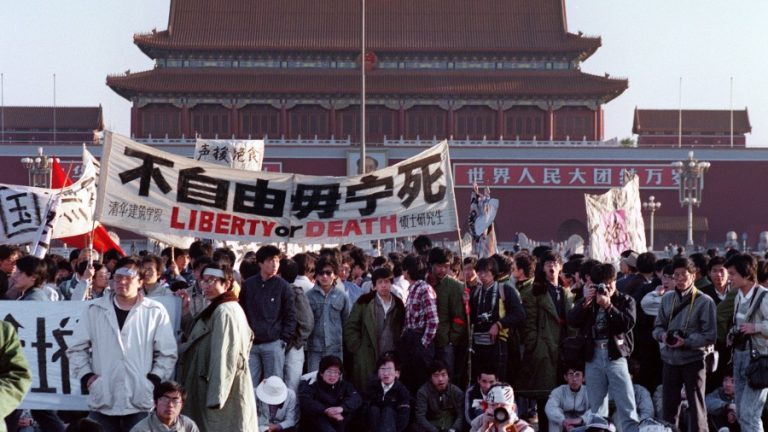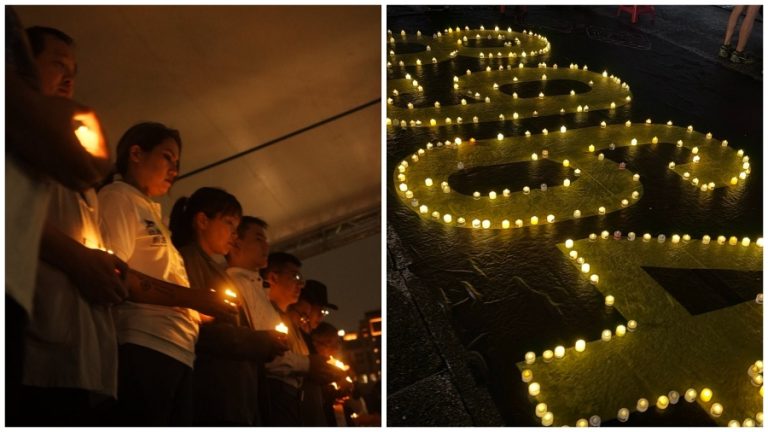
The 37th anniversary of the 1989 Tiananmen Square Protests and Massacre was marked on June 4. Multiple civic organizations and members of Hong Kong’s diaspora in Taiwan held candlelight vigils at Chiang Kai-shek Memorial Hall and 228 Peace Memorial Park.
Wu Renhua: Taiwan’s commemoration of June 4 demonstrates democratic values
Organizations including the Chinese Democracy Education Foundation Association, the Judicial Reform Foundation, and the Taiwan Association for Human Rights held a memorial gathering at Chiang Kai-shek Memorial Hall on the evening of June 4, according to the Taipei Times.
The event’s theme was “Memory Beyond Borders, Resistance Without Boundaries.”
The vigil began at 6:40 p.m. Despite heavy rain, many participants attended wearing raincoats and carrying umbrellas to commemorate what organizers described as a memory that must not be erased.
Among the displays was a 3D-printed replica of “Pillar of Shame,” a sculpture by Danish artist Jens Galschiøt, Taiwan News reported. Participants also took turns arranging lights to form the numbers “8964”—a reference to June 4, 1989—and placed flowers in a mourning area.
Success
You are now signed up for our newsletter
Success
Check your email to complete sign up
At approximately 8:00 p.m., attendees observed 64 seconds of silence to honor those who died during the Tiananmen Square crackdown.
Wu Renhua, a scholar and eyewitness to the June 4 events, said that Taiwan’s ability to publicly commemorate the anniversary demonstrates the values upheld by a democratic society.
According to Liberty Times, Wu Renhua, a survivor of the June 4 Incident, has attended the annual June 4 commemoration in Taipei for eight consecutive years.
He said that a regime willing to deploy the military against its own citizens and to harshly suppress Hong Kong would, if it were to gain control of Taiwan through either “peaceful reunification” or “military reunification,” likely turn Taiwan into the next Hong Kong. He therefore urged Taiwanese people to transcend partisan divisions and defend the fundamental principles of democracy.
Wu emphasized that while the traditional June 4 candlelight vigil in Hong Kong’s Victoria Park is no longer held, Taiwan is still able to publicly commemorate the anniversary. He said that such remembrance is not only a tribute to those who died during the 1989 Tiananmen Square Protests and Massacre, but also an expression of support for Hong Kong’s prisoners of conscience. According to Wu, this demonstrates the values of a democratic society. In the face of pressure from Beijing, he said, it is essential to uphold core principles and preserve a free way of life.
Shen You-chung: Compromise would only sacrifice democracy and freedom
According to the Liberty Times, Shen You-chung, deputy minister of Taiwan’s Mainland Affairs Council, said that Beijing is steadily increasing pressure on Taiwan to accept the “1992 Consensus” and the “One China framework.”
Shen argued that Taiwan must clearly recognize what he described as the ambitions of the Chinese Communist Party and warned that compromise would only lead to the loss of democratic freedoms.
“In Taiwan, democracy and freedom are things people take for granted; in Hong Kong, democracy and freedom have become something people can only aspire to,” he said, concluding with the remarks: “May Heaven bless Taiwan, and long live freedom.”
Zhou Fengsuo, current executive director of Human Rights in China and a former student leader of the 1989 movement, delivered remarks via video. He noted that video footage released last year of the trial of Xu Qinxian—the People’s Liberation Army general who refused orders related to the 1989 crackdown—confirmed that some senior military officers at the time opposed the suppression on grounds of conscience.
Drawing a parallel to contemporary security concerns facing Taiwan, Zhou reflected on whether, in the event of a future Chinese military attack on Taiwan, there might still be individuals within the PLA willing to act according to conscience. He stressed that as long as people continue to believe in truth and democracy, history cannot be erased.
Hsu Pai-ti: The CCP’s brutality cannot be tolerated
In addition to the event at Chiang Kai-shek Memorial Hall, a candlelight vigil was also held on the evening of June 4 at 228 Peace Memorial Park.
According to Liberty Times, Hsu Pai-ti, a former Hong Kong district councilor and chairman of the Taiwan-based Chinese Benevolence Taiwan-Hong Kong Integration Association, said in his remarks that 37 years ago a sweeping democratic movement—one that could have enabled the Chinese people to become masters of their own political destiny—was crushed by the Chinese Communist Party, resulting in countless deaths and injuries around Tiananmen Square.
He said he remembers with deep sorrow and indignation those who died during the crackdown, as well as the many individuals who gave their lives in pursuit of democracy and freedom.
Hsu further stated that, in his view, the Chinese Communist Party has never ceased pursuing and persecuting people since that time. He said that Hong Kong residents inherited the torch of the mainland Chinese democracy movement, courageously exposing the truth and resisting authoritarian power. According to Hsu, Hong Kong’s social movements continued for decades, and the candlelight vigils once held at Victoria Park were among the most moving and sincere commemorations in the world, serving as a spiritual home for Chinese democracy activists.
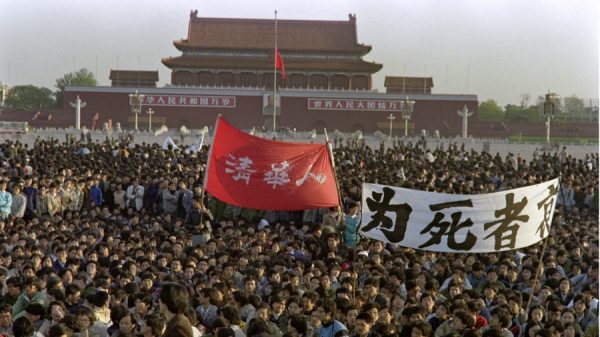
He added that the 1989 military crackdown exposed the nature of the Communist regime to the world. Hsu argued that the collapse of communist systems in the Soviet Union and Eastern Europe amid the global “third wave” of democratization demonstrated that such repression had become unacceptable to the international community.
Hsu Pai-ti said that in the past, he and others did not dare to chant slogans such as “Eliminate the Chinese Communist Party.” However, he argued that the CCP’s actions have become so destructive that, in his view, “the Chinese nation is at its most perilous moment.”
He accused the Chinese Communist Party of single-handedly destroying Hong Kong, which he described as a model of modern civilization, turning its people into prisoners and creating what he called the world’s largest “prison of the mind.” He further alleged that the CCP seeks to extinguish independent thought through ideological control and indoctrination.
Hsu went on to say that, in his view, the CCP has attached itself to Chinese civilization while simultaneously undermining it, comparing the party to a virus that consumes its host. On that basis, he argued that people are justified in chanting slogans such as:
“Eliminate the CCP, redress the June Fourth incident, liberate Hong Kong, liberate all of China! The spirit of the June Fourth heroes will never die!”