By Meng Hao, Vision Times
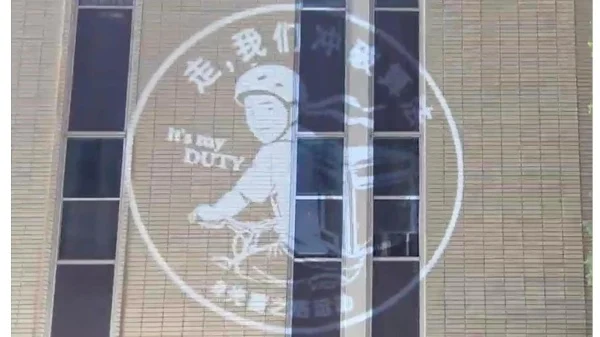
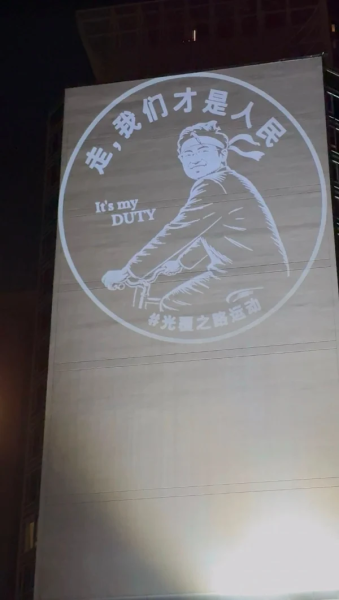
Shortly before 11 p.m. on June 4 in New York City, the exterior wall of the Chinese Consulate in Manhattan was illuminated by a series of projected images. One showed a young man riding a bicycle and glancing back over his shoulder. Three phrases in Chinese then appeared on the wall:
- “走,我们才是人民” (“Go. We are the people.”)
- “走,我已脱下长衫” (“Go. I have taken off my long gown.”)
- “走,该我给你说法了” (“Go. It is my duty to answer you.”)
The projection concluded with the logo of “Road of Light,” marking the first action in the group’s global “It’s My Duty” campaign and its public debut on the 37th anniversary of the 1989 Tiananmen Square crackdown.
RELATED: US Lawmakers Spotlight China’s Transnational Repression on Tiananmen Anniversary
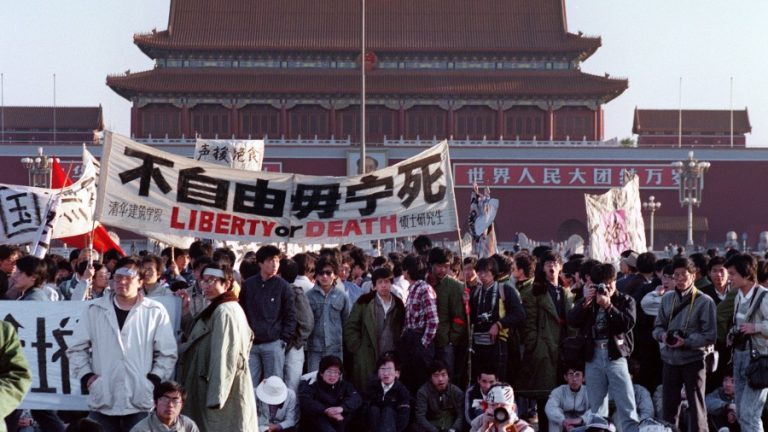
On June 4, 1989, the Chinese Communist Party (CCP) deployed troops and tanks to crush a nationwide pro-democracy movement led largely by students. Though publicly-available information is scarce, the military assault ended weeks of peaceful demonstrations centered in Beijing’s Tiananmen Square and resulted in the deaths of hundreds, and according to some estimates, thousands of civilians.
Blazing a new path
Success
You are now signed up for our newsletter
Success
Check your email to complete sign up
According to organizers, dozens of passersby stopped to watch the roughly ten-minute display. Several security personnel employed by the consulate later arrived at the scene. Activists said one attempted to approach the projection equipment and disrupt the display but was unsuccessful. The group subsequently contacted police, who responded to the scene.
“Road of Light” spokesperson Su Yutong told Vision Times that what mattered most was not simply the projected images themselves. “When a few quiet black-and-white images appear on the wall of a consulate, and a large institution chooses to devote long-term manpower and equipment to countering them, people naturally begin to wonder what is contained in those images,” she said.
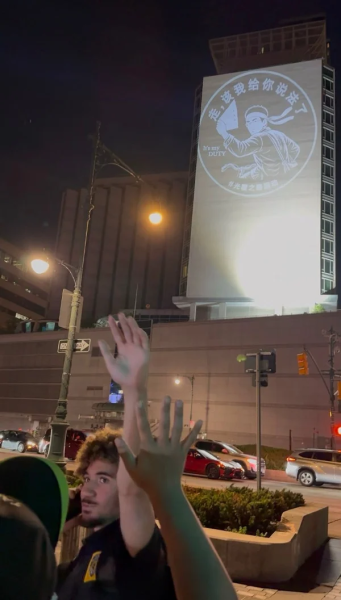
Organizers said they had observed increased lighting installations around the consulate in recent months, which they believe were intended to deter projection activities.
‘We are the people’
Su said the campaign’s Chinese name, “Guang Fu Zhi Lu” (“Road of Light”), carries a dual meaning. The character fu means “to cover” or “to overlay.” “We hope to use beams of light to cover buildings that symbolize state power,” she said, adding, “while allowing Chinese people who have long been suppressed, silenced, or marginalized to be seen again.”
She said slogans such as “We are the people” reflect what she views as growing frustration among younger Chinese generations. “The people themselves should be the owners of the country, not any organization or power group,” she said.
Su linked the phrase “I have taken off my long gown” to the online phenomenon known as “Kong Yiji literature,” which emerged during China’s youth unemployment crisis. The expression draws on Lu Xun’s fictional scholar Kong Yiji and became shorthand for educated young people struggling to reconcile social expectations with shrinking economic opportunities.
RELATED: Los Angeles June 4 Museum Vandalized Days Ahead of Tiananmen Anniversary
“Taking off the long gown is not surrender,” she said. “It represents a psychological transformation; the realization that young people cannot simply wait for circumstances to change.” She added, “The deepest problem facing Chinese youth today is not a lack of diligence, but a lack of hope.”
Raising awareness
Su said each projection campaign combines satire, civic themes, and visual storytelling. “In societies where normal public discussion is absent, satire often becomes the beginning of awakening,” she said. “And awakening can become the starting point for action.”
She also argued that humor weakens fear by undermining the aura of seemingly untouchable authority. Rather than relying on lengthy political manifestos, the movement employs images and symbols that can spread quickly across audiences and borders.
Su pointed to expressions such as “lying flat,” emigration discourse known as “runology,” homophones, and internet memes as examples of how Chinese netizens have developed alternative forms of public expression under censorship. She cited the concept of “Laughtivism,” popularized by Serbian activist Srdja Popovic, as an important influence on the campaign’s nonviolent approach.
RELATED: Growing ‘Lying Flat’ Movement Threatens to Derail China’s Ambitions
From New York to Los Angeles
The day after the New York projection, organizers staged another action outside the Chinese Consulate in Los Angeles. This time, the projected figure was a food delivery worker accompanied by the slogan: “Go. We’ll break through the algorithm.”
Su said delivery riders symbolize millions of Chinese platform workers whose livelihoods are shaped by algorithms governing assignments, timing, rankings, and penalties. She argued that the term “algorithm” has also become a broader metaphor for systems that monitor behavior, regulate speech, and narrow individual choice.
Despite increasingly sophisticated countermeasures, organizers said the Los Angeles projection remained visible for more than 30 minutes. Su described “Road of Light” not as a technological competition but as “a contest between expression and fear.” Success, she said, is measured not only by whether the images are seen, but by whether they foster connections and inspire replication elsewhere.
China maintains hundreds of diplomatic missions worldwide, and organizers say they hope to expand the campaign across North America, Europe, Asia, and Oceania. “For 37 years, they have tried to make that night forgotten,” Su said. “But as long as someone is willing to raise this beam of light, it will continue from city to city, wall to wall, until there is no corner left in darkness.”