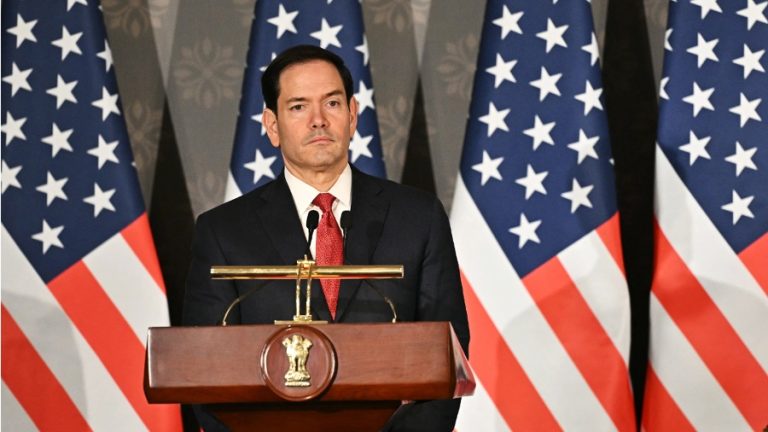
Marco Rubio issued a statement on the U.S. State Department website marking the 37th anniversary of the June Fourth crackdown. He posted the same on X as well.
The following day, the U.S. consulate General Hong Kong and Macau reposted Rubio’s statement on its website. China’s Foreign Ministry subsequently criticized both the United States and Rubio.
Many Chinese internet users responded by expressing gratitude toward Rubio and the United States through online comments, with some writing messages such as “Thank you, Rubio” and “Thank you, America.”
Secretary Rubio’s statement
Rubio honored the June 4 protestors in a message on the Department of State’s website on June 3 and on X the next day.
“On June 4, the world marks 37 years since the Chinese Communist Party ordered its troops to attack thousands of peaceful demonstrators in and around Tiananmen Square. Chinese students, workers, and other civilians who lost their lives had gathered to exercise their natural rights and demand democratic reforms and accountability for corruption.”
Success
You are now signed up for our newsletter
Success
Check your email to complete sign up
“We remember their lives and honor their legacy. No amount of censorship can erase the past. Those who sacrificed to uphold their unalienable rights of free expression and peaceful assembly will be vindicated someday.”
He shared the same statement on X, and the U.S. diplomatic mission in China also shared a Chinese-language version of the statement on the platform.
After the posts went viral
The statement by Secretary Marco Rubio on X and the U.S. diplomatic mission in China received millions of views online. The combined content was viewed more than seven million times, with the Chinese-language version accounting for more than 5.7 million views.
China’s Foreign Ministry subsequently criticized the United States and Rubio, accusing Washington of “inciting ideological confrontation,” “distorting historical facts,” “smearing” China’s political system, and interfering in China’s internal affairs.
The comments reflected sentiments that some Chinese users felt unable to express publicly elsewhere.
Among the comments were: “Rubio is going to be sanctioned again. Next time he visits China, the Secretary of State will be ‘Lu Biao’ instead of Rubio.”
Another commenter recalled watching events unfold on television in 1989: “In May 1989, my family bought a second-hand color television. I watched those older brothers and sisters peacefully demonstrating against corruption. One day my father suddenly stood up and said, ‘This is bad. They’ve been labeled counterrevolutionaries. People are going to be killed.'”
Other comments included: “People who fight for freedom deserve respect.”
“Thank you, Rubio. Thank you, America. Thank you for continuing to speak out for the victims of June Fourth.”
“The Communist Party is a scourge on humanity and has caused countless deaths directly and indirectly.”
“The CCP must come to an end.”
“Thank you to the U.S. government. Natural human rights cannot be taken away.”
These comments are expressed by some users online and do not necessarily represent broader public opinion.
Statement by President Lai Ching-te
Taiwanese President Lai Ching-te also issued a statement in both Chinese and English on Facebook and X to mark the anniversary. President Lai Ching-te wrote in Chinese: “Thirty-seven years is enough time for an infant to grow into an adult, build a family, establish a career, and forge a path through life.
“But on this day 37 years ago, thousands of young people in the prime of their lives, filled with ideals and aspirations, were killed by soldiers and tanks on the streets of Beijing, in Tiananmen Square, and elsewhere across China.”
President Lai said that the massacre destroyed not only the lives and youth of the participants but also “hopes and efforts” of an entire generation of people in China who wanted freedom and democracy.
“A truly great nation should not be obsessed with powerful ships and cannons or engage in militarism, but should be tolerant of different voices, protect the people’s right to pursue their dreams, and have the courage to face the wounds of history,” he said.
He said he hopes that China faces the June 4 incident and acknowledges its truth, heals the pain, and starts with reconciliation and dialogue.
“People should be able to express their views freely, and citizens of different generations and political perspectives should be able to participate in public decision-making.”
The statement framed the June Fourth anniversary as both a historical reflection and a broader argument for political pluralism, freedom of expression, and civic participation. It also reiterated Lai’s view that confronting historical events openly is an important part of national reconciliation and democratic development.