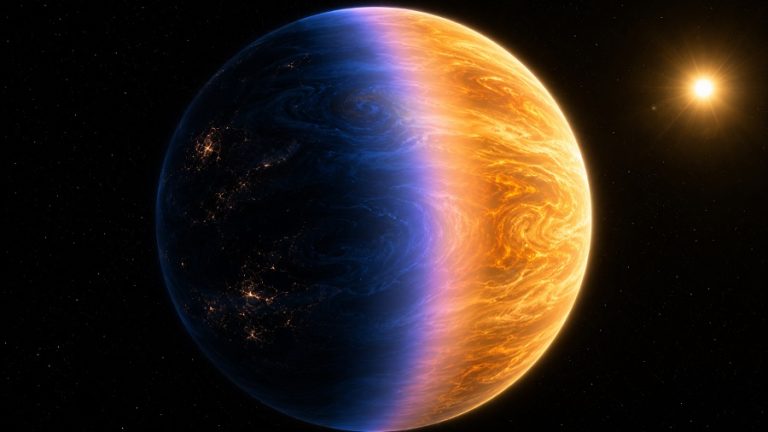
The universe is so vast that it continually reveals sights beyond imagination. Deep in space, far from Earth, a giant planet known as WASP-121 b presents a landscape completely unlike anything on our world. There are no changing seasons and no cycle of sunrise and sunset. One side of the planet permanently faces its star, enduring endless scorching heat, while the other side remains shrouded in perpetual darkness, like a realm forgotten by light. Along the boundary between these two extremes, dawn and dusk take on remarkably different appearances.
According to a report by SciTechDaily, WASP-121 b belongs to a class of giant gas planets known as “hot Jupiters.” Because it orbits extremely close to its parent star, powerful tidal forces have synchronized its rotation and revolution. As a result, the same side of the planet always faces the star—much like the Moon always shows the same face to Earth. This creates two dramatically different worlds on the planet. The star-facing side reaches temperatures of around 2,500°C (4,532°F), hot enough to melt many metals. The dark side remains in permanent night, with temperatures around 725°C (1,337°F). While still unimaginably hot by human standards, it is relatively cool compared with the blazing day side.

A permanent twilight zone on WASP-121 b
Between these two extreme regions lies a permanent twilight zone. It is neither day nor night but remains forever suspended between sunrise and sunset. Astronomical observations show that the two sides of this twilight boundary are not symmetrical. One might assume that dawn and dusk are simply opposite directions along the same dividing line, but reality is far stranger. The atmosphere in the dusk region is more expanded and significantly hotter than that in the dawn region, as though the planet’s heat is continually gathering there.
The reason lies in the planet’s extraordinary high-speed winds. Intense heat from the day side is constantly carried toward the night side by powerful atmospheric currents. As these heat flows move across the planet, they cause the dusk side to accumulate more energy, creating an atmospheric environment entirely different from that of the dawn side. Temperatures in the dusk region are so extreme that water molecules can be broken apart into smaller components. In other words, even water struggles to remain intact under such conditions.
This world stands in sharp contrast to Earth. Here, sunrises and sunsets occur every day, with morning light and evening twilight constantly alternating. On WASP-121 b, however, dawn and dusk are permanently fixed in place, as if frozen in time, maintaining the same appearance for billions of years.
Success
You are now signed up for our newsletter
Success
Check your email to complete sign up
Some astronomers speculate that the planet’s atmosphere may even contain clouds made of minerals. Unlike Earth’s clouds, which consist of water droplets, these clouds may be composed of high-temperature minerals such as silicates. Materials that exist as rock on Earth could form vast cloud banks in the skies of this extreme world.
When people gaze up at the night sky, it is difficult to imagine that somewhere in the universe there exists a planet like this: half locked in eternal daylight and half in endless night; one side blazing like a furnace, the other submerged in darkness; and between them, a never-ending dawn and dusk suspended forever.
The natural wonders of the universe are far more magnificent than we often imagine. The skies, storms, and light of distant worlds unfold in ways completely different from those on Earth, revealing the limitless marvels of the cosmos.