On the occasion of our national holidays, we are often called to remember what America stands for, and to honor those who made great sacrifices for the liberties that we enjoy today.
As this year marks the 250th anniversary of the signing of the Declaration of Independence, we will celebrate our independence, remember our founding fathers, commemorate the heroes who fought for our freedom, and reflect on the fact that freedom is not “free.”
But there is one element, essential to our nation’s founding and success, that is rarely fully acknowledged. It brought immigrants to America, it fueled a victory against all odds, it set the moral standards for a new nation, and informed its governance. That element is faith in God.
America is often called “The Land of Opportunity,” “The Land of Liberty,” or “The Great Melting Pot.” In our Pledge of Allegiance, we call it “One Nation, Under God.” This is significant.
Faithful origins
Since ancient times, people around the world have believed in God, or a powerful, omnipotent Creator who ought to be revered and obeyed. Various religions arose, thus worship was institutionalized, and animosity arose over conflicting beliefs. Religious persecution became common, even between groups that believed in the same God.
Success
You are now signed up for our newsletter
Success
Check your email to complete sign up
In particular, after the Church of England was established during the English Reformation, various Christian denominations faced persecution, often against each other. Many were drawn to America, where they could practice their faith in peace.
To be sure, there remained lingering tensions, especially since England established its Anglican churches among the colonists. But when King George III stepped beyond the limits of what they deemed tolerable, religious differences were set aside in favor of the American Revolution. Although our faithful founding fathers did not share a common church or religion; this, in fact, paved the way for lasting religious tolerance in America.
Faith fueled revolution
The decision to separate from England was based on a belief in God’s benevolence, as we can see in the second paragraph of the Declaration of Independence —
“We hold these truths to be self-evident, that all men are created equal, that they are endowed by their Creator with certain unalienable Rights, that among these are Life, Liberty and the pursuit of Happiness.”
— as well as the humility to seek God’s guidance and follow His will, as seen in the final paragraph:
“We, therefore, the Representatives of the united States of America, in General Congress, Assembled, appealing to the Supreme Judge of the world for the rectitude of our intentions, do, in the Name, and by Authority of the good People of these Colonies, solemnly publish and declare, That these United Colonies are, and of Right ought to be Free and Independent States; … And for the support of this Declaration, with a firm reliance on the protection of divine Providence, we mutually pledge to each other our Lives, our Fortunes and our sacred Honor.”
Answered prayers
The American Revolution was studded with seemingly-impossible endeavors that succeeded against all odds. Many consider them to be acts of Providence. Indeed, for a poorly-trained militia — numbering only a fraction of its opponent’s established army — to secure victory over the most powerful nation in the world was nothing short of a miracle; or more accurately, a series of miracles.
Crossing the East River
The first such notable event took place on the night of August 29, 1776. The Continental Army, trapped between the British and the East River, was about to be obliterated. In a twist of fate, an incredibly dense fog rolled in, rendering them practically invisible, and enabling Washington and his 9,000 men to safely cross the river before morning.
Crossing the Delaware
Four months later, Washington made an audacious attempt to cross the frozen Delaware River for a surprise attack in Trenton. Again, the weather played the role of a powerful ally — the ice thawed enough for passing, and what could have been a catastrophe resulted in a triumph that fortified the revolutionary spirit.
Valley Forge
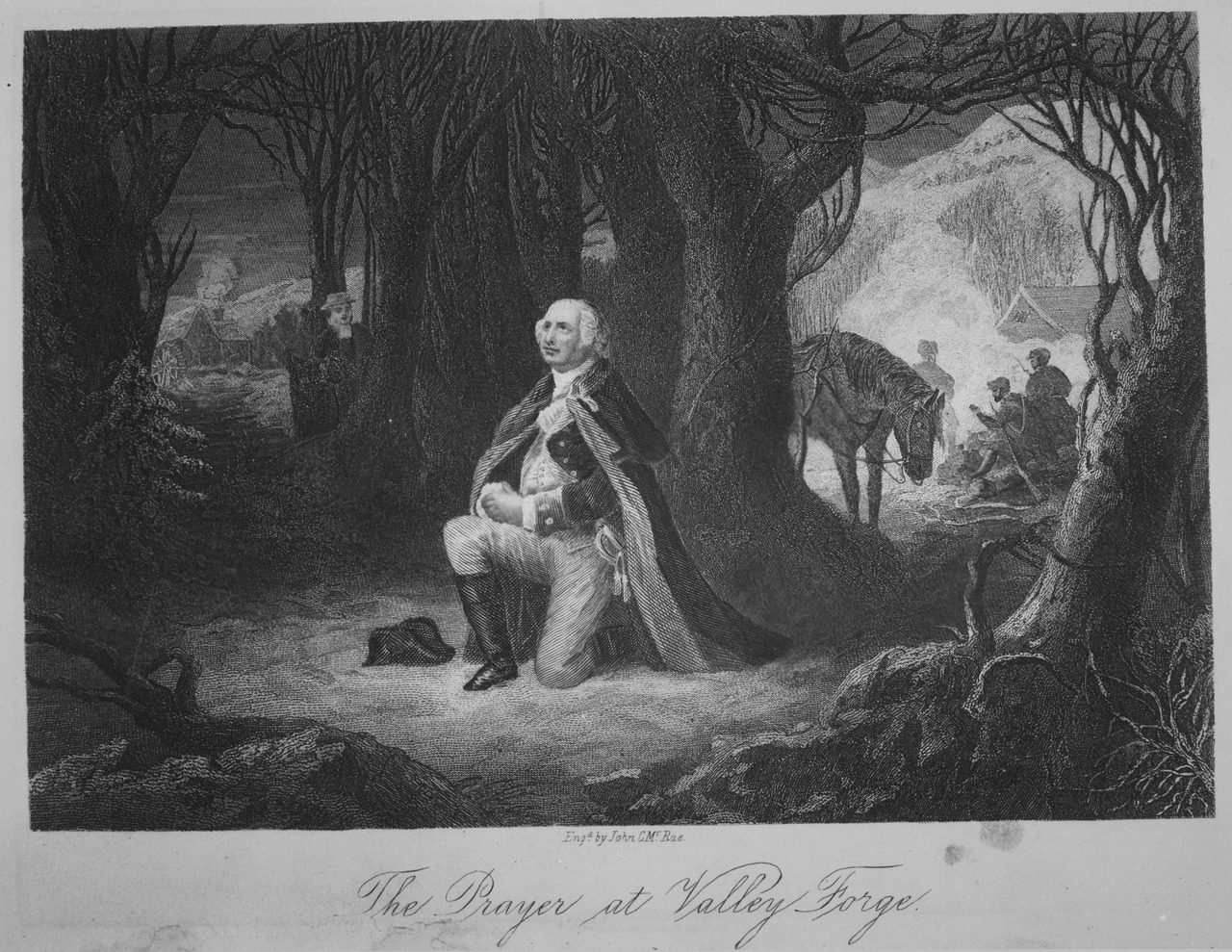
Then, there was Valley Forge. Although no battles were fought at this winter encampment, it was here, during the six months following December 1777, that the inferior Continental Army was transformed into a formidable force, capable of defeating the British.
Some 12,000 soldiers erected fortifications and built log huts (about 1,500 of them) where they dwelled in “tolerable comfort” with the 400 women and children that had accompanied them. As winter drew on, they experienced insufficient clothing, food, and supplies, and significant loss to disease. Washington remained a pillar of strength, offering hope, resilience, and prayer.
A Quaker named Isaac Potts recalled encountering the general in prayer, “I saw a man on his knees, praying most fervently in the snow… such a prayer I never heard from the lips of man.”
Washington’s prayers were answered — with reforms to improve the supply chain, the arrival of experienced officers capable of training the troops, and a much-desired alliance with France. When the fortified troops left Valley Forge in June, it was in pursuit of the British.
A decisive victory was gained with the Surrender at Yorktown in 1781 and a peace agreement was signed in Paris in 1783.
Faith informed governance
Free of England’s rule, The United States of America was faced with the challenge of governing itself, and it moved forward with faith — seeking righteousness, humility and wisdom.
To the Governor of each state, Washington wrote:
“I now make it my earnest prayer that God would have you, and the State over which you preside, in His holy protection; that He would incline the hearts of the citizens to cultivate a spirit of subordination and obedience to government… And finally, that He would most graciously be pleased to dispose us all to do justice, to love mercy, and to demean ourselves with that charity, humility, and pacific temper of mind which were the characteristics of the Divine Author of our blessed religion.”
As the most widely-read book in our fledgling country, the Bible, provided an ethical framework for our early government, and its influence holds fast to this day.
The Bible’s concept of covenant refers to a solemn and binding agreement between God and His people. Our forefathers thus felt bound to uphold divine principles with moral codes of responsibility and cooperation, which laid the groundwork for democratic governance.
The Bible also guided them in stewardship, holding those in power accountable to their constituents as well as to God, thus fostering their role as faithful public servants.
The concept of justice, in the Bible, encompasses qualities like accountability, fairness, mercy, and reconciliation. Our laws are inspired by the righteous wish to grant justice to all; yet we are far from perfect.
In no fewer than 30 verses, the Bible alludes to man’s sinful nature. Our founding fathers understood that humans are flawed, that power could be abused, and that oversight was essential. They thus established many checks and balances — including separation of powers, judicial review, presidential veto, and the power of impeachment. This has enabled us to move forward after making inevitable mistakes.
Faith in the future

250 years is a great milestone, but we are still relatively young as nations go. To ensure another 250 years of success, we would do well to remember the words of George Mason, a faithful founding father and author of The Virginia Declaration of Rights:
In Section 15, under “Qualities necessary to preservation of free government” he writes:
That no free government, nor the blessings of liberty, can be preserved to any people, but by a firm adherence to justice, moderation, temperance, frugality, and virtue; by frequent recurrence to fundamental principles; and by the recognition by all citizens that they have duties as well as rights…”
As “One nation, under God,” our fundamental principles are based on faith. At this historic moment, let us not forget that everything is provided by the Creator; and that by trusting Him, and seeking His guidance, we will not fail to move forward.