Beijing students took to the streets within days of Hu Yaobang’s death
On April 15, 1989, Hu Yaobang died. Hu had served as general secretary of the Chinese Communist Party before being forced out in 1987 by hardliners who blamed him for tolerating liberal dissent. Within two days of his death, students across Beijing were already moving.
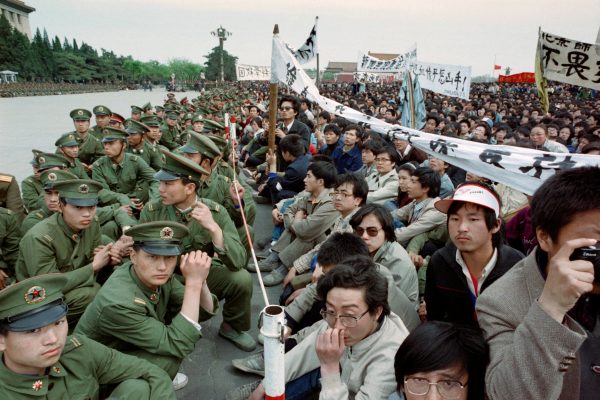
“We at the law university were among the very first to march out and mourn, to demonstrate, and to present petitions,” Tom Li recalled. Because university administrators refused to let them carry the school’s official banner, students grabbed the law faculty’s departmental flag instead. That night, Voice of America reported that law students from the Beijing law university had taken to the streets. In fact, Li said, the marchers came from every faculty in the school.
The procession wound toward Tiananmen Square, chanting demands for democracy, freedom, an end to official corruption, and justice for Hu Yaobang. Li carried a tape recorder on his shoulder, playing funeral music as he marched alongside the crowd. “Our slogans were ‘rule of law, democracy, end to corruption, press freedom,'” he said. “The most basic demands. Pure and legitimate democratic demands. Everything we called for was reasonable and legal. Nothing exceeded the scope of China’s own constitution.”
The Party’s rejection of student petitions escalated the confrontation
On April 22, the day of Hu Yaobang’s state memorial service, authorities sealed Tiananmen Square and barred the public from attending. Students from universities across Beijing were furious. The night before, Li and his classmates had gone ahead to the square and waited overnight, hungry, to secure their place for the following morning’s service.
After the ceremony, students submitted formal written petitions to the authorities. The regime’s response was a blunt refusal. “It completely enraged us,” Li said. “This government had total contempt for public opinion. It was arrogant and dismissive.” That same night, Li and several hundred other students stood outside Zhongnanhai, the heavily guarded compound in central Beijing where the Party leadership lives and works, calling on then-prime minister Li Peng to come out and meet with them. Security forces responded with beatings and forcible dispersal.

Success
You are now signed up for our newsletter
Success
Check your email to complete sign up
The ‘counter-revolutionary riot’ label criminalized the student movement
On April 26, the CCP’s official mouthpiece, People’s Daily, published a front-page editorial denouncing the student movement as “counter-revolutionary riot,” a term carrying grave political and legal weight in the Party’s vocabulary. The label effectively branded every participant a criminal.
“We were expressing normal citizens’ democratic demands,” Li said. “How did we become turmoil? A normal mourning activity, labeled as something seriously harmful to the state, illegal and disorderly. We found that completely unacceptable.”
Students responded with fury. Li and his classmates burned copies of the paper, throwing them from the upper floors of their dormitory building. Some smashed beer bottles in anger. The mood across Beijing’s universities hardened overnight, and a far larger demonstration was already being planned.
The April 27 march was enormous. Students from universities across the city poured into the streets. Police set up roadblocks at multiple points along the route, but Li believed officers had received instructions not to escalate into direct violence. “Every time we pushed forward, the police stepped aside,” he said. The march completed a full circuit of Beijing’s Second Ring Road, covering roughly twenty to thirty kilometers, moving and stopping throughout the day.
“We never imagined the Party would react the way it did,” Li said. “This was a peaceful student movement. It hadn’t reached any level of turmoil. There was no need for such an extreme response. Everything was still within the range of discussion and dialogue.”
The regime refused all dialogue
After April 27, the government staged several televised dialogue sessions with students, but they were theater. Authorities refused to recognize the Beijing Students’ Autonomous Federation, the main independent student organization, as a legitimate body. Federation members were barred from speaking. Only representatives from the official, Party-controlled student unions were permitted to ask questions.
“Watching those phony dialogues on television, we felt deceived,” Li said. “You’re not having a real conversation. You don’t want to solve the problem. It was a bureaucratic face, looking down on the people from above.”
When Zhao Ziyang, then the Party’s general secretary and its most senior reformist voice, gave a speech calling for problems to be resolved “on the track of democracy and rule of law,” Li and his fellow students were skeptical. The April 26 editorial calling their movement “counter-revolutionary turmoil” had never been retracted. Surveillance footage had been filmed. Photographs had been taken. A retaliatory crackdown after the movement ended remained a live possibility.
“We felt the movement couldn’t just dissolve without any positive result,” Li said. “We needed stronger, more powerful action to force the authorities to correct course.”
Students launched a hunger strike timed to Gorbachev’s Beijing visit
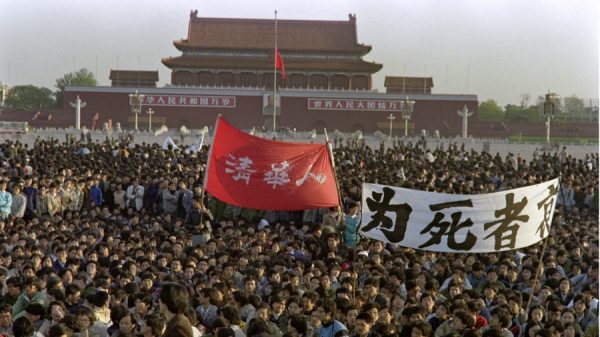
Students from Peking University and Tsinghua University launched a hunger strike on May 13. When the column of fasting students passed Li’s university, many of his classmates joined. Li himself hesitated at first.
“Some of our classmates had gone along, and we who stayed behind immediately said: ‘So-and-so has joined the hunger strike, this won’t do. A hunger strike is dangerous. People could die. There’s no need to use our young lives to fight a thuggish government. The government is lawless and contemptuous of the people. Why should we sincerely offer our lives to make them change their ways? There’s absolutely no need. Let’s go pull them back. We’ll find another method.'”
Li and a group of classmates ran out to intercept their friends. They caught up somewhere near Xinjiekou, a major intersection in northwestern Beijing. But the atmosphere on the street overwhelmed them. “The mood there completely infected us,” he said. “We ended up walking with the hunger strike column all the way to Tiananmen Square.”
The timing was deliberate. Soviet leader Mikhail Gorbachev was due to arrive in Beijing on May 15 for the first Sino-Soviet summit in three decades, an event of enormous diplomatic significance for the Party. Occupying Tiananmen Square before his arrival put the regime in an impossible position: it would need to clear the square before the state welcome ceremony, which meant either negotiating with students or removing them by force in full view of the world’s press, assembled in Beijing to cover the summit.
“We decided to use the hunger strike to occupy the square and put pressure on the government,” Li said. “You need to receive Gorbachev. You need to hold a grand welcoming ceremony in Tiananmen Square. So you have to talk to the students first and resolve the problem. You can’t keep stalling. And the international media from Hong Kong, Europe, America, Japan, and Korea was already in Beijing to cover the visit. They could cover our hunger strike too. Otherwise, the Party’s media would never report on us.”
Inside the hunger strike: cold nights, citizen solidarity, and despair by the second morning
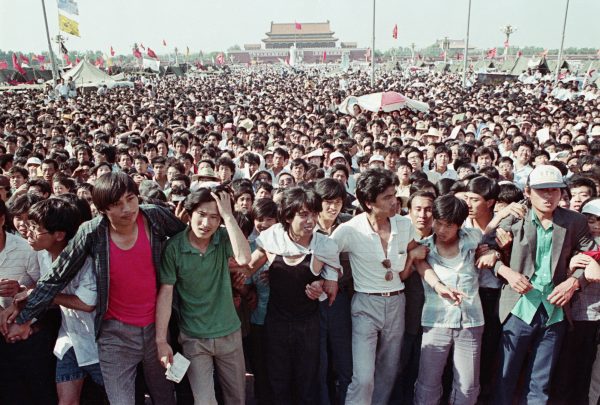
The hunger strikers arrived at Tiananmen Square around seven in the evening on May 13. Each university’s contingent chose a position, raised its banner, and established order within its own section. A student marshal corps patrolled the perimeter to keep outsiders from infiltrating the protest and giving authorities a pretext for arrests.
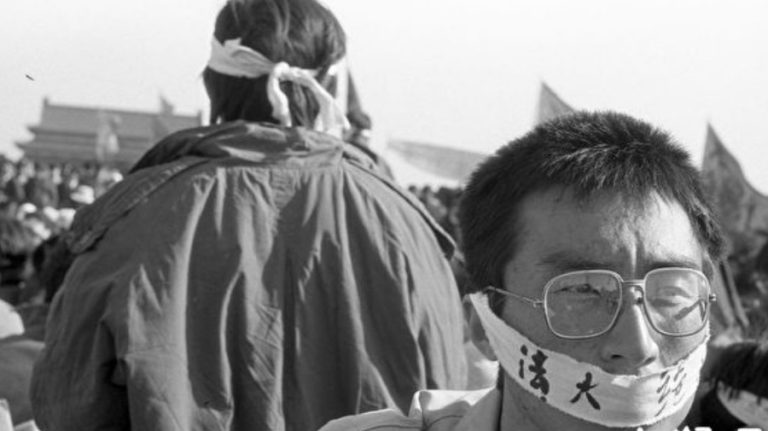
Li’s group from the law university sat wrapped in military overcoats and quilts, their mouths sealed with strips of cloth inscribed with the words “hunger strike” and their university’s name.
The citizens of Beijing gave the students their full backing. Along the route, residents lined the streets cheering them on. Food and drink materialized continuously at the roadside, handed over freely. “They kept saying: ‘Well done, students. We support you. You’re doing the right thing,'” Li recalled. “And they gave us mung bean soup, tea, steamed buns, pastries. They kept pressing food on us.”
Li described the feeling as an immense sense of mission. “We felt we weren’t doing this only for our own ideals. We were doing it for the voice of the people, the wishes of the people. A powerful sense of historical responsibility.”
The cold and hunger set in overnight. Sleep was impossible. New information came in waves through the night, along with noise and loudspeaker announcements. Moods swung violently between elation and despair. By the morning of May 14, with the government still silent, Li felt a deepening hopelessness. The strike had to work that day; if the regime had not moved by the following morning, Gorbachev would arrive and the window would close.
Around noon on May 14, a young photographer with a camera approached Li, spotted the cloth strip across his mouth, and asked him to shift position so that Tiananmen Gate could appear in the frame behind him. Li raised himself up on his folded overcoat and the photograph was taken. The man left without giving his name. That image later circulated internationally; the photographer was later identified as Jian Liu, who provided the photo to an independent overseas Chinese media outlet.
READ MORE:
- California Tiananmen Museum Vandalized Ahead of Massacre Anniversary
- China Bars Tiananmen Massacre Families From Cemetery for the First Time in Three Decades
- Marco Rubio’s Statement Following The 37th Anniversary Of the Tiananmen Square Massacre
Li left the hunger strike after thirty-six hours to run a campus radio station
By the morning of May 15, Li had been fasting for a day and a half. He and a fellow student decided to leave.
“This government isn’t worth it,” he told his companion. “We shouldn’t use this extreme method to fight them. Let’s go.”
Once they stepped outside the hunger strike zone, there was no going back in. They walked to the subway station at Qianmen and took the train back to campus. Outside a dumpling restaurant near the station, the owner spotted them. “You’re the hunger-striking students, aren’t you? Come in. Free. Order whatever you want.” They ate, bowed to the owner in thanks, and left.
Back at the university, Li threw himself into a different form of resistance. Students had seized control of the campus broadcast station, installed in the gatehouse at the university’s main entrance, equipped with speakers, amplifiers, and microphones. Two announcers and one editor: Li was the editor. His job was to collect and edit copy, gather leaflets from neighboring universities, and write his own broadcasts promoting democratic ideals, exposing the Party’s crimes, and reporting on the state of the movement in the square and across the country.
The Party moved troops secretly into Beijing as martial law approached
On the night of May 19, students in the square heard that troops were moving toward the city and that martial law was imminent. Military helicopters passed overhead. Rumors circulated that the regime planned to disperse the crowd with tear gas. The hunger strike command center quickly distributed face masks and water, instructing people to soak cloth and cover their mouths and noses. The order came down to end the hunger strike; everyone rose to prepare for resistance.
The troops were turned back by citizens who blocked roads across the city, preventing military vehicles from entering. After the hunger strike formally ended, the protest shifted: students and citizens began rolling demonstrations through the city’s streets. Li rode on the back of demonstration trucks as they circled the city, a bicycle chain wrapped deliberately around his wrist to evoke the image of a slave’s iron shackles, which he would raise above his head and tear apart to symbolize breaking free from Party rule. The standoff continued until the evening of June 3.
His father’s telegram got Li out of Beijing the night before the massacre
On June 3, Li received a telegram from his family. Five characters: “Father critically ill, return immediately.”
His father had a history of illness, but the urgency felt wrong. The explanation came later. That morning, troops from the northeast of China had been moving toward Beijing. One soldier, passing through Li’s hometown, stopped at the post office to send a telegram to his own family. Li’s father happened to be in the same post office.
The elder Li asked the soldier where he was going.
“Field exercises,” the soldier said.
“You’re going to suppress the students,” Li’s father told him. “If your commanding officers order you to open fire, will you fire?”
“A soldier’s duty is to obey orders,” the soldier replied. “I have no choice. I will fire.”
The elder Li walked out of the post office and watched a column of military trucks and tanks pass along the national highway in front of his home. He sent the telegram immediately.
By that point, most Beijing university students had already returned from the square to their campuses or traveled elsewhere in the country to spread news of the movement. The square was held mainly by students from other provinces. Students across Beijing were waiting for China’s Party-controlled legislature, the National People’s Congress, to convene a special session when its chairman, Wan Li, returned from a visit to Canada around June 20. There was a widespread belief that the congress, which had the nominal authority to revoke the martial law decree issued unlawfully by prime minister Li Peng, might yet provide a political off-ramp.
Li asked his class monitor for leave, packed his things, and headed for Beijing Station to catch the 7:30 train.
Walking into the departure hall, he stopped cold. The hall was packed with soldiers in full green combat gear, steel helmets on their heads, automatic weapons cradled across their chests, seated in rows on the waiting-room benches, staring straight ahead. “I was terrified,” he said. “I was afraid they’d see I was a student fleeing Beijing and arrest me on the spot.”
He hid his student ID card, kept his head down, walked through the middle of the boarding queue without making eye contact, and passed through two lines of armed soldiers flanking the ticket barrier. Troops were checking passengers individually, verifying identity documents, comparing faces to photographs, and waving people through only after a soldier nodded approval. Li said nothing, avoided meeting any soldier’s gaze, and was finally waved through. He exhaled quietly.
The train accepted students free of charge that night. The departure hall admitted only outbound passengers; no one was allowed to enter Beijing by rail. On board, soldiers accompanied the ticket inspectors on patrol.
“My classmates and the students still in the square had no idea that so many troops had already come through the station and taken up their positions,” Li said. “I wanted so badly to fly to the square and warn them that soldiers had already slipped into the city, armed, and were surrounding them. The signs of what was coming were everywhere. All those soldiers with their weapons in the departure hall. What else were they there for? I kept praying silently: don’t let anything terrible happen. Don’t actually shoot people.”
He boarded an overnight train. That night, the Party’s military killed hundreds of people in and around Tiananmen Square. By the time Li arrived home, it was the morning of June 4.
Three years of university had already made him a dissident
“Eight-nine didn’t change my thinking about the Party,” Li said. “The 1989 movement and the June Fourth massacre were the outcome of a long transformation in my thinking, not the starting point.”
By the time he joined the first march in April 1989, Li had already spent three years at university absorbing ideas that had systematically dismantled his faith in the Party. The intellectual atmosphere of Chinese universities in the late 1980s was unlike anything before or since. Documentaries, investigative literature, and political philosophy circulated widely. He read the script of “River Elegy,” a television documentary that mounted a sweeping cultural critique, accusing China’s civilization of stagnation under authoritarian rule; the Party banned it after the crackdown. He read investigative journalism by Su Xiaokang and Liu Binyan, two of China’s most daring reporters of the era. He bought and studied Gorbachev’s book “Perestroika and New Thinking.” The American Embassy distributed free pamphlets explaining the founding principles of the United States, its constitution, and its foundational political documents. “All of these completely transformed my thinking,” he said.
In the classroom, young faculty members pushed the transformation further. Chen Xiaoping, who later joined Voice of America’s Chinese-language service, taught Li’s constitutional law course. “He dissected the Four Cardinal Principles in the Chinese constitution one by one and demolished them completely,” Li recalled. The Four Cardinal Principles are the ideological pillars the Party uses to obligate the state and citizens to uphold its authority and Marxist-Leninist doctrine; the Party treats them as beyond challenge. “For us as first-year students, this was a thunderclap. We thought: he’s incredibly brave. We worried he’d bring serious trouble on himself. But gradually we all accepted it. We realized we’d been brainwashed and deceived by the Party our whole lives. What the teacher was saying was correct.”
Teachers of Chinese revolutionary history also spoke candidly in class, tracing the crimes and catastrophes concealed inside the official red narrative. Through law, human rights, and history, Li said, his professors showed their students what systematic state violence against citizens looks like.
“By the time June Fourth came, after three years of university, our thinking had been transformed completely,” he said. “We were no longer the patriotic high school kids who had entered as freshmen loving the Party and loving the country. We had become a new generation of university students with a sense of the rule of law, an awareness of human rights, a pursuit of democracy, and a concept of freedom.”
“Our generation didn’t get passively swept up in the democracy movement. We weren’t ‘deceived and used by others,’ as the official line claims. We were a generation that had fully and clearly awakened. We understood that Chinese society needed transformation. This absurd era needed to be changed. We refused to go on being the Party’s slaves.”
Every day during those weeks, Li said, he and his peers felt they were witnessing history and shaping it. “The 1980s movement was magnificent. It was great. And it was rare. It’s just a tragedy that the Party finally crushed it with violence.”