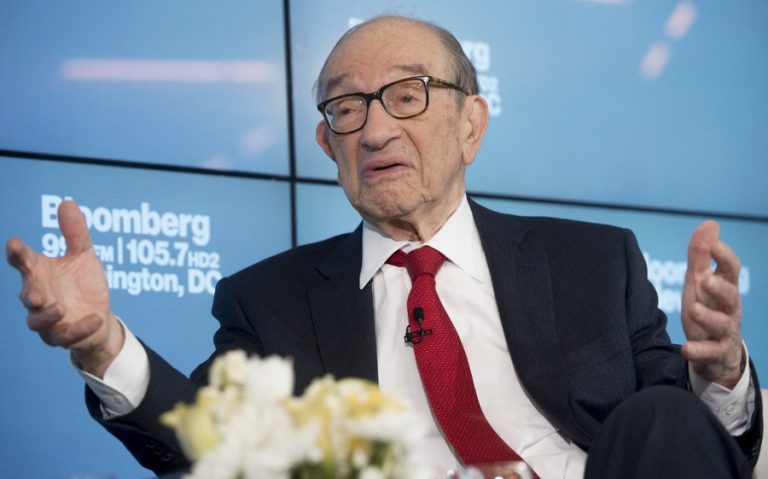
Alan Greenspan, former Chair of the U.S. Federal Reserve died on Monday, June 22 at the age of 100. His wife, prominent American journalist Andrea Mitchell, said Greenspan passed away at home due to complications from Parkinson’s disease, Reuters reported.
“He was a giant of a man who helped shape the U.S. economy for decades under presidents of both parties, but was always honest in acknowledging his mistakes. He will be remembered for his brilliance and his kindness. Being his life partner was the joy of my life,” Mitchell said.
Greenspan, who led the U.S. Federal Reserve from August 1987 to January 2006, left an undeniable mark on the U.S. economy. He oversaw an uninterrupted decade of growth from March 1991 to March 2001, helping foster years of American prosperity and earning him the moniker “maestro.”
His judgement and intuition is recognized for keeping inflation contained during a surge in productivity in the mid-1990s, an accomplishment former Fed Chair Jerome Powell cited as a prime example of how judgement can outperform technical economic models.
A gifted mathematician
Born in New York City on March 6, 1926, Alan Greenspan grew up as the only child of a single mother in Washington Heights. A gifted mathematician from a young age, he initially pursued music, studying clarinet at the Juilliard School and playing saxophone in a touring jazz band.
Success
You are now signed up for our newsletter
Success
Check your email to complete sign up
He later turned to economics, earning a B.A. summa cum laude and an M.A. from New York University, and began doctoral studies at Columbia University under future Fed Chair Arthur Burns.
Before entering government service, Greenspan built a successful career in the private sector. In 1954, he co-founded Townsend-Greenspan & Co., an economic consulting firm in New York that advised major corporations for over three decades.
He briefly stepped away to serve as Chairman of the Council of Economic Advisers under President Gerald Ford from 1974 to 1977 and later chaired the National Commission on Social Security Reform under President Reagan.
Greenspan’s deep understanding of markets and data-driven intuition earned him a reputation as one of Washington’s most respected economists long before he took the helm of the Federal Reserve. His appointment as Fed Chair in 1987 marked the beginning of an era that would define U.S. monetary policy for nearly two decades.
Legacy and lasting influence
Greenspan’s influence on monetary policy extended far beyond his 18-and-a-half years at the Federal Reserve. He was often lauded for his ability to navigate complex economic cycles, he championed deregulation and low interest rates, policies that contributed to the longest economic expansion in U.S. history but later drew criticism for helping inflate the housing bubble that triggered the 2008 financial crisis.
According to Reuters, Stephen Oliner, a former Fed official, offered a more balanced assessment of Greenspan’s legacy: “I think the deification that came just before the financial crisis was never really deserved, and I think the lambasting that he took after he left was never fully deserved either.”
In the years after stepping down in 2006, Greenspan remained an active commentator through books, speeches, and advisory roles. He expressed regret over some aspects of his record, most notably admitting in 2008 congressional testimony that he had put too much faith in the self-correcting power of free markets.
Even in retirement, his views carried significant weight in financial circles. He continued to warn about fiscal imbalances, rising inequality, and the long-term risks of excessive government debt.
Despite the controversies that marked the end of his tenure, Greenspan is widely regarded as one of the most consequential economic figures of the late 20th and early 21st centuries — a man whose pragmatic, data-driven approach helped define modern central banking.